Running Virtual Meetings That People Don’t Dread

DIGITAL  |  7 MIN READ

Running Virtual Meetings That People Don’t Dread

Virtual meetings are now a permanent part of business life, linking colleagues, clients and partners across cities and continents. Done well, they save time and travel. Done poorly, they drain energy and attention. The difference lies in preparation, behaviour and follow-up.

Before the meeting

  • Define the purpose. If you cannot say in one sentence why the meeting is needed, it may be better as an email.
  • Send an agenda with topics, time slots and the decisions needed, at least a day ahead.
  • Invite only the right people. Mark others as optional and share notes afterwards.
  • Choose the platform that all participants can access, and share the link, dial-in details and time zone.
  • Test the technology: audio, camera, screen sharing and recording permissions.
  • Share materials in advance so the meeting is for discussion, not for reading.

During the meeting

For the host

  • Start on time, welcome everyone and state the objective and the agenda.
  • Assign a note-taker and a timekeeper.
  • Invite participation by name, especially from quieter participants.
  • Use polls, chat and breakout rooms to maintain engagement.
  • Summarise decisions and next steps before closing.

For participants

  • Join a couple of minutes early with a charged device and a stable connection.
  • Choose a tidy, well-lit space; use a neutral or blurred background.
  • Mute when not speaking; use the “raise hand” feature instead of interrupting.
  • Look at the camera when speaking, and keep your gestures natural.
  • Avoid multitasking. People notice when your eyes are elsewhere.
  • Dress as you would for an in-person meeting with the same audience.

After the meeting

Send minutes within 24 hours listing decisions, owners and deadlines. Share the recording if appropriate, and follow up on pending actions. A meeting without follow-up is only a conversation.

Common mistakes to avoid

MistakeFix
No agenda, wandering discussionCirculate an agenda; the chair keeps time
Everyone talks at onceUse raise-hand and a facilitator
Participants are silent and cameras offAsk direct questions; set expectations on cameras beforehand
Back-to-back calls all daySchedule 25 or 50-minute meetings to leave breaks
No action pointsEnd with a recap of owners and dates

Accessibility and inclusion

Turn on live captions, share slides in advance, speak clearly and describe visuals when needed. Be mindful of time zones so the same people do not always attend at inconvenient hours.

Key takeaways: Great virtual meetings have a clear purpose, a lean guest list, an agenda, polite participation and a written follow-up. Respect for people’s time is the heart of virtual etiquette.

Try this: Before your next call, write the one decision you need from it. If no decision is needed, consider sending an update instead.
Digital Communication Etiquette: Email and Chat Done Right

DIGITAL  |  7 MIN READ

Digital Communication Etiquette: Email and Chat Done Right

Most business communication now happens through screens. The speed of digital tools is a gift, but it also makes it easy to be careless. Because text carries no tone of voice or facial expression, small lapses in wording can cause big misunderstandings. These guidelines will help you stay clear, courteous and professional.

Email etiquette

Structure of a good email

  1. Subject line: specific and action-oriented, such as “Approval needed: Q3 travel budget by 12 Nov”.
  2. Greeting: “Dear Ms Rao” or “Hello Priya”, depending on formality.
  3. Opening: state the purpose in the first one or two lines.
  4. Body: short paragraphs; use bullets for lists and bold for key dates.
  5. Call to action: say exactly what you need and by when.
  6. Closing: “Regards” or “Thank you”, followed by your name, designation and contact details.

Email dos and don’ts

DoDon’t
Proofread names, numbers and attachmentsWrite in ALL CAPS or use excessive exclamation marks
Use CC for people who need to knowUse Reply All unless everyone needs the response
Reply within 24 working hours, or acknowledgeSend emails when angry
Keep one topic per emailShare confidential data on personal accounts
Set an out-of-office message when awayForward chains without checking what they contain

Chat etiquette (Slack, Teams, WhatsApp Business)

  • Write messages that stand alone: include enough context for someone to act without asking “What do you mean?”
  • Avoid sending a series of one-word messages; combine your thoughts.
  • Use threads to keep topics organised.
  • Respect working hours and status indicators; schedule non-urgent messages for the morning.
  • Use @mentions sparingly and only when action is needed from that person.
  • Use emojis and GIFs lightly; know your audience and the culture of the channel.
  • Move long, sensitive or emotional conversations to a call.

Choosing between email and chat

Use email whenUse chat when
The message is formal or needs a recordYou need a quick answer or confirmation
It contains attachments or detailed informationThe conversation is informal or time-sensitive
Multiple stakeholders must be informedIt is a short back-and-forth within a small group

Tone in text

Read your message aloud before sending. Short replies such as “Fine.” or “Noted.” can sound cold. Adding “Thanks, that works for me” costs a second and avoids friction. When in doubt, be a little warmer and a little clearer than you think necessary.

Key takeaways: Write specific subject lines, put the point first, keep messages brief and respectful, and choose the channel to suit the message. Digital tools amplify both good and poor communication habits.

Try this: Review your last five work emails. How many have a specific subject line and a clear call to action?

Ethics in Business Communication: Confidentiality, Inclusivity and Professionalism

ETHICS  |  7 MIN READ

Ethics in Business Communication: Confidentiality, Inclusivity and Professionalism

Ethical communication is more than avoiding lies. It is about respecting the people who send, receive and are affected by your messages. Companies lose trust far faster than they build it, and trust is built or broken one message at a time.

Why ethics matter in communication

  • They protect people from harm, including embarrassment, discrimination and loss of privacy.
  • They protect the organisation from legal and reputational damage.
  • They create a culture where people are comfortable speaking up.

Confidentiality

Employees regularly handle sensitive information: customer data, financial results, product plans, salary details and legal matters. Ethical communicators protect it.

  • Share information on a need-to-know basis.
  • Double-check recipients before sending; one wrong autofill can cause a data breach.
  • Avoid discussing client matters in lifts, cafes or on public calls.
  • Lock your screen and use secure channels for sensitive files.
  • Follow data protection laws and company policy, including India’s Digital Personal Data Protection Act, 2023, where relevant.
  • Do not forward private messages without permission.

Inclusivity

Inclusive communication ensures that people of every gender, age, culture, ability and background feel respected and able to take part.

  • Use neutral terms (“chairperson”, “team members”) instead of gendered or exclusive ones.
  • Avoid stereotypes, slang and idioms that outsiders may not understand.
  • Make materials accessible: captions on videos, readable fonts and contrast, alt text for images, and sharing slides in advance.
  • Invite quieter voices in meetings and rotate speaking opportunities.
  • Be mindful of time zones, festivals and languages when scheduling and writing.
Instead ofTry
Guys, let’s get startedEveryone, let’s get started
ManpowerWorkforce
Does anyone have a problem with this? (rushed)Please share any concerns by Friday, in the meeting or by email

Professionalism

  • Honesty: do not exaggerate, mislead or hide material facts.
  • Accuracy: verify before you publish or forward.
  • Respect: disagree with ideas, not with people.
  • Accountability: admit mistakes quickly and fix them.
  • Credit: acknowledge others’ work and cite sources.
  • Timeliness: respond within a reasonable time and meet commitments.
  • Tone: match language and formality to the context, in person and online.

A simple ethical test

Before sending a sensitive message, ask three questions. Is it true? Is it fair to everyone involved? Would I be comfortable if it were quoted in a public forum? If any answer is no, rewrite it.

Key takeaways: Confidentiality protects information, inclusivity protects people, and professionalism protects trust. Together they define the character of an organisation’s communication.

Think about it: Have you ever received a message that excluded or embarrassed you? How could it have been written differently?

The 7Cs of Effective Communication, with Examples

SKILLS  |  7 MIN READ

The 7Cs of Effective Communication, with Examples

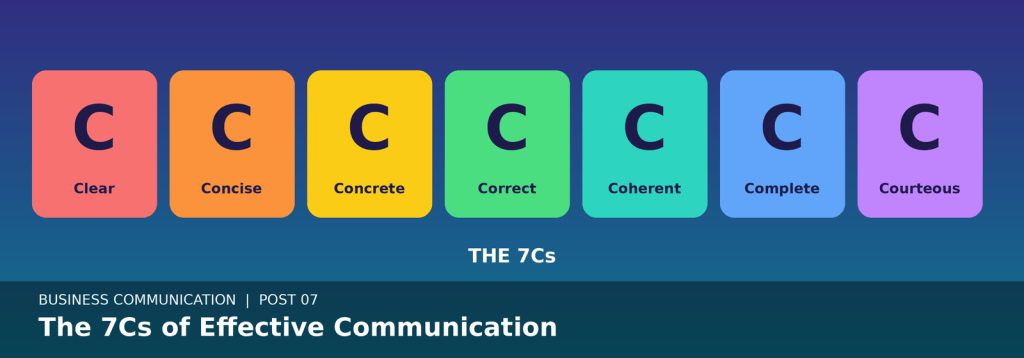
If you could keep only one checklist for business writing and speaking, it would be the 7Cs. Widely taught in business communication courses, they give you seven questions to ask before any message leaves your hands.

1. Clear

State the purpose early and keep to one main idea per message. Readers should not have to guess what you want.

WeakBetter
There are some issues with the thing we discussed.The vendor invoice for October does not match the purchase order. Please recheck by Wednesday.

2. Concise

Say it in as few words as the message needs. Cut filler phrases, repeated points and unnecessary background.

WordyConcise
In the event that you are unable to attendIf you cannot attend
Due to the fact thatBecause
At this point in timeNow

3. Concrete

Use facts, figures, names and examples. Specific statements are persuasive and easy to act on.

VagueConcrete
Sales improved a lot.Sales rose 18 percent between July and September.

4. Correct

Check facts, figures, spelling, grammar and tone. Errors damage credibility, and a wrong number can cost money. Use the right level of formality for the reader.

5. Coherent

Organise ideas logically, with smooth transitions and consistent tone. Use headings, short paragraphs and connectors such as “first”, “however” and “as a result”.

6. Complete

Give the receiver everything needed to act: who, what, when, where, why and how. Missing details create follow-up emails and delays.

IncompleteComplete
Please join the meeting tomorrow.Please join the budget review tomorrow, 11 Nov, 10:30 a.m., in Conference Room 2 (or via the Teams link). Bring last month’s expense sheet.

7. Courteous

Be respectful, considerate and positive. Use “please” and “thank you”, focus on the reader’s point of view and avoid blame. Courtesy builds goodwill even when the news is bad.

Using the 7Cs as a final check

  1. Is my purpose obvious in the first two lines?
  2. Can I cut 20 percent of the words?
  3. Have I included specifics instead of vague claims?
  4. Are facts, names and grammar correct?
  5. Does the message flow logically?
  6. Does the reader have everything needed to act?
  7. Would I be comfortable receiving this tone myself?

Key takeaways: The 7Cs are Clear, Concise, Concrete, Correct, Coherent, Complete and Courteous. Treat them as a pre-send checklist for emails, reports, proposals and presentations.

Try this: Rewrite the last email you sent using the 7Cs. How many words did you save, and what did you add?

Eight Strategies to Overcome Communication Barriers

BARRIERS  |  6 MIN READ

Eight Strategies to Overcome Communication Barriers

Knowing the barriers is useful; removing them is powerful. The strategies below turn awareness into daily habit. None of them requires a big budget, only attention and practice.

1. Listen actively

Give the speaker your full attention. Put the phone away, make eye contact, nod, and avoid interrupting. Paraphrase what you heard (“So you need the draft by Friday, correct?”) and ask follow-up questions. Active listening is the single most effective fix for misunderstandings.

2. Use clear, simple language

Choose short words over long ones and explain any technical term the first time you use it. If you wouldn’t say it aloud to a colleague, don’t write it in an email.

3. Seek and give feedback

Replace “Any questions?” with “What will you do first after this meeting?” Feedback closes the loop. Give your own feedback promptly, specifically and kindly.

4. Match the channel to the message

  • Complex or emotional topics: face-to-face or video call.
  • Quick coordination: chat.
  • Decisions, approvals and records: email or formal document.
  • Urgent matters: phone call, followed by written confirmation.

5. Build cultural awareness

Learn about the communication styles of the people you work with: how direct, formal and hierarchical they are. Avoid idioms and humour that may not translate, and ask when you are unsure.

6. Flatten the channels

Encourage open-door policies, skip-level meetings and anonymous suggestion tools. Shorter paths mean less distortion and faster information.

7. Control emotions and timing

Do not send a critical message while angry. Draft it, wait an hour or sleep on it, and then reread. Choose times when the receiver can give attention, not five minutes before closing.

8. Manage information

Chunk long messages, use headings and bullets, lead with the main point and attach details separately. Follow up in writing after important conversations so there is a shared record.

BarrierBest remedy
Jargon, ambiguityPlain language, examples, specific deadlines
Noise, distanceQuiet space, reliable technology, backup channel
Emotion, biasPause, reflect, focus on facts
Cultural differencesResearch norms, ask clarifying questions
Hierarchy filtersOpen-door policy, direct updates
OverloadSummaries, priorities, fewer but better messages

Key takeaways: Overcoming barriers is a skill built by habit: listen, simplify, check understanding, choose the right channel, respect cultures and manage emotion.

Try this week: In your next conversation, paraphrase what the other person said before you reply. Notice how often it surfaces a small misunderstanding.

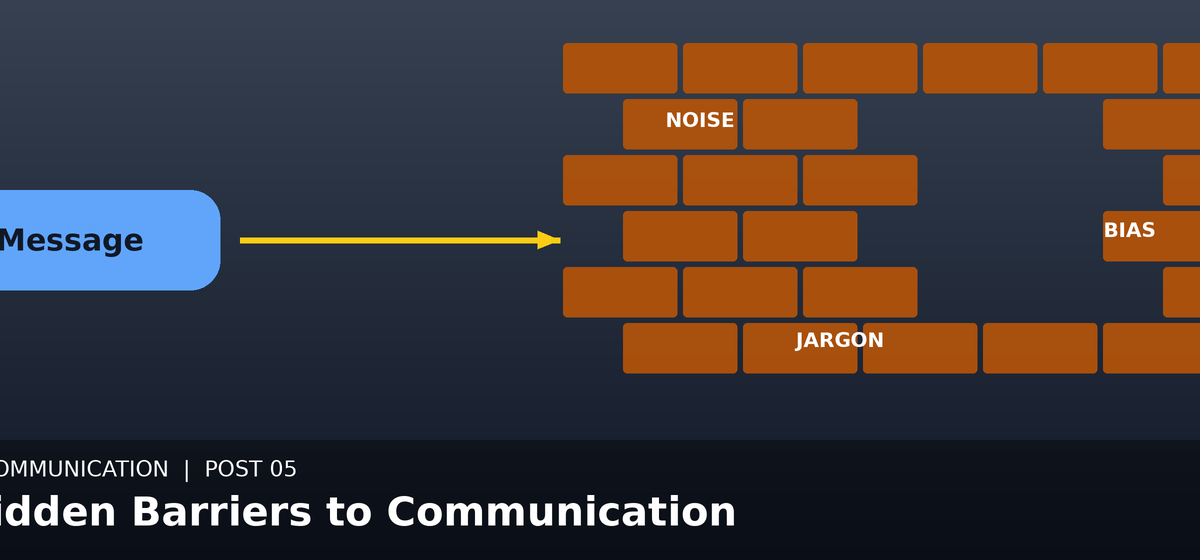
The Hidden Barriers to Business Communication

BARRIERS  |  6 MIN READ

The Hidden Barriers to Business Communication

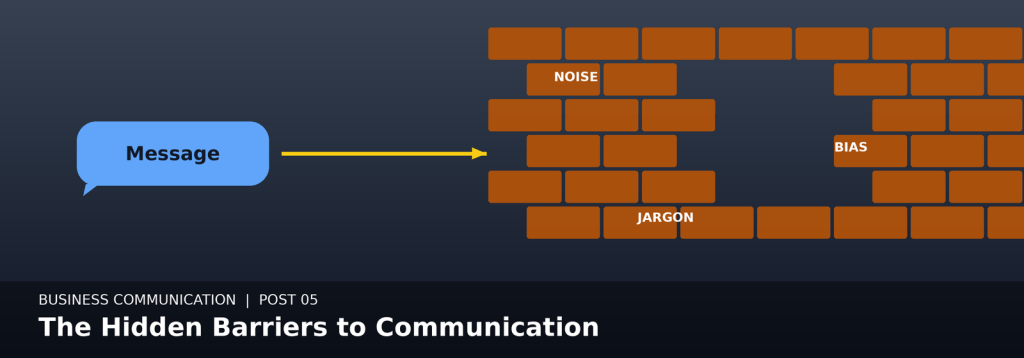
A message can be well planned, well written and perfectly timed, and still fail. Somewhere between the sender’s intention and the receiver’s understanding, barriers get in the way. The first step to solving a problem is to name it, so let’s map the most common ones.

Physical barriers

Background noise, poor lighting, distance, faulty microphones, weak internet and uncomfortable temperature all disturb the message before it even begins. In hybrid work, a dropping video call is the modern equivalent of a crackling phone line.

Language and semantic barriers

  • Jargon: terms such as “EBITDA”, “synergy” or “bandwidth” may confuse people outside your field.
  • Ambiguity: “Send it soon” means an hour to one person and a week to another.
  • Multiple meanings: to “table” a motion means opposite things in British and American English.
  • Accent and fluency gaps: especially in global teams.

Psychological and emotional barriers

Stress, fear, anger, prejudice and low trust change how we send and receive messages. An employee afraid of criticism may hide bad news. A manager who is angry may phrase feedback harshly. Preconceived ideas make us hear what we expect rather than what was said.

Perceptual and attitude barriers

People interpret messages through their own beliefs, experiences and biases. Stereotypes about age, gender, region or position can cause good ideas to be dismissed. Selective perception means we notice what supports our views and ignore the rest.

Cultural barriers

Cultures differ in directness, eye contact, personal space, the role of hierarchy and the meaning of silence. In some cultures a “yes” means agreement; in others it means “I hear you.” Gestures that are friendly in one country can be rude in another.

Organisational barriers

  • Too many layers of hierarchy that filter or delay information.
  • Unclear reporting lines and roles.
  • Information silos between departments.
  • A culture that punishes honest feedback.

Information overload and poor listening

When people receive too many emails, notifications and documents, important messages get lost. And listening is often the weakest link: many of us listen only to reply, not to understand.

Spot the barrier

SituationBarrier
A manager says “I’ll need it ASAP” with no deadlineSemantic (ambiguity)
Team members in a noisy open office miss instructionsPhysical
A junior hides a mistake out of fearPsychological / organisational
A 40-page report is sent with no summaryInformation overload
An overseas client stays silent during a negotiationCultural

Key takeaways: Barriers are physical, linguistic, psychological, perceptual, cultural, organisational and personal. Most are avoidable once you recognise them, and the next post shows how.

Think about it: Which barrier affects you the most at college or work? What triggers it?

Berlo’s SMCR and Schramm’s Model: Communication as a Two-Way Street

MODELS  |  7 MIN READ

Berlo’s SMCR and Schramm’s Model: Communication as a Two-Way Street

Shannon and Weaver treated communication like a signal travelling down a wire. Human beings are not wires. We bring our own knowledge, attitudes and culture to every exchange. Two later models, by David Berlo and Wilbur Schramm, put people back into the picture.

Berlo’s SMCR model (1960)

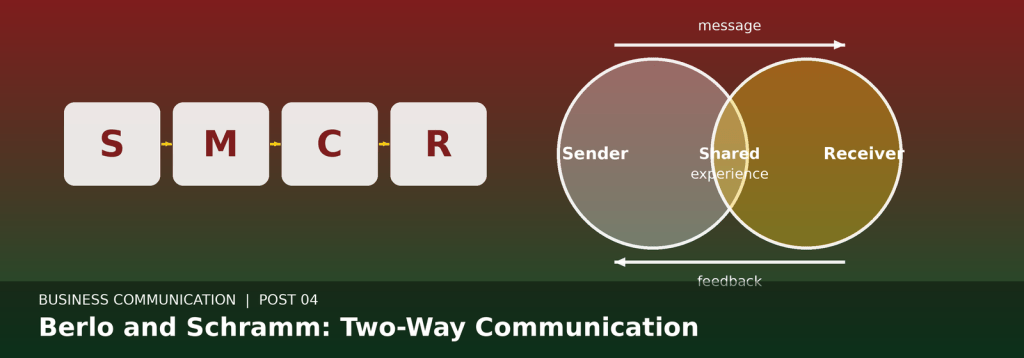
SMCR stands for Source, Message, Channel and Receiver. Berlo’s contribution was to look inside each element and list the factors that decide whether communication works.

ElementFactors that influence it
SourceCommunication skills, attitudes, knowledge, social system, culture
MessageContent, elements, treatment, structure, code (language, gestures, symbols)
ChannelThe five senses: seeing, hearing, touching, smelling, tasting
ReceiverThe same five factors as the source: skills, attitudes, knowledge, social system, culture

The central idea is that the source and the receiver should be on the same wavelength. If a technical expert (high knowledge, specialised vocabulary) addresses a layperson without adjusting, the message fails, however accurate it is.

Strengths and limits of Berlo’s model

  • Highlights the human factors behind communication, including skill, attitude and culture.
  • Applicable to speaking, writing, teaching and selling.
  • Does not clearly show feedback or noise, and is still fairly linear in layout.

Schramm’s model (1954)

Wilbur Schramm moved from a straight line to a circle. In his model, both parties act as sender and receiver at different moments. Each one encodes, decodes and interprets, and each one has a field of experience: the sum of their background, education, culture and past encounters.

Communication works only in the overlap of the two fields of experience. If a sales executive and a customer share no common ground, the message will not land, no matter how polished it is.

Key ideas in Schramm’s model

  • Circular process: feedback keeps the conversation going and lets the sender correct course.
  • Shared experience: the bigger the overlap, the easier the understanding.
  • Interpretation: meaning lives in people, not in words.

Comparing the three models

 Shannon-WeaverBerlo SMCRSchramm
ShapeLinearLinear, detailedCircular
FeedbackAbsentNot explicitCentral
FocusSignal and noiseHuman factorsShared experience
Best forTechnical channelsAnalysing skills and attitudesConversations and teamwork

Putting it to use

Before a presentation, ask: What does my audience already know? What vocabulary do they use? What do they care about? Then build a bridge from their field of experience to yours with examples, analogies and simple terms. After you speak, ask a question that checks understanding rather than just “Any questions?”

Key takeaways: Berlo shows what shapes the source and the receiver; Schramm shows that understanding lives in shared experience and feedback. Good communicators study their audience first and their slides second.

Think about it: How would you explain your course project differently to a classmate, a professor and your grandparent?

The Communication Process and the Shannon-Weaver Model

MODELS  |  7 MIN READ

The Communication Process and the Shannon-Weaver Model

Before studying specific models, it helps to understand the basic communication process. Once you can see the steps, it becomes much easier to spot where a message breaks down.

The communication process step by step

  1. Sender (source): the person who has an idea or information to share.
  2. Encoding: converting the idea into words, symbols, images or gestures.
  3. Message: the actual content being sent.
  4. Channel (medium): the route, such as email, phone, meeting or notice board.
  5. Receiver: the person for whom the message is meant.
  6. Decoding: the receiver interprets the message and assigns meaning.
  7. Feedback: the receiver’s response, which tells the sender whether the message was understood.

Running through all of this is noise, any disturbance that distorts the message: a bad phone line, unfamiliar jargon, distraction, or even a negative mood.

The Shannon-Weaver model (1949)

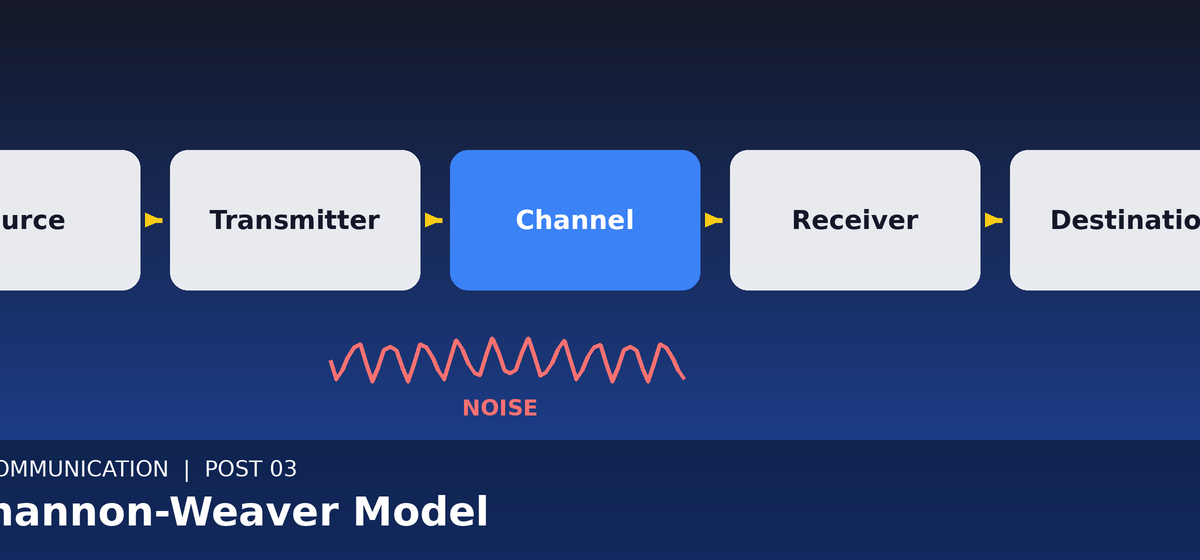
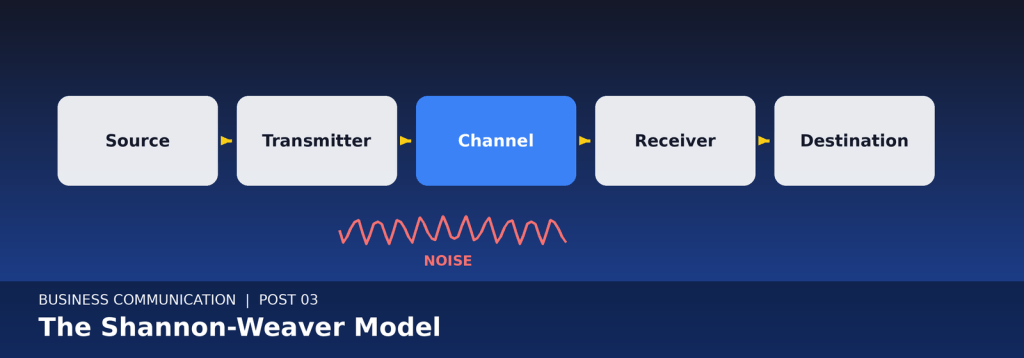
Claude Shannon, an engineer at Bell Labs, and Warren Weaver, a mathematician, developed this model to improve the accuracy of telephone and radio signals. Shannon’s 1948 paper, “A Mathematical Theory of Communication”, was popularised with Weaver’s contribution in 1949 and became one of the most influential frameworks in communication studies.

The six components

ComponentRoleBusiness example
Information sourceProduces the messageA manager decides to announce a new policy
TransmitterConverts the message into signalsThe manager types and sends an email
ChannelCarries the signalThe company email server
NoiseInterferes with the signalA spam filter, a cluttered inbox, unclear wording
ReceiverReconstructs the messageThe employee’s device and mind reading the email
DestinationThe intended recipientThe employee who must act on the policy

Strengths of the model

  • Simple and easy to remember.
  • First to introduce the concept of noise as a barrier.
  • Useful for analysing technical channels such as phone, email and broadcast.

Limitations

  • It is linear: communication is shown as one-way, from sender to receiver.
  • It has no feedback loop, though real conversations depend on feedback.
  • It treats communication as transmission of data and ignores meaning, culture and context.
  • It assumes that if the signal arrives intact, the message has been understood, which is often untrue.

What it means for you at work

The model’s lasting lesson is practical: protect your message from noise. Use a quiet room for calls, a clear subject line for emails, plain language instead of jargon, and a reliable channel for urgent news. Then go beyond the model by asking for feedback, because the arrival of a signal is not the same as understanding.

Key takeaways: Shannon-Weaver gives us the vocabulary of source, transmitter, channel, noise, receiver and destination. It is excellent for diagnosing technical problems but too linear for human conversation, which is why later models added feedback and shared experience.

Think about it: List three sources of noise you face in a typical working day. Which one can you remove first?

Why Business Communication Matters: Its Real Significance

FOUNDATIONS  |  6 MIN READ

Why Business Communication Matters: Its Real Significance

Ask a hiring manager which skill matters most in a graduate and the answer is rarely a technical one. It is almost always communication. That is because in any organisation, communication is the thread that ties strategy to action. When it is strong, even an average plan succeeds; when it is weak, even a brilliant plan falls apart.

1. It gives direction

People cannot work towards a goal they do not understand. Clear communication of vision, targets and responsibilities lets every employee see how their daily task connects to the larger picture.

2. It improves decision-making

Good decisions need accurate and timely information. A finance head cannot approve a budget without correct figures, and a product team cannot launch without customer insight. Communication carries the data from the people who have it to the people who need it.

3. It enables coordination

Modern businesses are made of departments, branches and time zones. Communication synchronises them. Without it, teams duplicate effort, miss deadlines or work at cross purposes.

4. It builds morale and trust

Employees who are kept informed feel respected. Open, two-way communication reduces rumours, increases engagement and lowers attrition. Research on workplace engagement consistently links manager communication to retention.

5. It strengthens customer relationships

Prompt replies, honest updates and polite language turn a one-time buyer into a loyal customer. A poorly worded complaint response can do the opposite, and in the age of social media the damage spreads quickly.

6. It prevents and resolves conflict

A large share of workplace conflict is simply misunderstanding. Clarifying expectations early, listening to concerns and giving honest feedback keep small issues from becoming big ones.

7. It shapes the public image of the organisation

Advertisements, annual reports, press statements and even the tone of a call centre agent shape how the market sees a company. During a crisis, the speed and honesty of communication often matter more than the crisis itself.

What poor communication costs

  • Rework caused by unclear instructions.
  • Missed deadlines because of delayed or incomplete information.
  • Lost customers after careless or discourteous replies.
  • Low morale and high turnover in teams that feel uninformed.
  • Legal and reputational risk from inaccurate or leaked messages.

Key takeaways: Communication is not a soft skill sitting beside real work. It is how real work gets done. Treat every message as an investment in clarity, trust and results.

Think about it: Think of a project that went wrong in your college or workplace. How much of the problem was really a communication problem?

What Is Business Communication? Meaning, Features and Types

FOUNDATIONS  |  6 MIN READ

What Is Business Communication? Meaning, Features and Types

Every sale closed, every project delivered and every policy understood begins with a message that travelled from one person to another. Business communication is the engine behind all of it. Whether you are a first-year management student or a new team member, understanding what business communication really is will shape how you work for the rest of your career.

What is business communication?

Business communication is the exchange of information, ideas, opinions and instructions between people, inside or outside an organisation, in order to achieve a business purpose. The words “business purpose” matter. A chat with a friend about the weekend is social communication; a briefing on this month’s sales targets is business communication, because it is planned, goal-directed and tied to organisational results.

Key features

  • Purposeful: it aims to inform, persuade, instruct, request or build goodwill.
  • Two-way: it is complete only when the receiver understands and responds.
  • Formal in structure: it follows conventions of format, tone and etiquette, though modern workplaces use informal channels too.
  • Continuous: it never stops; organisations communicate every day through meetings, emails, reports and conversations.
  • Often recorded: emails, minutes and contracts create evidence that can be used later.
  • Multi-directional: messages flow up, down and across the hierarchy.

Types of business communication

There is no single way to classify communication, so it helps to look at it through three lenses: where the message goes, which way it flows, and what mode carries it.

BasisTypeExample
AudienceInternalTeam meeting, HR circular, project update
AudienceExternalCustomer proposal, press release, vendor invoice
FlowDownwardManager sets targets for the sales team
FlowUpwardAnalyst sends a progress report to the director
FlowHorizontalMarketing and finance agree on a campaign budget
FlowDiagonalAn IT officer briefs a regional sales manager
ModeVerbal (oral)Phone call, presentation, interview
ModeVerbal (written)Email, report, memo, contract
ModeNon-verbalBody language, tone of voice, dress, punctuality

Formal and informal channels

Formal communication follows the official chain of command: a notice from the HR head, a quarterly report, a signed contract. Informal communication, often called the grapevine, flows through personal relationships: a hallway chat, a lunch conversation, a WhatsApp group. Smart managers do not ignore the grapevine. It can spread rumours quickly, but it also carries honest feedback that never reaches formal reports.

Oral versus written: choosing wisely

 Oral communicationWritten communication
SpeedImmediate, instant feedbackSlower, delayed feedback
RecordUsually nonePermanent, can be referred to later
Best forSensitive, urgent or complex discussionsInstructions, policies, contracts, detailed data
RiskForgotten or misquotedMisread tone, harder to correct once sent

A quick scenario

A project manager discovers that a delivery will be two days late. She phones the client first (oral, urgent, relationship-sensitive), then follows up with an email summarising the new date and the reason (written, for the record), and finally informs her own team in the morning huddle (internal, downward). Three messages, three channels, one purpose. That is business communication at work.

Key takeaways: Business communication is purposeful, structured and goal-oriented. Classify it by audience, flow and mode, and always choose the channel that fits the message, not just the one that is most convenient.

Think about it: Recall the last important message you sent at college or work. Which type was it, and was the channel the best choice?