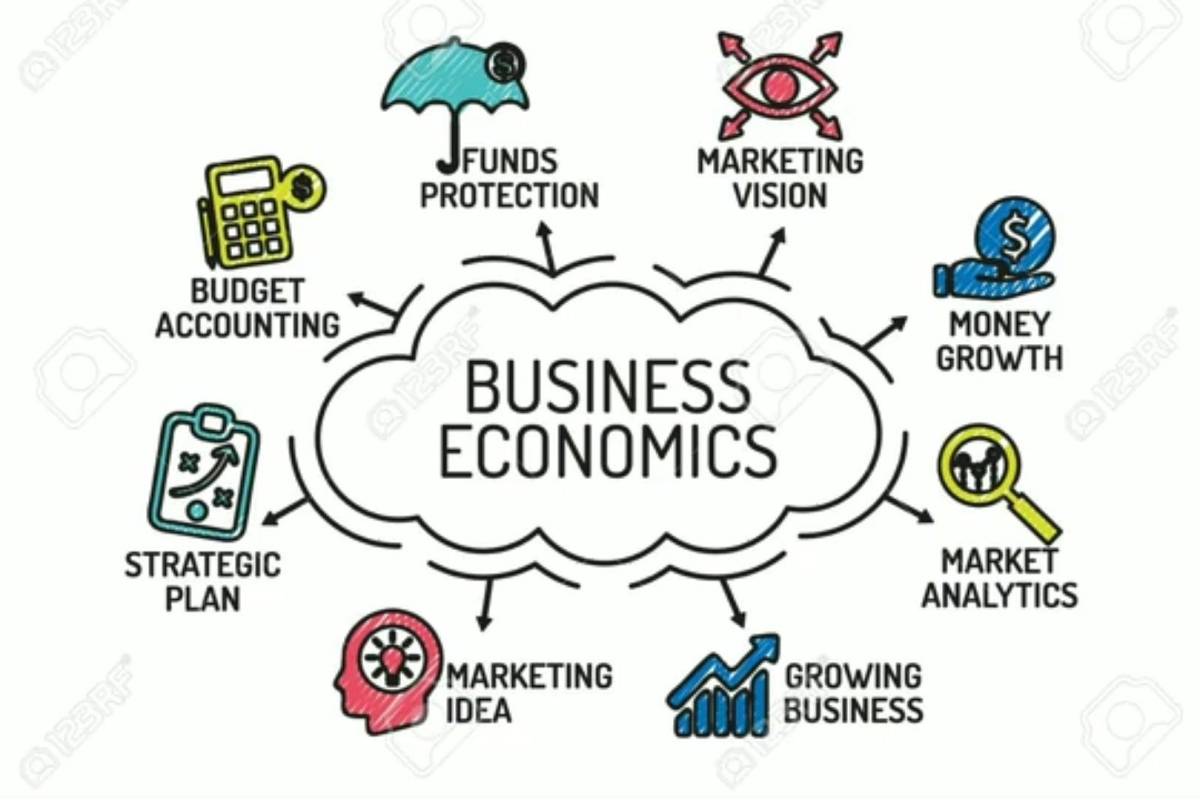
Introduction to Business Economics
Business economics, also known as managerial economics, is a branch of economics that focuses on applying economic theory and analysis to solve business problems and make informed decisions. It explores the relationship between business and the economy, examining how businesses operate, compete, and thrive in the marketplace.
Business economics primarily aims to utilize economic principles to understand and predict the behaviour of businesses, markets, and consumers. It provides valuable insights and tools that help organizations effectively allocate resources, maximize profits, and optimize decision-making processes.
Business economics encompasses various topics, including demand and supply analysis, cost and production analysis, market structures, pricing strategies, risk analysis, forecasting, and business strategy formulation. It blends economic theory with practical applications, enabling managers and decision-makers to evaluate different alternatives and make rational choices in the face of uncertainty.
One of the key aspects of business economics is the concept of optimization. Businesses aim to maximize their outcomes, whether profit, market share, or customer satisfaction, by optimizing their use of resources. This involves analyzing various trade-offs and making decisions that yield the best possible results given the constraints faced by the organization.
Furthermore, business economics considers both microeconomic and macroeconomic factors. Microeconomics examines the behaviour of individual firms, consumers, and markets, while macroeconomics considers broader economic factors such as inflation, unemployment, interest rates, and government policies. Understanding the interplay between micro and macro forces is crucial for businesses to navigate the complex and dynamic economic environment.
Business economics provides a framework for understanding the economic forces that shape business decisions and outcomes. It equips managers with analytical tools and insights to make informed choices, optimize resource allocation, and enhance overall business performance. By incorporating economic principles into their decision-making processes, businesses can gain a competitive edge and adapt to the ever-changing business landscape.
Business Economics.[1]
Business economics is a field of applied economics that studies the financial, organizational, market-related, and environmental issues faced by corporations.
Business economics assesses certain factors impacting corporations—business organization, management, expansion, and strategy—using economic theory and quantitative methods. Research topics in the field of business economics might include how and why corporations expand, the impact of entrepreneurs, interactions among corporations, and the role of governments in regulation.
Understanding Business Economics.
In the broadest sense, economics refers to the study of the components and functions of a particular marketplace or economy—such as supply and demand—and the impact of the concept of scarcity. Within economics, production factors, distribution methods, and consumption are important subjects of study. Business economics focuses on the elements and factors within business operations and how they relate to the economy as a whole.
The field of business economics addresses economic principles, strategies, standard business practices, the acquisition of necessary capital, profit generation, the efficiency of production, and overall management strategy. Business economics also includes the study of external economic factors and their influence on business decisions such as a change in industry regulation or a sudden price shift in raw materials.
The Scope of Business Economics.[2]
1. Analyzing Demand and Forecasting.
Analyzing demand is all about understanding buyer behavior. It studies the preferences of consumers along with the effects of changes in the determinants of demand. Also, these determinants include the price of the good, consumer’s income, tastes/ preferences, etc.
Forecasting demand is a technique used to predict the future demand for a good and service. Further, this prediction is based on the past behavior of factors which affect the demand. This is important for firms as accurate predictions help them produce the required quantities of goods at the right time.
Further, it gives them enough time to arrange various factors of production in advance like raw materials, labor, equipment, etc. Business Economics offers scientific tools which assist in forecasting demand.
2. Production and Cost Analysis.
A business economist has the following responsibilities with regards to the production:
- Decide on the optimum size of output based on the objectives of the firm.
- Also, ensure that the firm does not incur any undue costs.
By production analysis, the firm can choose the appropriate technology offering a technically efficient way of producing the output. Cost analysis, on the other hand, enables the firm to identify the behavior of costs when factors like output, time period, and the size of plant change. Further, by using both these analyses, a firm can maximize profits by producing optimum output at the least possible cost.
3. Inventory Management.
Firms can use certain rules to reduce costs associated with maintaining inventory in the form of raw materials, work in progress, and finished goods. Further, it is important to understand that the inventory policies affect the profitability of a firm. Hence, economists use methods like the ABC analysis and mathematical models to help the firm in maintaining an optimum stock of inventories.
4. Market Structure and Pricing Policies.
Any firm needs to know about the nature and extent of competition in the market. A thorough analysis of the market structure provides this information. Further, with the help of this, firms command a certain ability to determine prices in the market. Also, this information helps firms create strategies for market management under the given competitive conditions.
Price theory, on the other hand, helps the firm in understanding how prices are determined under different kinds of market conditions. Also, it assists the firm in creating pricing policies.
[1] https://www.investopedia.com/terms/b/business-economics.asp
[2] https://www.toppr.com/guides/business-economics/introduction-to-business-economics/scope-of-business-economics/