

Eight Strategies to Overcome Communication Barriers

BARRIERS  |  6 MIN READ

Eight Strategies to Overcome Communication Barriers

Knowing the barriers is useful; removing them is powerful. The strategies below turn awareness into daily habit. None of them requires a big budget, only attention and practice.

1. Listen actively

Give the speaker your full attention. Put the phone away, make eye contact, nod, and avoid interrupting. Paraphrase what you heard (“So you need the draft by Friday, correct?”) and ask follow-up questions. Active listening is the single most effective fix for misunderstandings.

2. Use clear, simple language

Choose short words over long ones and explain any technical term the first time you use it. If you wouldn’t say it aloud to a colleague, don’t write it in an email.

3. Seek and give feedback

Replace “Any questions?” with “What will you do first after this meeting?” Feedback closes the loop. Give your own feedback promptly, specifically and kindly.

4. Match the channel to the message

  • Complex or emotional topics: face-to-face or video call.
  • Quick coordination: chat.
  • Decisions, approvals and records: email or formal document.
  • Urgent matters: phone call, followed by written confirmation.

5. Build cultural awareness

Learn about the communication styles of the people you work with: how direct, formal and hierarchical they are. Avoid idioms and humour that may not translate, and ask when you are unsure.

6. Flatten the channels

Encourage open-door policies, skip-level meetings and anonymous suggestion tools. Shorter paths mean less distortion and faster information.

7. Control emotions and timing

Do not send a critical message while angry. Draft it, wait an hour or sleep on it, and then reread. Choose times when the receiver can give attention, not five minutes before closing.

8. Manage information

Chunk long messages, use headings and bullets, lead with the main point and attach details separately. Follow up in writing after important conversations so there is a shared record.

BarrierBest remedy
Jargon, ambiguityPlain language, examples, specific deadlines
Noise, distanceQuiet space, reliable technology, backup channel
Emotion, biasPause, reflect, focus on facts
Cultural differencesResearch norms, ask clarifying questions
Hierarchy filtersOpen-door policy, direct updates
OverloadSummaries, priorities, fewer but better messages

Key takeaways: Overcoming barriers is a skill built by habit: listen, simplify, check understanding, choose the right channel, respect cultures and manage emotion.

Try this week: In your next conversation, paraphrase what the other person said before you reply. Notice how often it surfaces a small misunderstanding.
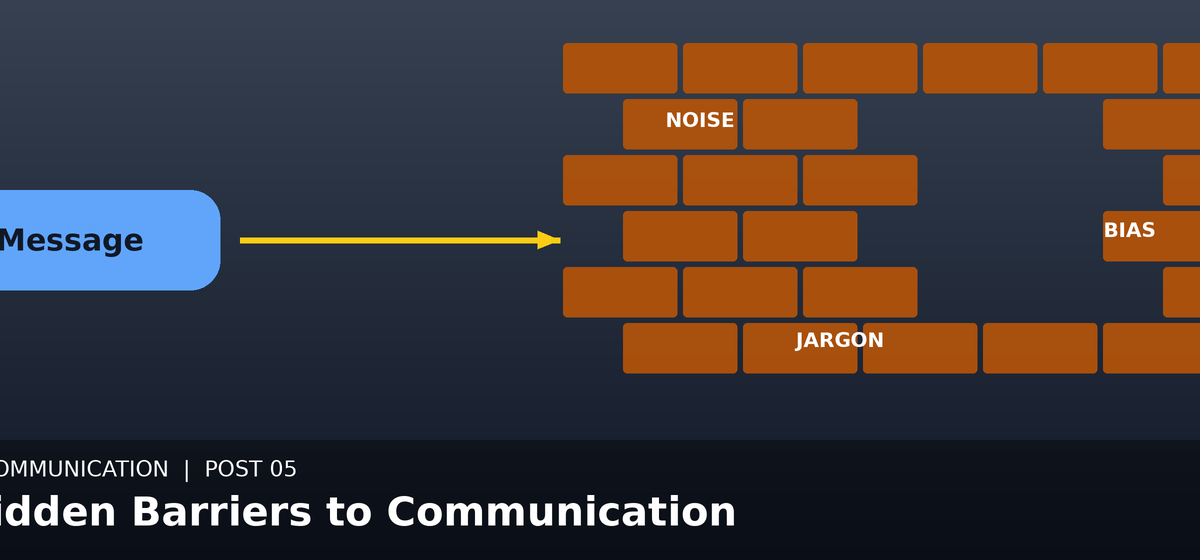
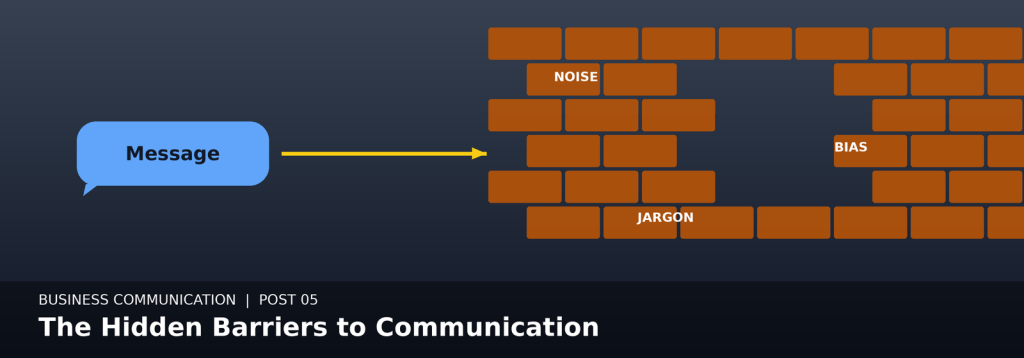
The Hidden Barriers to Business Communication

BARRIERS  |  6 MIN READ

The Hidden Barriers to Business Communication

A message can be well planned, well written and perfectly timed, and still fail. Somewhere between the sender’s intention and the receiver’s understanding, barriers get in the way. The first step to solving a problem is to name it, so let’s map the most common ones.

Physical barriers

Background noise, poor lighting, distance, faulty microphones, weak internet and uncomfortable temperature all disturb the message before it even begins. In hybrid work, a dropping video call is the modern equivalent of a crackling phone line.

Language and semantic barriers

  • Jargon: terms such as “EBITDA”, “synergy” or “bandwidth” may confuse people outside your field.
  • Ambiguity: “Send it soon” means an hour to one person and a week to another.
  • Multiple meanings: to “table” a motion means opposite things in British and American English.
  • Accent and fluency gaps: especially in global teams.

Psychological and emotional barriers

Stress, fear, anger, prejudice and low trust change how we send and receive messages. An employee afraid of criticism may hide bad news. A manager who is angry may phrase feedback harshly. Preconceived ideas make us hear what we expect rather than what was said.

Perceptual and attitude barriers

People interpret messages through their own beliefs, experiences and biases. Stereotypes about age, gender, region or position can cause good ideas to be dismissed. Selective perception means we notice what supports our views and ignore the rest.

Cultural barriers

Cultures differ in directness, eye contact, personal space, the role of hierarchy and the meaning of silence. In some cultures a “yes” means agreement; in others it means “I hear you.” Gestures that are friendly in one country can be rude in another.

Organisational barriers

  • Too many layers of hierarchy that filter or delay information.
  • Unclear reporting lines and roles.
  • Information silos between departments.
  • A culture that punishes honest feedback.

Information overload and poor listening

When people receive too many emails, notifications and documents, important messages get lost. And listening is often the weakest link: many of us listen only to reply, not to understand.

Spot the barrier

SituationBarrier
A manager says “I’ll need it ASAP” with no deadlineSemantic (ambiguity)
Team members in a noisy open office miss instructionsPhysical
A junior hides a mistake out of fearPsychological / organisational
A 40-page report is sent with no summaryInformation overload
An overseas client stays silent during a negotiationCultural

Key takeaways: Barriers are physical, linguistic, psychological, perceptual, cultural, organisational and personal. Most are avoidable once you recognise them, and the next post shows how.

Think about it: Which barrier affects you the most at college or work? What triggers it?

Why Business Communication Matters: Its Real Significance

FOUNDATIONS  |  6 MIN READ

Why Business Communication Matters: Its Real Significance

Ask a hiring manager which skill matters most in a graduate and the answer is rarely a technical one. It is almost always communication. That is because in any organisation, communication is the thread that ties strategy to action. When it is strong, even an average plan succeeds; when it is weak, even a brilliant plan falls apart.

1. It gives direction

People cannot work towards a goal they do not understand. Clear communication of vision, targets and responsibilities lets every employee see how their daily task connects to the larger picture.

2. It improves decision-making

Good decisions need accurate and timely information. A finance head cannot approve a budget without correct figures, and a product team cannot launch without customer insight. Communication carries the data from the people who have it to the people who need it.

3. It enables coordination

Modern businesses are made of departments, branches and time zones. Communication synchronises them. Without it, teams duplicate effort, miss deadlines or work at cross purposes.

4. It builds morale and trust

Employees who are kept informed feel respected. Open, two-way communication reduces rumours, increases engagement and lowers attrition. Research on workplace engagement consistently links manager communication to retention.

5. It strengthens customer relationships

Prompt replies, honest updates and polite language turn a one-time buyer into a loyal customer. A poorly worded complaint response can do the opposite, and in the age of social media the damage spreads quickly.

6. It prevents and resolves conflict

A large share of workplace conflict is simply misunderstanding. Clarifying expectations early, listening to concerns and giving honest feedback keep small issues from becoming big ones.

7. It shapes the public image of the organisation

Advertisements, annual reports, press statements and even the tone of a call centre agent shape how the market sees a company. During a crisis, the speed and honesty of communication often matter more than the crisis itself.

What poor communication costs

  • Rework caused by unclear instructions.
  • Missed deadlines because of delayed or incomplete information.
  • Lost customers after careless or discourteous replies.
  • Low morale and high turnover in teams that feel uninformed.
  • Legal and reputational risk from inaccurate or leaked messages.

Key takeaways: Communication is not a soft skill sitting beside real work. It is how real work gets done. Treat every message as an investment in clarity, trust and results.

Think about it: Think of a project that went wrong in your college or workplace. How much of the problem was really a communication problem?