The Economic Problem-Scarcity and Choice

The Economic Problem-Scarcity and Choice.[1]

Economy is derived from two Greek words which mean house and distribute. Economy was studied to understand the management of a household that later started being used to manage resources.

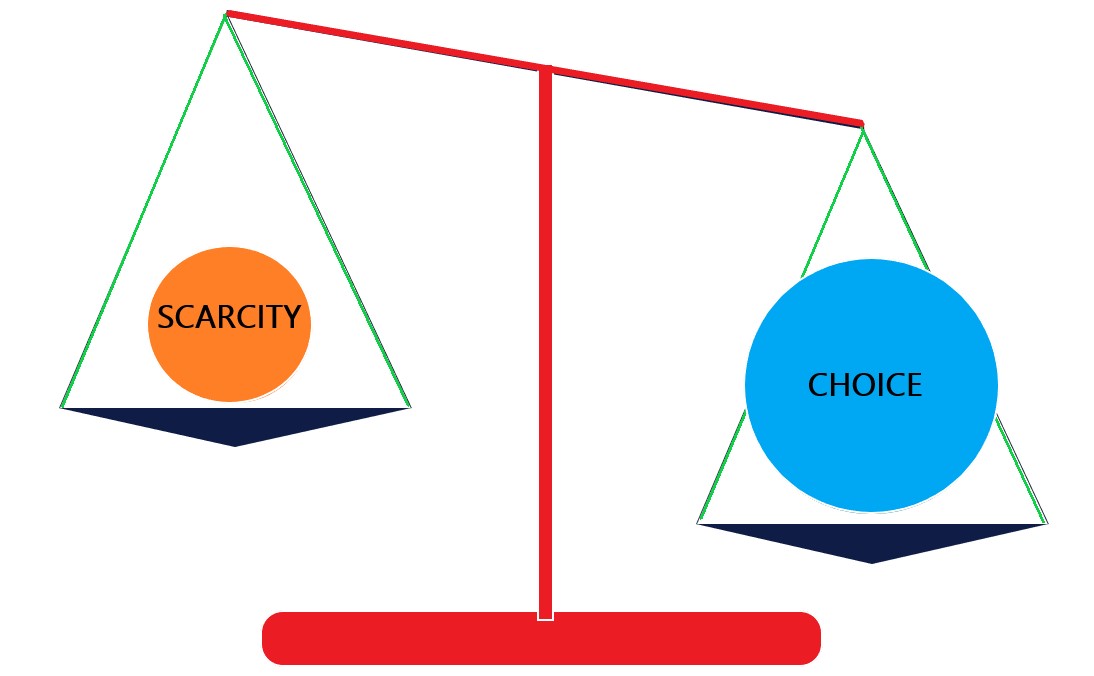
The chart shows the basic problem of the economy.

The basic problem of an economy deals with a man’s unlimited needs and wants and scarce resources. The resources include the production factors: land, labour, capital and entrepreneurship.

The factors of production.

Economics is the social science that studies how people use their scarce resources to satisfy unlimited needs and wants. From a teenager to a homemaker and then to a businessman, all face the same issue of how to spend their income to attain maximum satisfaction.

L5

Scarcity.

The purpose of production is to satisfy one’s ‘want’, but as the resources are limited, not enough output is available to fulfil every man’s wants. This explains that human wants are unlimited and are not fulfilled by limited resources, as stated by the Law of scarcity.

This chart shows how the Law of scarcity arises.

The demand is high compared to the supply, and satisfaction is not achieved due to insufficient resources. To overcome this, the choice is made available to man to allocate their resources to achieve maximum satisfaction.

For instance, if a man walks into a grocery store with ₹500, he would buy products in a way that when he walks out, the products with him would equal the value of ₹500. He might want food grains, toiletries, milk, cooking essentials, etc. but would allocate the money available to him so that he attains maximum satisfaction from his purchase.

Choices.

Scarcity gives rise to the economic problem of choice. With limited resources, the choice is given to decide what one wishes to get by sacrificing one of its demands. When the choice is made, there is sacrifice involved in it. The decision to consume a product also means not consuming another. One product can only be consumed by giving up something in exchange. Opportunity Cost refers to the cost of sacrifice that is done to choose the next best alternative.


[1] https://studiousguy.com/the-economic-problem-scarcity-and-choice/
Importance of Business Economics

Importance of Business Economics.[1]

Business economics plays an important role in decision making in an organization. Decision making is a process of selecting the best course of action from the available alternatives.

The following points explain the importance of business economics:

Business economics covers various important concepts, such as Demand and Supply analysis; Short run cost and Long run costs; and Law of Diminishing Marginal Utility. These concepts support managers in identifying and analyzing problems and finding solutions.

Business economics helps in establishing relationships between different economic factors, such as income, profits, losses, and market structure. This helps in guiding managers in effective decision making and running the organization.

Difference Between Economics and Business Economics.

  • Economics is a traditional subject that has prevailed from a long time.
  • Business economics is a modern concept and is still developing.
  • Economics mainly covers theoretical aspects.
  • Business economics covers practical aspects.
  • In economics, the problems of individuals and societies are studied.
  • In Business economics, the main area of study is the problems of organizations.
  • In economics, only economic factors are considered.
  • In business economic, both economic and no-economic factors are considered.
  • Both microeconomics and macroeconomics fall under the scope of economics.
  • Only microeconomics falls under the scope of business economics.
  • Economics has a wider scope and covers the economic issues of nations.
  • Business economics is a part of economics and is limited to the economic problems of organizations.

Limitations of Business Economics/Managerial Economics.[2]

The limitations of managerial economics are listed below:

  • Business economics focuses on business analysis based on financial and costing data. The reliability of this data, therefore, depends on the accuracy of the financial accounting information.
  • This analysis is based on historical information. But things change when new systems are introduced, and conclusions cannot be predicted from this previous information. Management controls are subject to the personal preferences of individual managers, which may influence to some extent.
  • It is a costly process as the company usually needs a certain number of managers to keep it functioning properly.
  • The science of business management is relatively new and not fully developed. So, it can be ambiguous in certain scenarios.


[1] https://geektonight.medium.com/what-is-business-economics-definition-scope-importance-geektonight-5b602377ab0e

[2] https://www.vedantu.com/commerce/limitations-of-economics