MODELS | 7 MIN READ
Berlo’s SMCR and Schramm’s Model: Communication as a Two-Way Street
Shannon and Weaver treated communication like a signal travelling down a wire. Human beings are not wires. We bring our own knowledge, attitudes and culture to every exchange. Two later models, by David Berlo and Wilbur Schramm, put people back into the picture.
Berlo’s SMCR model (1960)
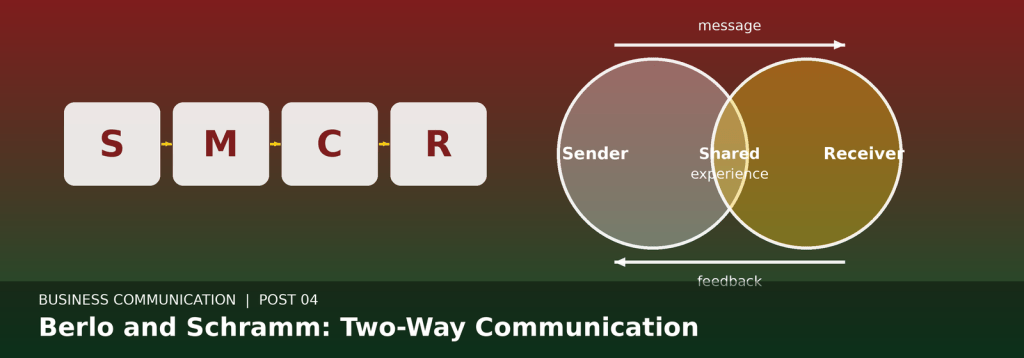
SMCR stands for Source, Message, Channel and Receiver. Berlo’s contribution was to look inside each element and list the factors that decide whether communication works.
| Element | Factors that influence it |
| Source | Communication skills, attitudes, knowledge, social system, culture |
| Message | Content, elements, treatment, structure, code (language, gestures, symbols) |
| Channel | The five senses: seeing, hearing, touching, smelling, tasting |
| Receiver | The same five factors as the source: skills, attitudes, knowledge, social system, culture |
The central idea is that the source and the receiver should be on the same wavelength. If a technical expert (high knowledge, specialised vocabulary) addresses a layperson without adjusting, the message fails, however accurate it is.
Strengths and limits of Berlo’s model
- Highlights the human factors behind communication, including skill, attitude and culture.
- Applicable to speaking, writing, teaching and selling.
- Does not clearly show feedback or noise, and is still fairly linear in layout.
Schramm’s model (1954)
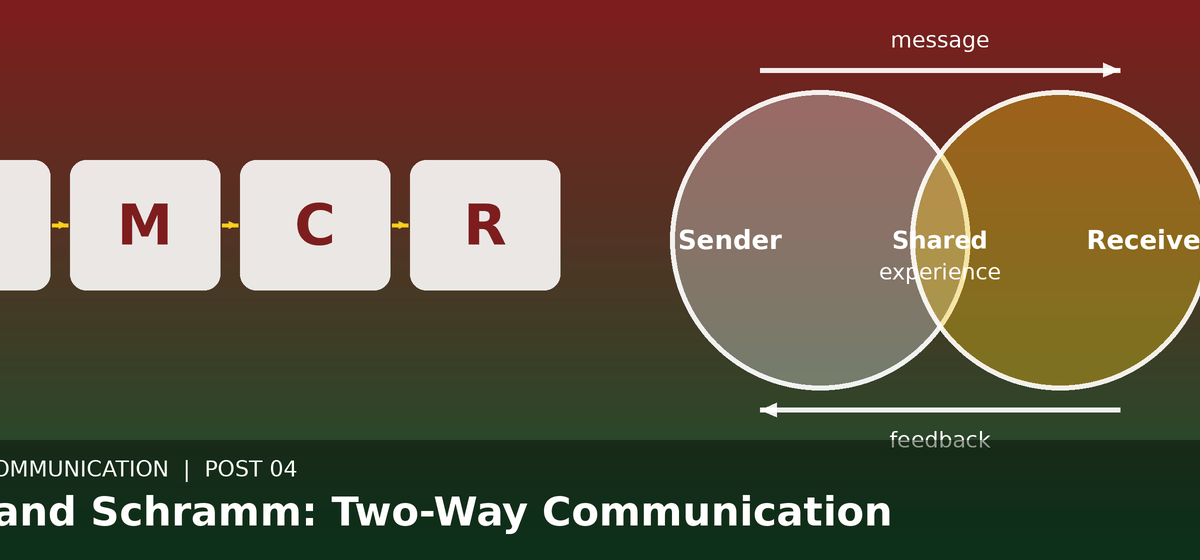
Wilbur Schramm moved from a straight line to a circle. In his model, both parties act as sender and receiver at different moments. Each one encodes, decodes and interprets, and each one has a field of experience: the sum of their background, education, culture and past encounters.
Communication works only in the overlap of the two fields of experience. If a sales executive and a customer share no common ground, the message will not land, no matter how polished it is.
Key ideas in Schramm’s model
- Circular process: feedback keeps the conversation going and lets the sender correct course.
- Shared experience: the bigger the overlap, the easier the understanding.
- Interpretation: meaning lives in people, not in words.
Comparing the three models
| Shannon-Weaver | Berlo SMCR | Schramm | |
| Shape | Linear | Linear, detailed | Circular |
| Feedback | Absent | Not explicit | Central |
| Focus | Signal and noise | Human factors | Shared experience |
| Best for | Technical channels | Analysing skills and attitudes | Conversations and teamwork |
Putting it to use
Before a presentation, ask: What does my audience already know? What vocabulary do they use? What do they care about? Then build a bridge from their field of experience to yours with examples, analogies and simple terms. After you speak, ask a question that checks understanding rather than just “Any questions?”
Key takeaways: Berlo shows what shapes the source and the receiver; Schramm shows that understanding lives in shared experience and feedback. Good communicators study their audience first and their slides second.
Think about it: How would you explain your course project differently to a classmate, a professor and your grandparent?

