
Eight Strategies to Overcome Communication Barriers

BARRIERS  |  6 MIN READ

Eight Strategies to Overcome Communication Barriers

Knowing the barriers is useful; removing them is powerful. The strategies below turn awareness into daily habit. None of them requires a big budget, only attention and practice.

1. Listen actively

Give the speaker your full attention. Put the phone away, make eye contact, nod, and avoid interrupting. Paraphrase what you heard (“So you need the draft by Friday, correct?”) and ask follow-up questions. Active listening is the single most effective fix for misunderstandings.

2. Use clear, simple language

Choose short words over long ones and explain any technical term the first time you use it. If you wouldn’t say it aloud to a colleague, don’t write it in an email.

3. Seek and give feedback

Replace “Any questions?” with “What will you do first after this meeting?” Feedback closes the loop. Give your own feedback promptly, specifically and kindly.

4. Match the channel to the message

  • Complex or emotional topics: face-to-face or video call.
  • Quick coordination: chat.
  • Decisions, approvals and records: email or formal document.
  • Urgent matters: phone call, followed by written confirmation.

5. Build cultural awareness

Learn about the communication styles of the people you work with: how direct, formal and hierarchical they are. Avoid idioms and humour that may not translate, and ask when you are unsure.

6. Flatten the channels

Encourage open-door policies, skip-level meetings and anonymous suggestion tools. Shorter paths mean less distortion and faster information.

7. Control emotions and timing

Do not send a critical message while angry. Draft it, wait an hour or sleep on it, and then reread. Choose times when the receiver can give attention, not five minutes before closing.

8. Manage information

Chunk long messages, use headings and bullets, lead with the main point and attach details separately. Follow up in writing after important conversations so there is a shared record.

BarrierBest remedy
Jargon, ambiguityPlain language, examples, specific deadlines
Noise, distanceQuiet space, reliable technology, backup channel
Emotion, biasPause, reflect, focus on facts
Cultural differencesResearch norms, ask clarifying questions
Hierarchy filtersOpen-door policy, direct updates
OverloadSummaries, priorities, fewer but better messages

Key takeaways: Overcoming barriers is a skill built by habit: listen, simplify, check understanding, choose the right channel, respect cultures and manage emotion.

Try this week: In your next conversation, paraphrase what the other person said before you reply. Notice how often it surfaces a small misunderstanding.
Berlo’s SMCR and Schramm’s Model: Communication as a Two-Way Street

MODELS  |  7 MIN READ

Berlo’s SMCR and Schramm’s Model: Communication as a Two-Way Street

Shannon and Weaver treated communication like a signal travelling down a wire. Human beings are not wires. We bring our own knowledge, attitudes and culture to every exchange. Two later models, by David Berlo and Wilbur Schramm, put people back into the picture.

Berlo’s SMCR model (1960)

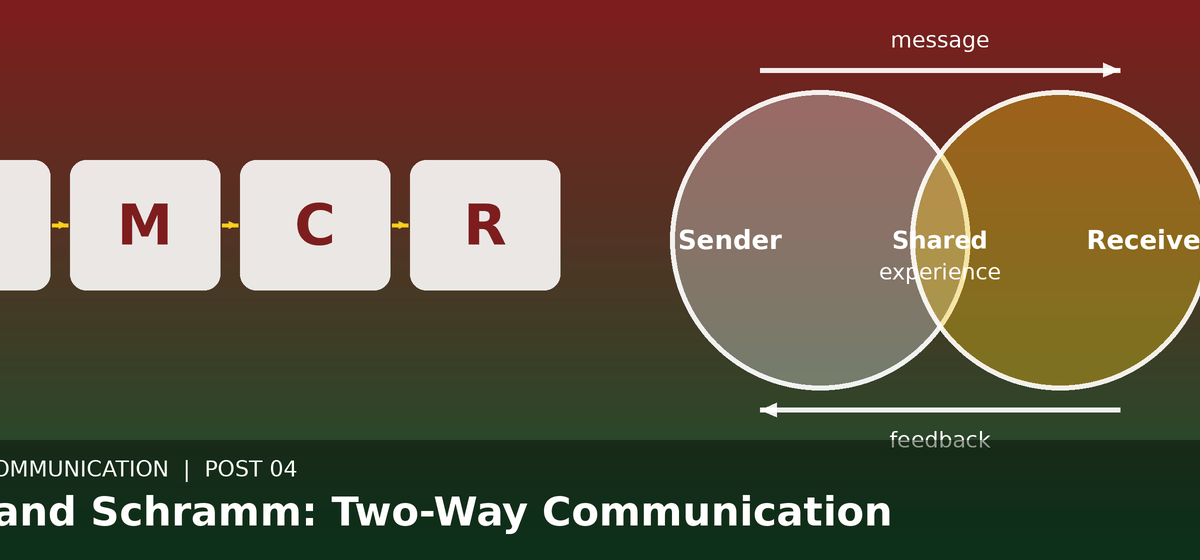
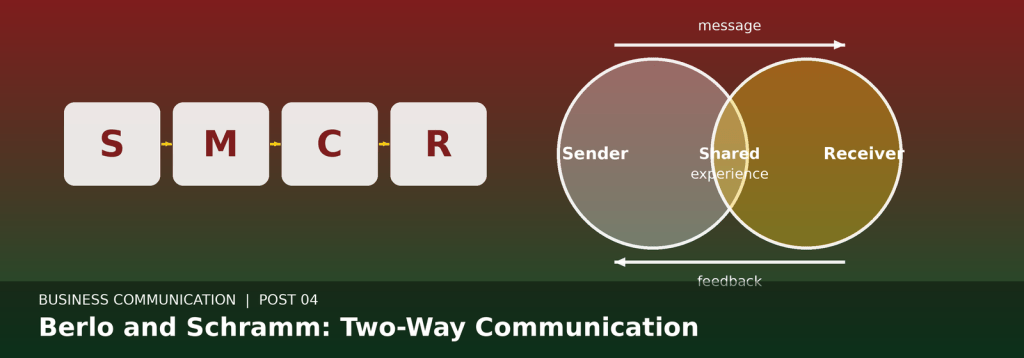
SMCR stands for Source, Message, Channel and Receiver. Berlo’s contribution was to look inside each element and list the factors that decide whether communication works.

ElementFactors that influence it
SourceCommunication skills, attitudes, knowledge, social system, culture
MessageContent, elements, treatment, structure, code (language, gestures, symbols)
ChannelThe five senses: seeing, hearing, touching, smelling, tasting
ReceiverThe same five factors as the source: skills, attitudes, knowledge, social system, culture

The central idea is that the source and the receiver should be on the same wavelength. If a technical expert (high knowledge, specialised vocabulary) addresses a layperson without adjusting, the message fails, however accurate it is.

Strengths and limits of Berlo’s model

  • Highlights the human factors behind communication, including skill, attitude and culture.
  • Applicable to speaking, writing, teaching and selling.
  • Does not clearly show feedback or noise, and is still fairly linear in layout.

Schramm’s model (1954)

Wilbur Schramm moved from a straight line to a circle. In his model, both parties act as sender and receiver at different moments. Each one encodes, decodes and interprets, and each one has a field of experience: the sum of their background, education, culture and past encounters.

Communication works only in the overlap of the two fields of experience. If a sales executive and a customer share no common ground, the message will not land, no matter how polished it is.

Key ideas in Schramm’s model

  • Circular process: feedback keeps the conversation going and lets the sender correct course.
  • Shared experience: the bigger the overlap, the easier the understanding.
  • Interpretation: meaning lives in people, not in words.

Comparing the three models

 Shannon-WeaverBerlo SMCRSchramm
ShapeLinearLinear, detailedCircular
FeedbackAbsentNot explicitCentral
FocusSignal and noiseHuman factorsShared experience
Best forTechnical channelsAnalysing skills and attitudesConversations and teamwork

Putting it to use

Before a presentation, ask: What does my audience already know? What vocabulary do they use? What do they care about? Then build a bridge from their field of experience to yours with examples, analogies and simple terms. After you speak, ask a question that checks understanding rather than just “Any questions?”

Key takeaways: Berlo shows what shapes the source and the receiver; Schramm shows that understanding lives in shared experience and feedback. Good communicators study their audience first and their slides second.

Think about it: How would you explain your course project differently to a classmate, a professor and your grandparent?

The Communication Process and the Shannon-Weaver Model

MODELS  |  7 MIN READ

The Communication Process and the Shannon-Weaver Model

Before studying specific models, it helps to understand the basic communication process. Once you can see the steps, it becomes much easier to spot where a message breaks down.

The communication process step by step

  1. Sender (source): the person who has an idea or information to share.
  2. Encoding: converting the idea into words, symbols, images or gestures.
  3. Message: the actual content being sent.
  4. Channel (medium): the route, such as email, phone, meeting or notice board.
  5. Receiver: the person for whom the message is meant.
  6. Decoding: the receiver interprets the message and assigns meaning.
  7. Feedback: the receiver’s response, which tells the sender whether the message was understood.

Running through all of this is noise, any disturbance that distorts the message: a bad phone line, unfamiliar jargon, distraction, or even a negative mood.

The Shannon-Weaver model (1949)

Claude Shannon, an engineer at Bell Labs, and Warren Weaver, a mathematician, developed this model to improve the accuracy of telephone and radio signals. Shannon’s 1948 paper, “A Mathematical Theory of Communication”, was popularised with Weaver’s contribution in 1949 and became one of the most influential frameworks in communication studies.

The six components

ComponentRoleBusiness example
Information sourceProduces the messageA manager decides to announce a new policy
TransmitterConverts the message into signalsThe manager types and sends an email
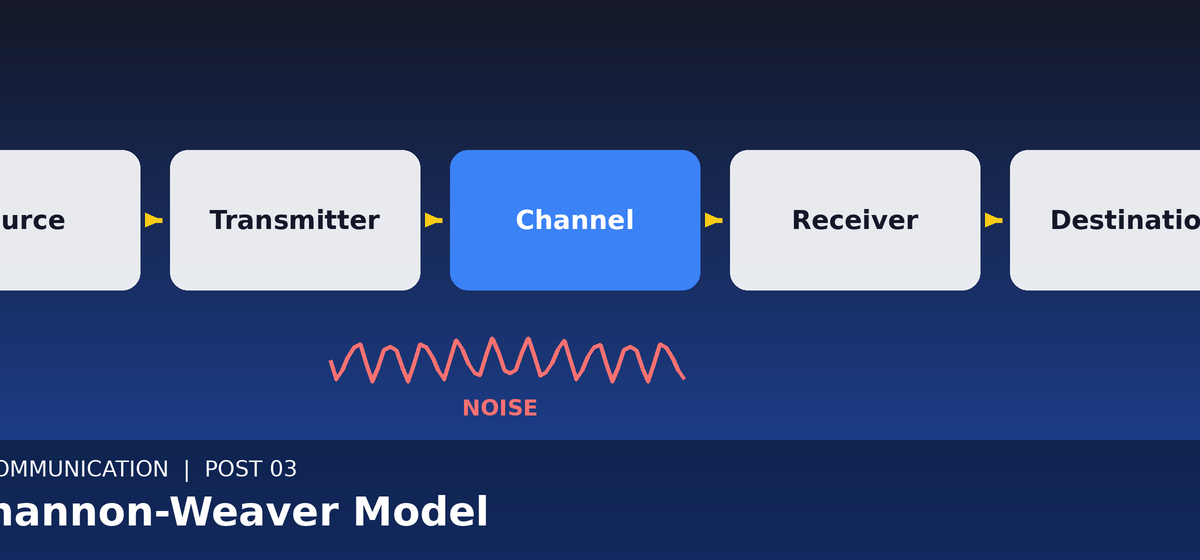
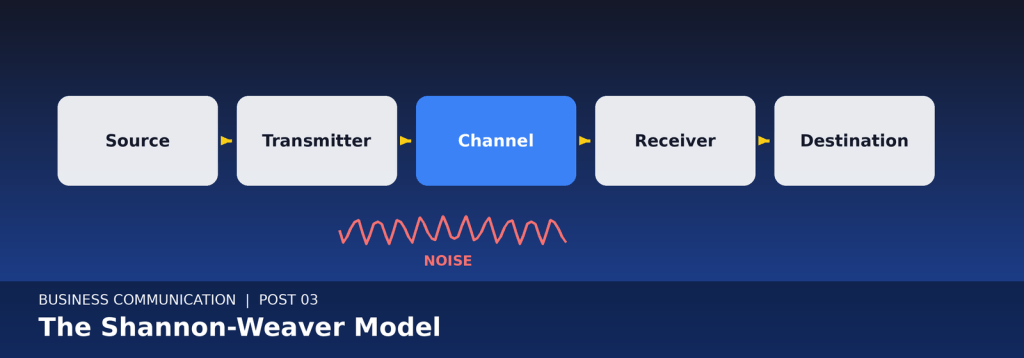
ChannelCarries the signalThe company email server
NoiseInterferes with the signalA spam filter, a cluttered inbox, unclear wording
ReceiverReconstructs the messageThe employee’s device and mind reading the email
DestinationThe intended recipientThe employee who must act on the policy

Strengths of the model

  • Simple and easy to remember.
  • First to introduce the concept of noise as a barrier.
  • Useful for analysing technical channels such as phone, email and broadcast.

Limitations

  • It is linear: communication is shown as one-way, from sender to receiver.
  • It has no feedback loop, though real conversations depend on feedback.
  • It treats communication as transmission of data and ignores meaning, culture and context.
  • It assumes that if the signal arrives intact, the message has been understood, which is often untrue.

What it means for you at work

The model’s lasting lesson is practical: protect your message from noise. Use a quiet room for calls, a clear subject line for emails, plain language instead of jargon, and a reliable channel for urgent news. Then go beyond the model by asking for feedback, because the arrival of a signal is not the same as understanding.

Key takeaways: Shannon-Weaver gives us the vocabulary of source, transmitter, channel, noise, receiver and destination. It is excellent for diagnosing technical problems but too linear for human conversation, which is why later models added feedback and shared experience.

Think about it: List three sources of noise you face in a typical working day. Which one can you remove first?