MODELS | 7 MIN READ
The Communication Process and the Shannon-Weaver Model
Before studying specific models, it helps to understand the basic communication process. Once you can see the steps, it becomes much easier to spot where a message breaks down.
The communication process step by step
- Sender (source): the person who has an idea or information to share.
- Encoding: converting the idea into words, symbols, images or gestures.
- Message: the actual content being sent.
- Channel (medium): the route, such as email, phone, meeting or notice board.
- Receiver: the person for whom the message is meant.
- Decoding: the receiver interprets the message and assigns meaning.
- Feedback: the receiver’s response, which tells the sender whether the message was understood.
Running through all of this is noise, any disturbance that distorts the message: a bad phone line, unfamiliar jargon, distraction, or even a negative mood.
The Shannon-Weaver model (1949)
Claude Shannon, an engineer at Bell Labs, and Warren Weaver, a mathematician, developed this model to improve the accuracy of telephone and radio signals. Shannon’s 1948 paper, “A Mathematical Theory of Communication”, was popularised with Weaver’s contribution in 1949 and became one of the most influential frameworks in communication studies.
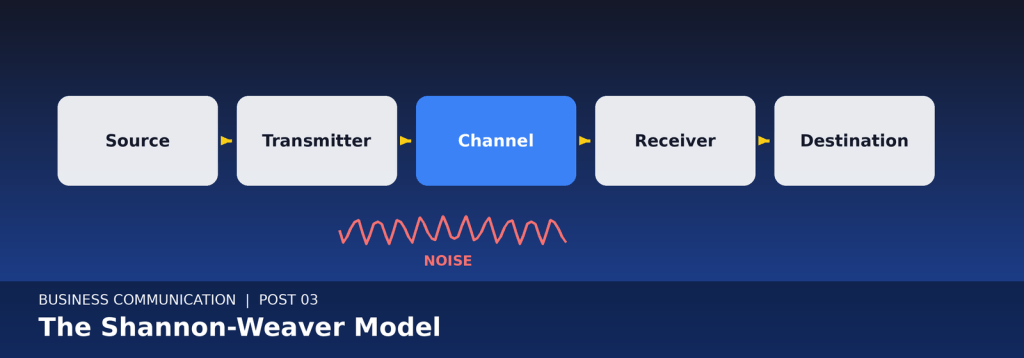
The six components
| Component | Role | Business example |
| Information source | Produces the message | A manager decides to announce a new policy |
| Transmitter | Converts the message into signals | The manager types and sends an email |
| Channel | Carries the signal | The company email server |
| Noise | Interferes with the signal | A spam filter, a cluttered inbox, unclear wording |
| Receiver | Reconstructs the message | The employee’s device and mind reading the email |
| Destination | The intended recipient | The employee who must act on the policy |
Strengths of the model
- Simple and easy to remember.
- First to introduce the concept of noise as a barrier.
- Useful for analysing technical channels such as phone, email and broadcast.
Limitations
- It is linear: communication is shown as one-way, from sender to receiver.
- It has no feedback loop, though real conversations depend on feedback.
- It treats communication as transmission of data and ignores meaning, culture and context.
- It assumes that if the signal arrives intact, the message has been understood, which is often untrue.
What it means for you at work
The model’s lasting lesson is practical: protect your message from noise. Use a quiet room for calls, a clear subject line for emails, plain language instead of jargon, and a reliable channel for urgent news. Then go beyond the model by asking for feedback, because the arrival of a signal is not the same as understanding.
Key takeaways: Shannon-Weaver gives us the vocabulary of source, transmitter, channel, noise, receiver and destination. It is excellent for diagnosing technical problems but too linear for human conversation, which is why later models added feedback and shared experience.
Think about it: List three sources of noise you face in a typical working day. Which one can you remove first?

