Running Virtual Meetings That People Don’t Dread

DIGITAL  |  7 MIN READ

Running Virtual Meetings That People Don’t Dread

Virtual meetings are now a permanent part of business life, linking colleagues, clients and partners across cities and continents. Done well, they save time and travel. Done poorly, they drain energy and attention. The difference lies in preparation, behaviour and follow-up.

Before the meeting

  • Define the purpose. If you cannot say in one sentence why the meeting is needed, it may be better as an email.
  • Send an agenda with topics, time slots and the decisions needed, at least a day ahead.
  • Invite only the right people. Mark others as optional and share notes afterwards.
  • Choose the platform that all participants can access, and share the link, dial-in details and time zone.
  • Test the technology: audio, camera, screen sharing and recording permissions.
  • Share materials in advance so the meeting is for discussion, not for reading.

During the meeting

For the host

  • Start on time, welcome everyone and state the objective and the agenda.
  • Assign a note-taker and a timekeeper.
  • Invite participation by name, especially from quieter participants.
  • Use polls, chat and breakout rooms to maintain engagement.
  • Summarise decisions and next steps before closing.

For participants

  • Join a couple of minutes early with a charged device and a stable connection.
  • Choose a tidy, well-lit space; use a neutral or blurred background.
  • Mute when not speaking; use the “raise hand” feature instead of interrupting.
  • Look at the camera when speaking, and keep your gestures natural.
  • Avoid multitasking. People notice when your eyes are elsewhere.
  • Dress as you would for an in-person meeting with the same audience.

After the meeting

Send minutes within 24 hours listing decisions, owners and deadlines. Share the recording if appropriate, and follow up on pending actions. A meeting without follow-up is only a conversation.

Common mistakes to avoid

MistakeFix
No agenda, wandering discussionCirculate an agenda; the chair keeps time
Everyone talks at onceUse raise-hand and a facilitator
Participants are silent and cameras offAsk direct questions; set expectations on cameras beforehand
Back-to-back calls all daySchedule 25 or 50-minute meetings to leave breaks
No action pointsEnd with a recap of owners and dates

Accessibility and inclusion

Turn on live captions, share slides in advance, speak clearly and describe visuals when needed. Be mindful of time zones so the same people do not always attend at inconvenient hours.

Key takeaways: Great virtual meetings have a clear purpose, a lean guest list, an agenda, polite participation and a written follow-up. Respect for people’s time is the heart of virtual etiquette.

Try this: Before your next call, write the one decision you need from it. If no decision is needed, consider sending an update instead.
The Hidden Barriers to Business Communication

BARRIERS  |  6 MIN READ

The Hidden Barriers to Business Communication

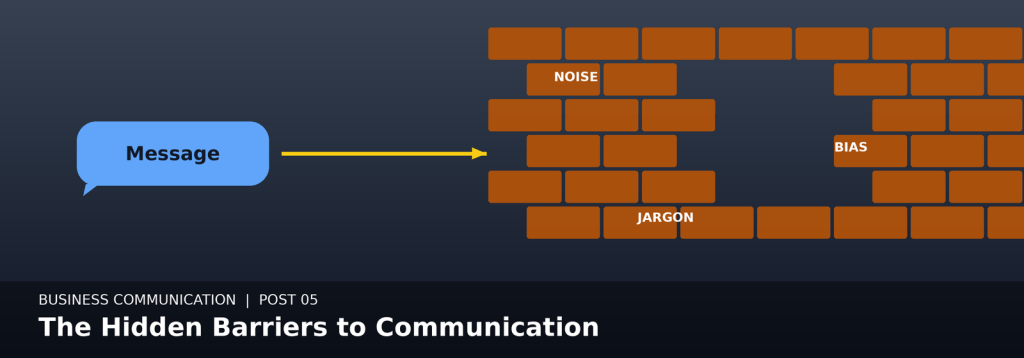
A message can be well planned, well written and perfectly timed, and still fail. Somewhere between the sender’s intention and the receiver’s understanding, barriers get in the way. The first step to solving a problem is to name it, so let’s map the most common ones.

Physical barriers

Background noise, poor lighting, distance, faulty microphones, weak internet and uncomfortable temperature all disturb the message before it even begins. In hybrid work, a dropping video call is the modern equivalent of a crackling phone line.

Language and semantic barriers

  • Jargon: terms such as “EBITDA”, “synergy” or “bandwidth” may confuse people outside your field.
  • Ambiguity: “Send it soon” means an hour to one person and a week to another.
  • Multiple meanings: to “table” a motion means opposite things in British and American English.
  • Accent and fluency gaps: especially in global teams.

Psychological and emotional barriers

Stress, fear, anger, prejudice and low trust change how we send and receive messages. An employee afraid of criticism may hide bad news. A manager who is angry may phrase feedback harshly. Preconceived ideas make us hear what we expect rather than what was said.

Perceptual and attitude barriers

People interpret messages through their own beliefs, experiences and biases. Stereotypes about age, gender, region or position can cause good ideas to be dismissed. Selective perception means we notice what supports our views and ignore the rest.

Cultural barriers

Cultures differ in directness, eye contact, personal space, the role of hierarchy and the meaning of silence. In some cultures a “yes” means agreement; in others it means “I hear you.” Gestures that are friendly in one country can be rude in another.

Organisational barriers

  • Too many layers of hierarchy that filter or delay information.
  • Unclear reporting lines and roles.
  • Information silos between departments.
  • A culture that punishes honest feedback.

Information overload and poor listening

When people receive too many emails, notifications and documents, important messages get lost. And listening is often the weakest link: many of us listen only to reply, not to understand.

Spot the barrier

SituationBarrier
A manager says “I’ll need it ASAP” with no deadlineSemantic (ambiguity)
Team members in a noisy open office miss instructionsPhysical
A junior hides a mistake out of fearPsychological / organisational
A 40-page report is sent with no summaryInformation overload
An overseas client stays silent during a negotiationCultural

Key takeaways: Barriers are physical, linguistic, psychological, perceptual, cultural, organisational and personal. Most are avoidable once you recognise them, and the next post shows how.

Think about it: Which barrier affects you the most at college or work? What triggers it?

Berlo’s SMCR and Schramm’s Model: Communication as a Two-Way Street

MODELS  |  7 MIN READ

Berlo’s SMCR and Schramm’s Model: Communication as a Two-Way Street

Shannon and Weaver treated communication like a signal travelling down a wire. Human beings are not wires. We bring our own knowledge, attitudes and culture to every exchange. Two later models, by David Berlo and Wilbur Schramm, put people back into the picture.

Berlo’s SMCR model (1960)

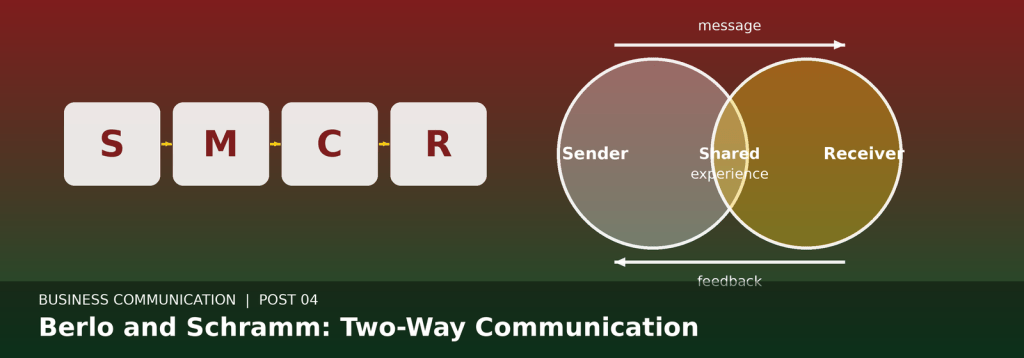
SMCR stands for Source, Message, Channel and Receiver. Berlo’s contribution was to look inside each element and list the factors that decide whether communication works.

ElementFactors that influence it
SourceCommunication skills, attitudes, knowledge, social system, culture
MessageContent, elements, treatment, structure, code (language, gestures, symbols)
ChannelThe five senses: seeing, hearing, touching, smelling, tasting
ReceiverThe same five factors as the source: skills, attitudes, knowledge, social system, culture

The central idea is that the source and the receiver should be on the same wavelength. If a technical expert (high knowledge, specialised vocabulary) addresses a layperson without adjusting, the message fails, however accurate it is.

Strengths and limits of Berlo’s model

  • Highlights the human factors behind communication, including skill, attitude and culture.
  • Applicable to speaking, writing, teaching and selling.
  • Does not clearly show feedback or noise, and is still fairly linear in layout.

Schramm’s model (1954)

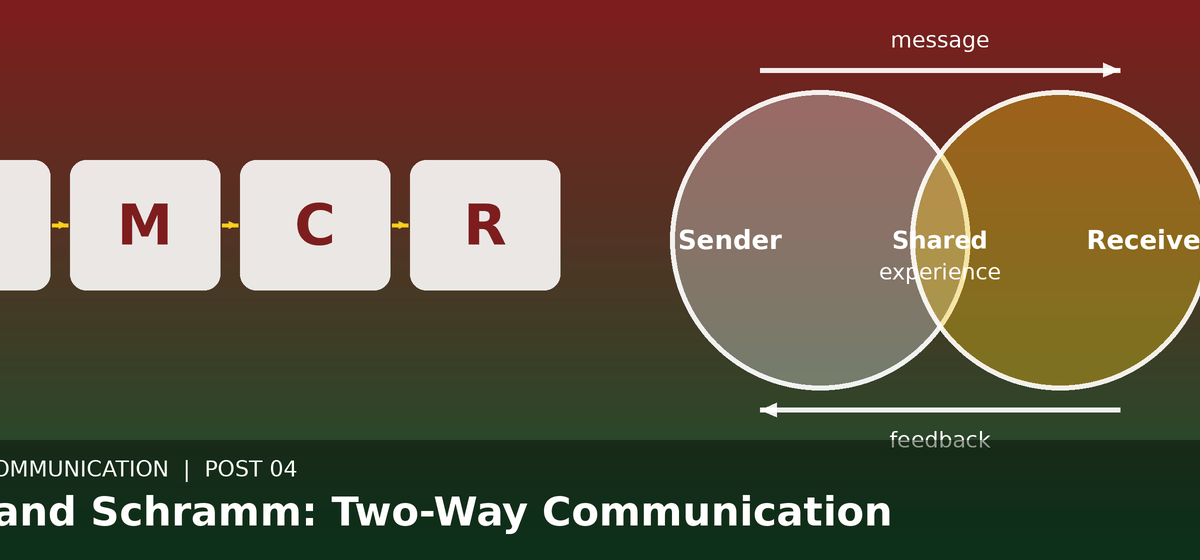
Wilbur Schramm moved from a straight line to a circle. In his model, both parties act as sender and receiver at different moments. Each one encodes, decodes and interprets, and each one has a field of experience: the sum of their background, education, culture and past encounters.

Communication works only in the overlap of the two fields of experience. If a sales executive and a customer share no common ground, the message will not land, no matter how polished it is.

Key ideas in Schramm’s model

  • Circular process: feedback keeps the conversation going and lets the sender correct course.
  • Shared experience: the bigger the overlap, the easier the understanding.
  • Interpretation: meaning lives in people, not in words.

Comparing the three models

 Shannon-WeaverBerlo SMCRSchramm
ShapeLinearLinear, detailedCircular
FeedbackAbsentNot explicitCentral
FocusSignal and noiseHuman factorsShared experience
Best forTechnical channelsAnalysing skills and attitudesConversations and teamwork

Putting it to use

Before a presentation, ask: What does my audience already know? What vocabulary do they use? What do they care about? Then build a bridge from their field of experience to yours with examples, analogies and simple terms. After you speak, ask a question that checks understanding rather than just “Any questions?”

Key takeaways: Berlo shows what shapes the source and the receiver; Schramm shows that understanding lives in shared experience and feedback. Good communicators study their audience first and their slides second.

Think about it: How would you explain your course project differently to a classmate, a professor and your grandparent?

What Is Business Communication? Meaning, Features and Types

FOUNDATIONS  |  6 MIN READ

What Is Business Communication? Meaning, Features and Types

Every sale closed, every project delivered and every policy understood begins with a message that travelled from one person to another. Business communication is the engine behind all of it. Whether you are a first-year management student or a new team member, understanding what business communication really is will shape how you work for the rest of your career.

What is business communication?

Business communication is the exchange of information, ideas, opinions and instructions between people, inside or outside an organisation, in order to achieve a business purpose. The words “business purpose” matter. A chat with a friend about the weekend is social communication; a briefing on this month’s sales targets is business communication, because it is planned, goal-directed and tied to organisational results.

Key features

  • Purposeful: it aims to inform, persuade, instruct, request or build goodwill.
  • Two-way: it is complete only when the receiver understands and responds.
  • Formal in structure: it follows conventions of format, tone and etiquette, though modern workplaces use informal channels too.
  • Continuous: it never stops; organisations communicate every day through meetings, emails, reports and conversations.
  • Often recorded: emails, minutes and contracts create evidence that can be used later.
  • Multi-directional: messages flow up, down and across the hierarchy.

Types of business communication

There is no single way to classify communication, so it helps to look at it through three lenses: where the message goes, which way it flows, and what mode carries it.

BasisTypeExample
AudienceInternalTeam meeting, HR circular, project update
AudienceExternalCustomer proposal, press release, vendor invoice
FlowDownwardManager sets targets for the sales team
FlowUpwardAnalyst sends a progress report to the director
FlowHorizontalMarketing and finance agree on a campaign budget
FlowDiagonalAn IT officer briefs a regional sales manager
ModeVerbal (oral)Phone call, presentation, interview
ModeVerbal (written)Email, report, memo, contract
ModeNon-verbalBody language, tone of voice, dress, punctuality

Formal and informal channels

Formal communication follows the official chain of command: a notice from the HR head, a quarterly report, a signed contract. Informal communication, often called the grapevine, flows through personal relationships: a hallway chat, a lunch conversation, a WhatsApp group. Smart managers do not ignore the grapevine. It can spread rumours quickly, but it also carries honest feedback that never reaches formal reports.

Oral versus written: choosing wisely

 Oral communicationWritten communication
SpeedImmediate, instant feedbackSlower, delayed feedback
RecordUsually nonePermanent, can be referred to later
Best forSensitive, urgent or complex discussionsInstructions, policies, contracts, detailed data
RiskForgotten or misquotedMisread tone, harder to correct once sent

A quick scenario

A project manager discovers that a delivery will be two days late. She phones the client first (oral, urgent, relationship-sensitive), then follows up with an email summarising the new date and the reason (written, for the record), and finally informs her own team in the morning huddle (internal, downward). Three messages, three channels, one purpose. That is business communication at work.

Key takeaways: Business communication is purposeful, structured and goal-oriented. Classify it by audience, flow and mode, and always choose the channel that fits the message, not just the one that is most convenient.

Think about it: Recall the last important message you sent at college or work. Which type was it, and was the channel the best choice?