U1 L3 FMI

L3

Objectives of Financial System.[1]

The objectives of the financial system are to lower transaction costs, reduce risk, and provide liquidity.

These are the three main problems that are faced by borrowers and lenders, which the financial system aims to regulate.

Transaction costs.

Lowering the transaction cost is one of the main objectives of the financial system.

Definition: Transaction cost is the cost that is associated with carrying out a financial transaction.

Example: An example of a transaction cost would be when a bank spends money and resources on a credit check for a business seeking a loan extension.

The objective of the financial system is to ensure that these transaction costs are reduced.

Example: For example, the financial system sets up credit scores that different financial institutions accept. That way, banks do not need to spend a massive amount of resources and time checking a borrower’s ability to pay, as it is reflected in the borrower’s credit score.

Similarly, when a corporation wants to raise public money and use it to expand, borrowing money from each individual would be very costly. Think about the time and resources spent preparing a deal between the corporate and all investors who want to invest. Instead, the financial system enables the corporate to raise money by either borrowing from the bank or issuing bonds.

Reducing financial risk.

Reducing financial risk is another objective of the financial system.

Definition: Financial risk is the future outcome associated with economic loss or benefit.

The future outcome of financial transactions in the financial system is not always certain. The uncertainty of the future, which includes the possibility of both losses and profits, gives rise to an issue known as financial risk, which is simply referred to as risk.

Example: For instance, you might buy shares in a company for your future retirement plans. However, you didn’t know that the company you invested in didn’t disclose all the financial information. At some point, the company files for bankruptcy which causes you to lose your life savings.

To prevent such situations, the financial system ensures that each company discloses all information about its financial health. This reduces risks and provides a more sound financial system.

Another way the financial system reduces risk is by enabling individuals to diversify their portfolio of investments.

Definition: Diversification is an investment strategy that includes investing in several assets with uncorrelated risks.

Example: An example of diversification would be buying stocks and, at the same time, buying gold. Stocks decrease in value when there is an economic recession. On the other hand, gold increases in value when there is an economic recession. This way, one would mitigate the risk of financial loss.

Providing liquidity

Providing liquidity is perhaps one of the most important objectives of the financial system.

Definition: Liquidity is the ability of an asset to be converted into cash.

When an asset is liquid, it can be turned into cash quickly. On the other hand, when an asset is illiquid, it is harder to turn it into cash. The financial system ensures that investors are provided with liquidity.

Example: Imagine you put your savings with a bank that uses your savings to make a loan to an individual who wants to buy a house. However, you are unaware that the bank makes loans to individuals with a small likelihood of paying back the loan. As a result, the bank isn’t capable of delivering your savings back.

The financial system makes sure that banks always keep a certain amount of deposits in their reserve to provide liquidity to depositors.

Components of Financial System.

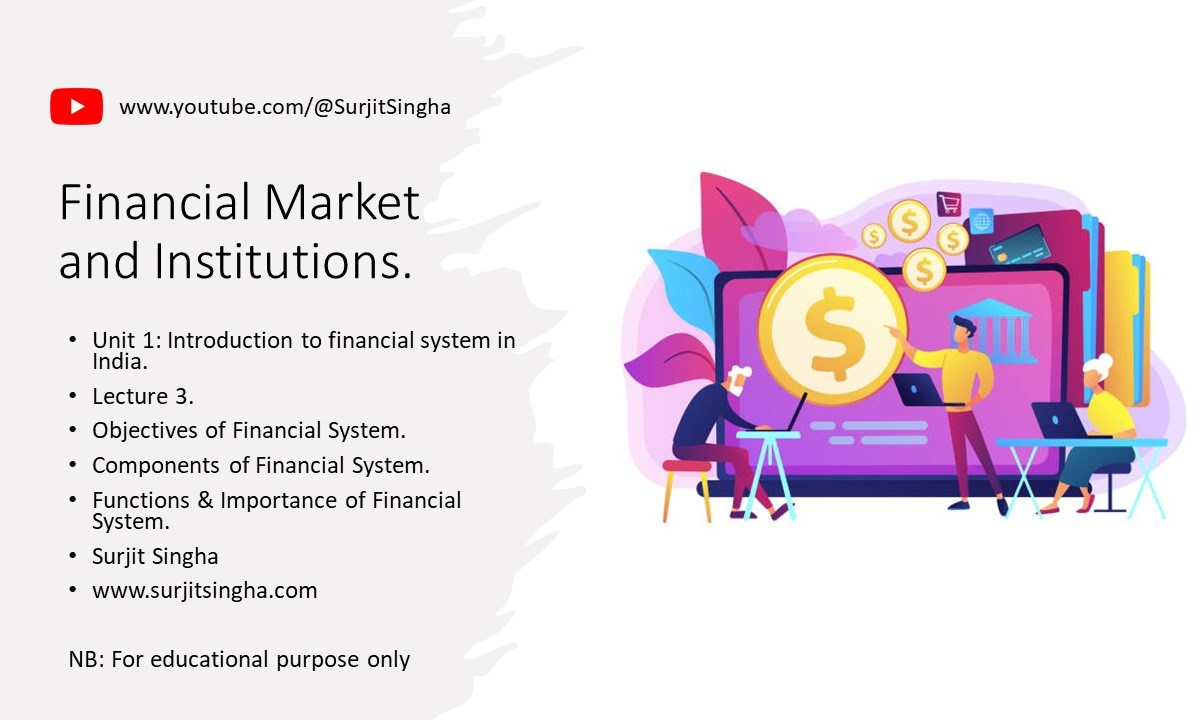
The main financial system components include financial institutions, financial services, financial markets, and financial instruments.

Financial institutions. Financial institutions play a significant role in bringing together lenders and borrowers. This is done by using various financial instruments and services, all of which contribute to an efficient financial system. The financial institution is one of the main components which ensure liquidity in the financial system through the development of credit and other liquid assets.

Financial services. Financial services include credit rating agencies, mutual funds, pension funds, venture capital, and other institutions that are part of the financial system. Financial services are an important component of the financial system due to their specific tasks.

Financial markets. A financial market is where both the creation of new financial assets and the trading of existing ones occur. Financial markets move funds from savers to borrowers much more efficiently and ensure that there is always liquidity.

Financial instruments. Financial instruments are another main component of the financial system. Financial instruments are papers that entitle the buyer to future income from the seller. That’s because there are different needs between investors and those looking for credit.

Functions of Financial System.

Financial system functions serve as an intermediary in allowing funds to be transferred from savers to borrowers. It is financial system functions that enable the surplus and deficit of funds to be allocated efficiently in the economy.

Example: It is a well-functioning financial system that enabled Elon Musk to raise the necessary funds to create EV vehicles and contribute to reducing carbon emissions. All the bonds, stocks, and credit that are an instrumental part of the financial system provided Elon with the necessary means to produce EVs.

Financial system function includes stimulating higher savings and higher investment by providing an efficient environment where funds can be channelled from savers to borrowers. Financial system ensures that there is incentive from savers to save via providing a return on their savings. Additionally, the financial system allows borrowers to access funds they can borrow for investment.

Investment is crucial to economic growth and development as it provides more output and lowers the unemployment rate. Therefore, a well-functioning financial system is crucial in attaining sustained economic development over the long term.

Importance of Financial System.

Financial system importance comes from its role in stimulating higher savings and investment expenditure, leading to higher economic growth. A well-functioning financial system is crucial in attaining sustained economic development over the long term. Additionally, it guarantees that expenditures on investments and savings are carried out effectively.

Financial systems contribute to the local and international economies’ overall economic and financial stability. They serve as the foundation upon which economic transactions may occur and upon which monetary policy can be based.

Due to financial regulations, economic and financial institutions between parties involved in the financial system are safe and secure. The financial system ensures that companies disclose all relevant information about their current financial situation, which helps investors make better decisions.

The financial systems also guarantee that monetary policies can successfully assist in managing and mitigating risk and avert various issues, such as an economic slowdown or a rise in fiscal expenses. This is becoming increasingly important as there are more financial technology businesses, more ways to connect, and stronger economic and commercial ties between countries. Financial systems help prevent problems by ensuring rules are followed across many industries and borders.


[1] https://www.studysmarter.co.uk/explanations/macroeconomics/financial-sector/financial-system/

U1 L2 FMI

L2

Components of Indian Financial System.[1]

There are four main components of the Indian Financial System. This includes:

  • Financial Institutions.
  • Financial Assets.
  • Financial Services.
  • Financial Markets.

Let’s discuss each component of the system in detail.

1. Financial Institutions.

The Financial Institutions act as a mediator between the investor and the borrower. The investor’s savings are mobilised either directly or indirectly via the Financial Markets.

The main functions of the Financial Institutions are as follows:

  • A short-term liability can be converted into a long-term investment.
  • It helps in conversion of a risky investment into a risk-free investment.
  • Also acts as a medium of convenience denomination, which means, it can match a small deposit with large loans and a large deposit with small loans.

The best example of a Financial Institution is a Bank. People with surplus amounts of money make savings in their accounts, and people in dire need of money take loans. The bank acts as an intermediate between the two.

The financial institutions can further be divided into two types:

  • Banking Institutions or Depository Institutions – This includes banks and other credit unions which collect money from the public against interest provided on the deposits made and lend that money to the ones in need.
  • Non-Banking Institutions or Non-Depository Institutions – Insurance, mutual funds and brokerage companies fall under this category. They cannot ask for monetary deposits but sell financial products to their customers.

Further, Financial Institutions can be classified into three categories:

  • Regulatory – Institutes that regulate the financial markets like RBI, IRDA, SEBI, etc.
  • Intermediates – Commercial banks which provide loans and other financial assistance such as SBI, BOB, PNB, etc.
  • Non-Intermediates – Institutions that provide financial aid to corporate customers. It includes NABARD, SIBDI, etc.


2. Financial Assets

The products which are traded in the Financial Markets are called Financial Assets. Based on the different requirements and needs of the credit seeker, the securities in the market also differ from each other.

Some important Financial Assets have been discussed briefly below:

  • Call Money – When a loan is granted for one day and is repaid on the second day, it is called call money. No collateral securities are required for this kind of transaction.
  • Notice Money – When a loan is granted for more than a day and for less than 14 days, it is called notice money. No collateral securities are required for this kind of transaction.
  • Term Money – When the maturity period of a deposit is beyond 14 days, it is called term money.
  • Treasury Bills – Also known as T-Bills, these are Government bonds or debt securities with maturity of less than a year. Buying a T-Bill means lending money to the Government.
  • Certificate of Deposits – It is a dematerialised form (Electronically generated) for funds deposited in the bank for a specific period of time.
  • Commercial Paper – It is an unsecured short-term debt instrument issued by corporations.

3. Financial Services

Services provided by Asset Management and Liability Management Companies. They help to get the required funds and also make sure that they are efficiently invested.

The financial services in India include:

  • Banking Services – Any small or big service provided by banks like granting a loan, depositing money, issuing debit/credit cards, opening accounts, etc.
  • Insurance Services – Services like issuing of insurance, selling policies, insurance undertaking and brokerages, etc. are all a part of the Insurance services.
  • Investment Services – It mostly includes asset management.
  • Foreign Exchange Services – Exchange of currency, foreign exchange, etc. are a part of the Foreign exchange services.

The main aim of the financial services is to assist a person with selling, borrowing or purchasing securities, allowing payments and settlements and lending and investing.

4. Financial Markets.

The marketplace where buyers and sellers interact with each other and participate in the trading of money, bonds, shares and other assets is called a financial market.

The financial market can be further divided into four types:

Capital Market: Designed to finance the long-term investment, the Capital market deals with transactions which are taking place in the market for over a year. The capital market can further be divided into three types:

         a. Corporate Securities Market.

         b. Government Securities Market.

         c. Long Term Loan Market.

Money Market: Mostly dominated by Government, Banks and other Large Institutions, the type of market is authorised for small-term investments only. It is a wholesale debt market which works on low-risk and highly liquid instruments. The money market can further be divided into two types:

         a. Organised Money Market.

         b. Unorganised Money Market.

Foreign exchange Market: One of the most developed markets across the world, the Foreign exchange market, deals with the requirements related to multi-currency. The transfer of funds in this market takes place based on the foreign currency rate.

Credit Market: A market where short-term and long-term loans are granted to individuals or Organisations by various banks and Financial and Non-Financial Institutions is called Credit Market.

Further readings:

https://byjus.com/govt-exams/indian-financial-system/


[1] https://byjus.com/govt-exams/indian-financial-system/

U1 L1 FMI

Financial Market and Institutions.

Unit 1: Introduction to financial system in India. 10 hours.

The structure of the financial system: Objectives, Functions and Importance, Elements of the financial system and economic development, Financial Sector Reforms: context, need and objectives; major reforms in the last decade; competition; deregulation; capital requirements; issues in financial reforms and restructuring; future agenda of reforms.

L1

Short story:[1]

When Elon Musk started Tesla, he needed financing to begin the production of EVs. Elon had to go to a bank and take a loan to do so. The bank’s loan was made possible because individuals like you decided to deposit money in the bank. The same money that the bank decided to loan to Elon to bring electric vehicles to life. Is it right to say that we helped Elon create Tesla? Or is it better to say that the financial system enabled Tesla to happen?

Meaning of Financial System.

The financial system’s meaning is based on the idea that sets of financial institutions make it possible for borrowers, lenders, and investors to exchange money with one another. The financial system provides borrowers with the funds necessary to finance initiatives, and it also provides investors with a return on their investments.

Definition: The financial system is a set of markets and financial institutions that enable funds to flow from lenders to borrowers.

Example: Examples of financial institutions and markets that are part of the financial system include commercial banks, stock exchanges, investment banks, insurance companies, etc.

The financial markets are comprised of several participants, including borrowers, lenders, and investors who arrange loans to make investments.

Definition: Financial markets are markets where borrowers and lenders meet and exchange funds.

Money is often exchanged between borrowers and lenders for the promise of a return on the investment at some point in the future.

Additionally, derivative instruments, contracts whose outcomes are decided according to the performance of an underlying asset, are traded on the financial markets.

The financial system enables investors, lenders, and borrowers to exchange these funds and have a return on their investment in a secure matter.

The financial system has a unique regulated framework that allows funds to flow across financial institutions. The government makes the regulation of the financial system, and other relevant parties involved.

Indian Financial System.[2]

The Indian Financial System is one of the most important aspects of the economic development of our country. This system manages the flow of funds between the people (household savings) of the country and the ones who may invest it wisely (investors/businessmen) for the betterment of both the parties.

This is an important topic with respect to the various Government exams conducted in the country, and aspirants must carefully consider going through this article and prepare themselves accordingly.

In this article, you shall know about what the Indian Financial system is, its components and how it helps in the economic growth of a country. Also, get some Sample Questions on the Indian Financial System further below in this article.

Indian Financial System – An Overview.

The services that are provided to a person by the various Financial Institutions including banks, insurance companies, pensions, funds, etc. constitute the financial system.

Given below are the features of the Indian Financial system:

  • It plays a vital role in the economic development of the country as it encourages both savings and investment.
  • It helps in mobilising and allocating one’s savings.
  • It facilitates the expansion of financial institutions and markets.
  • Plays a key role in capital formation.
  • It helps form a link between the investor and the one saving.
  • It is also concerned with the Provision of funds.

The financial system of a country mainly aims at managing and governing the mechanism of production, distribution, exchange and holding of financial assets or instruments of all kinds.


[1] https://www.studysmarter.co.uk/explanations/macroeconomics/financial-sector/financial-system/

[2] https://byjus.com/govt-exams/indian-financial-system/

U4 Ethics in Advertising

Advertising Skills

Unit 4: Ethics in advertising

Criticism of Advertising – Controversial effects of advertising – Impact of Advertisements on children- Unethical use of women in advertising-Puffery – Shock – advertisements – Subliminal advertising- Regulating bodies in India. Ethical Aspects of Advertising in India; Role of Advertising Standards Council of India (ASCI)

4.1. Meaning of ethics:[1]

Ethics, also called moral philosophy, is the discipline concerned with what is morally good and bad and morally right and wrong. The term is also applied to any system or theory of moral values or principles.

4.2. Meaning of advertising:[2]

Advertising is creating messages and using different psychological techniques to persuade and motivate someone to act, most likely to buy a product or service.

4.3. How does advertising work?

Advertising has a simple principle — get people interested in a product being sold.

After arousing interest, the goal is to persuade people to purchase the product, even if they hadn’t previously thought about buying it. Ads work by using psychology to influence the way people think and feel about a product or service.

4.4. Depending on the goals of your ad campaign, advertising can work for your company in a variety of ways:

  • To raise awareness of your brand
  • To drive potential customers to your business
  • To promote sales for both new and existing products
  • To introduce a new product or service to the market
  • To differentiate your product from your competitors’

Advertising can also be executed in various ways. Radio commercials, billboards, branded t-shirts, and social media endorsements all count as advertising.

4.5. Advertising ethics:[3]

Advertising ethics are the moral principles that govern how a business communicates with members of its target audience. Advertising has a set of defined principles that outline the type of communication that can take place between a potential buyer and a seller of goods or services. An example of ethical advertising is an ad that presents true statements in a decent manner, although the definition of decency may vary between individuals.

The purpose of advertising is to increase sales and generate more brand awareness. Good advertising can appeal to a wide audience and generate more demand for a product or service. Companies may claim that what they sell is better than what competitors sell, but ethics come into play when a business cannot back up their claims or use unacceptable methods to generate brand awareness.

Applying ethics in advertising can pose a challenge because the ethical beliefs that people hold vary, based on their background and moral beliefs. Certain regulations do apply to advertisers, who must exercise caution when creating ads to avoid facing legal issues or consumer backlash.

4.6. Criticism of Advertising:[4]

Main criticisms against advertising are: (1) increased price of the product, (2) multiplication of needs, (3) deceptive, (4) it leads to monopoly, (5) harmful for the society, (6) wastage of precious national resources!

Despite many benefits drawn from advertising, it suffers from a severe criticism advanced by different segments of society.

(1) Increased Price of The Product:

Advertising increases the cost of the product as the expenses on it form the part of the total cost of the product. The increased prices are borne by the consumers. But it cannot be denied that advertising leads to large scale production which considerably reduces the total and per unit cost of production. The consumer may pay less rather than higher.

(2) Multiplication of Needs:

Advertising creates artificial demand for the product and induces people to buy those products which are not needed by them. On account of its repetition, it allures and creates a desire in the minds of the people to possess an article not required by them.

(3) Deceptive:

Sometimes advertising is used as an instrument of cheating. In order to impress upon the people false statements are given with regard to different virtues of a product. Fraudulent means and deceptive practice are resorted to by various traders in order to sell their products. All these things adversely affect the public confidence in the advertising.

(4) It Leads to Monopoly:

Advertising sometimes leads to monopoly in a particular brand of a product. By investing large sums in advertising of his brand, a big producer eliminates small producers of the same product from the market and creates brand monopoly. This leads to exploitation of consumers.

But in reality, this argument does not hold good. The monopoly powers are temporarily acquired by the manufacturers as they face strong competition by the rival producers of the same product. In the words of Marry Hepner “advertisement stimulates competition. It often enables the small businessmen to compete with large concerns as well as to start new business”.

(5) Harmful for the Society:

Sometimes advertisements are un-ethical and objectionable. Most often, these carry indecent language and virtually nude photographs in order to attract the customers. This adversely affects the social values.

(6) Wastage of Precious National Resources:

A serious drawback levied against the advertisement is that it destroys the utility of certain products before their normal life. The latest and improved model of a product leads to the elimination of old ones. For instance, in the U.S.A., people like to possess the latest models of cars and discarding the old ones which are still in useable conditions. This leads to wastage of national resources.

4.7. Controversial effects of advertising:[5]

The persuasive role of advertising is presumed to have an impact on society’s values and life styles. In determining the ill-effects of advertising, there still remains the issue of whether advertising creates negative effect in the society or whether it merely reflects the values and attitudes that are already existing in society. Advertising is probably effective in creating an image rather than changing society’s values.

1. Promoting materialism

Advertising is accused of promoting materialism by inducing people to attach too much importance to the material aspects of life, it creates the notion that acquisition of material things will gratify basic and inner needs and aspirations of the people.

2. Advertisements are exploitative

Emotions, sensual feeling, self-centeredness, fear and lost for words, etc. are touched by advertisements. They also create negative feelings such as self-doubt, insecurity, envy, greed, lust, possessiveness and inferiority. It is better that they are rationally based, instead of thriving on emotional aspects of people.

3. Promoting Stereotypes

By portraying certain groups of individuals in certain roles, advertising becomes stereotyped. Women are usually portrayed as housewives or mothers. In a study done by the students of the Indian institute of Management, Ahmedabad, it was found that in a majority of advertisements, women are portrayed as housewives or as companions to men, thus apparently relegating them to a secondary role. Only in some cases they were shown as business executives or professionals.

Certain stereotypes may easily be spotted. In a number of advertisements, business executives are shown with cigars, which could be avoided. Also, a large number of cigarette advertisements in India include women, either to give an impression of a kind of sanctity provided by them, or to create a romantic situation.

4. Advertisements are ‘children-centered’

Most advertisements are children-centered. Advertisement on chewing gums, chocolates, toys and tattoos, etc., use children. The well-to-do can afford to buy them for their wards. But what about the millions of low income and lower-middle income group children living in India, who have absolutely no means to buy them?

The major issues are whether TV advertising to children is unfair, whether it causes children to make poor product decisions, whether it increases parent-child conflict, and whether it results in undesirable socialization of children.

5. Advertising to Children

It is argued that children are more susceptible to deception that adults have and cannot objectively evaluate advertisements. Thus, there is substantial scope for manipulation of children through television advertising. Because of children’s limited ability to interpret the selling intent of a message or identify a commercial, critics charge that advertising to them is inherently unfair and deceptive and should be severely restricted.

6. Advertising and Sensitivity to Price

There is a belief that advertising reduce the consumers’ sensitivity to the price on brands that closely resemble one another. However, a study has shown that the relative price elasticity increases with an increase in advertising, implying that advertising actually increases sensitivity to price.

7. Inferior goods

Advertisements for inferior goods are sometimes flashed in a high-profile manner. Several joint stock companies during 1994-95 lured investors to subscribe to their public issues. But for their high-gear advertisements, people would not have invested in such companies’ shares which are now totally worthless.

8. Advertising Creates Insecurity

Advertising can make people unduly worry about greying of hair, body complexion and odor, etc. They make them lack in self-confidence unnecessarily.

4.8. Impact of Advertisements on children:[6]

Positive effects of advertisements on children:

  • Advertising makes children endless variety of free information about different products.
  • Advertising makes the kids aware of the new products available in the market.
  • Children can learn moral lessons.

Negative effects of advertising:

  • Children adopt impulses buying behavior from childhood onwards.
  • By seeing different stunts, children also try to perform dangerous stunts.
  • Children demanding luxurious lifestyle.
  • Children are addicted to eat more junk food after watching junk food varieties in advertisement, Childhood obesity increases worldwide.
  • Children wasting much of their valuable time in watching TV.
  • Children are becoming more arrogant & irritable when they did not get their desired product.
  • Children are facing health problems after watching TV like eye sight problems, headache, and black circle around eyes.
  • Children learn more violence while watching cartoons like -Tom & Jerry whenever tom get hurt, they feel happier this type of tendency won’t give better impact in future.
  • As a human tendency negative point are attracted more than positive points, as children with immature brain get attracted more to the negative side and overlook the positive aspects.

4.9. Unethical use of women in advertising:

Portrayal of women in advertising:[7]

Advertisement is one of the major medias that affect our daily life consciously and unconsciously. It is also responsible to play a significant role in shaping the society in a much broader perspective. There is a lot of disputes on the issue that whether advertisements depict what is prevalent in the society or the society embraces in itself what is portrayed in the advertisements and other media. Over the last few decades, there has been a great socio-cultural change in the society especially in the context of role and position of women in the society. There are increasing numbers of women pursuing careers of their choice, changing role in the family structure, negative attitude towards gender-role stereotypes etc. But has the representation of women in advertisements changed over a period of time? Or does it still confirm to some traditional notions about women and their role in the society? Such stereotypes projected about women go a long way in deciding what the society thinks about women and how the society treats women in the long run.

There is a contrast between how males and females are portrayed in advertisements. This difference in portrayal has nothing to do with biology or natural traits, but with how our culture defines feminine and masculine. The gender roles that women play in advertisements are the decorative role, recreational role, independent career role, self- involved role, carefree role and family roles. Women are generally found in advertisements for home products, baby items, cosmetics and food items.

Since ages, women have been reflected in stereotypical roles. She has been highlighted as “her place is in the home, they don’t make important decisions, are regarded as being dependent on men. Women were stereotyped in the advertisements in the aspects of “objectifying women”, “showing women as subordinate to men”, and as “mentally withdrawn from the larger scene”.

Gradually this portrayal of women changed shape and in late 70’s, women were reflected as employed. Representation of women in advertisements has been experiencing a shift from the housewife centric advertisements to the career women advertisements. But female models are increasingly shown in advertisements to sell products that may or may not be directly related to them. The images of women are always attractive – who provides the desirable image for the advertisement, irrespective of her importance to the advertisement.

Even today, the images of women found in advertisements and commercials have the touch of the traditional homemaker. Women are seen as the beloved wife when she is able to cook good food, excellent daughter-in-law when she follows the traditions of her mother-in-law and a great mother when she takes good care of her children.

There is the difference in the portrayal of women in Asian countries as compared to that in the US and other western countries. While the portrayal of women in non-working roles is consistent with various findings of the studies conducted in China, Thailand, Hongkong and Turkey but the recent studies in America revealed the predominance of work- related roles of women in the advertisements. In the Indian context also, there is a lot of difference in the projection of women as compared to other nations as the common stereotypical portrayals seem less prevalent in Indian advertisements. Women were portrayed in neutral ways. Although there is a difference in the product categories advertised by women, but they are still portrayed more in traditional and stereotyped roles.

The latest advertisements on health drinks, detergent cakes and powders, soaps, medicines, cosmetics, mobike advertisements have represented women in a very rigorous way – very energetic, dynamic, strong and enthusiastic. Majority of modern Indian advertisements present a more realistic and balanced picture of a woman. There has been a general shift whereby advertisements have moved from showcasing women merely as tradition bound homemakers to those playing modern roles.

There is a shift in the portrayal of the woman in advertisements from a mere housewife to a career-oriented and professional with the independent identity and multiple identities, who is a super woman successful in balancing her personal and professional life.

4.10. Puffery in Advertising[8]

Puffery refers to a usually harmless amount of exaggeration in sales and marketing materials. However, some claims can go too far and cross the thin line into false advertising.

Have you ever been to a restaurant that claimed to have the best pie in the world? Or run across a blog post promising the most valuable read of your life?

Maybe you’ve seen advertisements for the softest mattress, the warmest sweaters, or the fastest cars.

These claims are all examples of a type of advertisement known as puffery.

In digital advertising, puffery is all about exaggerating and stretching the truth about a product or service in a harmless way.

However, there are legal dangers associated with puffery and your brand can suffer real harm if used incorrectly.

What is Puffery Advertising?

The term “puffery” first originated in 1893 in an English Court of Appeals.

The case involved a manufacturer’s promise to pay customers £100 if the flu was contracted after using their product. A consumer who was not reimbursed sued the company for making false claims.

The manufacturing company claimed the advertisement was “puff” and not meant to be taken literally.

While the court ultimately disagreed with the manufacturing company, it did set a legal precedent that some advertising promises weren’t meant as serious claims, and puffery was created.

In a modern definition, puffery refers to the use of exaggeration and hyperbole, sometimes to extreme levels, to promote a product or service.

Puffery advertising examples in common marketing and sales phrases include:

  • The best product for the job
  • Tastes or looks the best
  • Lasts longer than other brands
  • Best in the world
  • The last product you’ll need
  • Never go back to other brands


Have you ever been to a restaurant that claimed to have the best pie in the world? Or run across a blog post promising the most valuable read of your life?

Maybe you’ve seen advertisements for the softest mattress, the warmest sweaters, or the fastest cars.

These claims are all examples of a type of advertisement known as puffery.

In digital advertising, puffery is all about exaggerating and stretching the truth about a product or service in a harmless way.

However, there are legal dangers associated with puffery and your brand can suffer real harm if used incorrectly.

Why Puffery Works?

You may be wondering what is the value of puffery for brands.

After all, isn’t it better to promote factual statements with empirical data than make lofty claims?

While this way of thinking makes sense on the surface, puffery is often utilized in advertising for a few different reasons.

First and foremost, puffery works. Advertising slogans that use puffery and exaggerated language see high returns on investments.

Grab the Attention of Consumers

Puffery grabs the attention of consumers and helps them make quick decisions regarding a product.

People don’t want to digest complex marketing slogans, and the quick “best product in the world” claims are a fast way to convince customers to give your brand a try.

Puffery Advertising Examples

1. Red Bull

In 2014, the energy drink company Red Bull lost a $13 million lawsuit for false advertising.

The company had made claims that their product improved concentration and reaction speeds in consumers, which the brand said was just puffery advertising.

However, courts disagreed and stated that there was no way for those claims to be scientifically proven to be true, even if they might be accurate in some consumers for a short period of time.

The mistake Red Bull made is a classic in puffery advertising examples where the line was crossed — they were too specific.

By making claims of precise improvements their product could deliver, the advertisement went from subjective to objective.

2. Starbucks

The coffee giant Starbucks was sued for making the claim that Starbucks coffee was “The Best Coffee for the Best You”.

The basis behind the lawsuit was that Starbucks used pesticides and chemicals to kill bugs in stores, which made the advertisement for perfect coffee untrue and misleading.

Courts quickly found in favor of Starbucks, stating in the ruling that the language used in advertisements was legal puffery, and that the claims Starbucks was making in no way would mislead a customer about the types of pesticides used in stores.

While Starbucks was eventually found to be innocent of false advertising, the brand still took a hit as criticism of store cleaners and pesticides came into public light.

4.11. Shock advertising or Shockvertising

Shock advertising, also known as shockvertising, is a unique tactic where advertisers use provocative, taboo subjects and images to grab the public’s attention. Advertisers use this method because it incites strong feelings about the given advertisement. The audience feels strongly about the advertisement, which makes them much more likely to share and discuss it as well as remember it. In turn, this generates more brand awareness.[9]

Risks of Shock Advertising

Although more brand awareness sounds like a great thing for a company, doing it through shock advertising can be a risk. It does have the potential to backfire, as there is a fine line between tastefully disturbing or shocking and downright unacceptable. Shock advertising aims to toe this line without crossing it. This advertising method seeks to reach a large audience, so the advertisement going poorly can be detrimental to a company’s reputation. These advertisements can be incredibly offensive to certain groups, and there is a chance that the audience deems it unacceptable.

4.12. Subliminal Advertising

A subliminal message is an audio or visual stimulus that’s not perceived by your conscious mind. They’re often put into songs, films or adverts, as they can be used to enhance the persuasiveness of something – or convey something else entirely.[10]

Subliminal messages are below the threshold of conscious perception. You can picture your subconscious mind the same way as an iceberg, with far more mass below the surface than above. As the subconscious or unintentional aspect of your mind represents around 90% of your total brain function, it’s clearly way more powerful than your conscious mind when it comes to processing information.

Subliminal advertisement examples:

1. The Amazon logo

It’s a logo you’ve seen a million times, so where’s the subliminal message? Well, have you ever noticed that the arrow points from the ‘a’ to the ‘z’, telling your subconscious mind that you can literally get anything from Amazon? Plus, the arrow looks like a smile, subliminally making you feel good about the brand, so two messages are hidden in one device.

2. The FedEx logo

Bet you’ve never clocked this one – FedEx makes clever use of negative space – look between the ‘E’ and the ‘x’, and what do you spot? Yep, another arrow. Created by Landor Associated design bureau in 1994, it’s received more than 40 design awards and was mentioned in a run-down of the top 10 best emblems by Rolling Stone magazine.

3. Toblerone

The Toblerone logo isn’t really subliminally selling you anything – unlike FedEx’s subtle promise of speedy deliveries and Amazon’s that you’ll be able to buy anything from A-Z. Look closely at the mountain range, which mimics the chocolate’s distinctively-shaped chunks, and you’ll be able to find a bear standing on its hind legs. Bern, the Swiss capital where the Toblerone bar was created, is called the ‘City of Bears’ and the bear features on its coat of arms – the logo thus pays tribute to the bar’s birthplace.

4.13. Regulating bodies in India.

Advertising has become a serious and big business in the last few years. The advertising business is growing at a considerable rate. Several legislations control the content of advertising. Some of the principal legislations are[11]

• Cable Television Networks (Regulation) Act, 1955

• Press Council of India Act, 1978

• Cable Television Networks (Amendment) Rules, 2006

Some prominent, prohibitory legal provisions regulate advertising.

In 1985, the Advertising Standards Council of India (“ASCI”), a non-statutory tribunal, created a self-regulatory mechanism for ensuring ethical advertising practices. ASCI is a voluntary Self-regulation council. The members comprise advertisers, Media, Advertising Agencies and other Professional/Ancillary services connected with advertising practice. ASCI entertained and disposed of complaints based on its Code of Advertising Practice (“ASCI Code”).

This Code applies to advertisements read, heard or viewed in India even if they originate or are published abroad so long as they are directed to consumers in India or are exposed to a significant number of consumers in India.

4.14. Ethical Aspects of Advertising in India

In the olden days, few firms were engaged in producing and distributing goods and services and never bothered to advertise much. So, the message was straight and clear. But with the enormous growth of the business evolution of market economies, the competition turned more ruthless, if not uglier. The rapid changes in the market environment drive marketers to explore unique and innovative advertising paths and the urge to embrace even unethical and immoral means in advertising, with little consideration for social and ethical values.

Ethics are moral standards or principles against which one’s behaviour is judged. It broadly includes Honesty, Integrity, Fairness and Sensitivity. Though ethics is always a matter of personal values and interpretation, there are specific ethical standards governing the conduct of individuals and organizations in the society.[12]

Ethical advertising should have the following:

1. No place for deception and puffery.

2. Ads aimed at children should be controlled since it promotes superficiality. It influences children’s demands for everything they watch on TV.

3. Advertisers promoting theme parks and casinos etc. in the pretext of action shows in TV without revealing the sponsor’s name amounts to influencing children.

4. Promotion of controversial products, gambling, and wagering in the media should be checked.

To maintain and enhance the public’s confidence in advertising. ASCI seek to ensure that advertisements conform to its Code for Self-Regulation, which requires advertisements to be:[13]

  • Honest Representations – Truthful and Honest to consumers and competitors.
  • Non-Offensive to Public – Within the bounds of generally accepted standards of public decency and propriety.
  • Against Harmful Products/Situations – Not used indiscriminately for the promotion of products, hazardous or harmful to society or to individuals particularly minors, to a degree unacceptable to society at large.
  • Fair in Competition – Not derogatory to competition. No plagiarism.

4.15. Role of the Advertising Standards Council of India (ASCI)[14]

ASCI’s goals include monitoring, administering and promoting standards of advertising practices in India with a view to:

  • To ensure truthfulness and honesty of representations and claims made through advertising and safeguarding against misleading advertising.
  • To ensure that advertising is not offensive to generally accepted norms and standards of public decency.
  • To safeguard against indiscriminate use of advertising for the promotion of products or services that are generally regarded as hazardous to society or individuals or unacceptable to society as a whole.
  • To ensure that advertisements observe fairness in competition and the canons of generally accepted competitive behavior.
  • To codify adopt and from time to time modify the code of advertising practices in India and implement, administer, promote and publicize such a code.
  • To promote, maintain and uphold fair, sound, ethical and healthy principles and practices of advertising.
  • To promote a better understanding of the benefits of fair, sound and ethical advertising amongst the practitioners of advertising and in society at large.
  • To represent, protect, inform and guide members of the company on matters relating to advertising.
  • To foster and promote cooperation amongst persons or companies engaged and involved in advertising.

NB: This material is for educational purpose, and for private circulation. Readers are requested to follow prescribe text books, for further insights and understandings. The material needs upgradation with time and may become outdated in the due course of time, and may become irrelevant with future time.


[1] https://www.britannica.com/topic/ethics-philosophy

[2] https://blog.hubspot.com/marketing/advertising

[3] https://www.indeed.com/career-advice/career-development/advertising-ethics

[4] https://www.yourarticlelibrary.com/advertising/6-main-criticisms-against-advertising-explained/25869

[5] https://accountlearning.com/controversial-effects-advertising/

[6] https://www.ijsdr.org/papers/IJSDR1607047.pdf

[7] Chatley, P. (2018). Portrayal of women in advertising. IMPACT: IJRHAL, 6(7), 15–18. https://www.researchgate.net/publication/350276831_PORTRAYAL_OF_WOMEN_IN_ADVERTISING

[8] https://rockcontent.com/blog/puffery-advertising-examples/

[9] https://seodesignchicago.com/advertising-blog/what-is-shockvertising-and-does-it-work/

[10] https://www.audionetwork.com/content/the-edit/inspiration/subliminal-advertising

[11] https://ficci.in/Sedocument/20240/Survey_on_Advertising_Standards.pdf

[12] https://www.abacademies.org/articles/ethical-issues-in-advertising-13279.html

[13] https://iarjset.com/upload/2015/may-15/IARJSET%2024.pdf

[14] https://www.ibfindia.com/advertising-standards-council-india-asci
U1 L7 Financial Literacy

LECTURE 7


NEED FOR INSURANCE SERVICES.

There is no doubting that knowing you and your loved ones are financially secure from several unanticipated circumstances can give you more Peace of Mind. Life’s uncertainties, such as an untimely death or a medical emergency, might arise at any time. Accidents or damage to your vehicle, property or other items are examples of these scenarios. Having to deal with the financial consequences of these events might burn a hole in your wallet. You could have to use your savings or your family’s hard-earned cash. As a result, you and your family require immediate insurance covers and financial support against all dangers affecting your life, health, and property.

1.      Financial security: No matter how much money you make or how much you have saved, an unforeseen incident can devastate your financial situation in an instant. As a result, insuring yourself, your family, and your valuables is the best approach to becoming financially secure. Your family depends on your financial support to maintain a respectable living level, which is why insurance becomes even more critical once we have a family. It implies that if something unexpected happens, the people who matter most in your life may be safeguarded from financial difficulty.2.      Transfer of risk: The insurance contract is based on financial risk transfer from the insured to the insurer. As an insured, you pay premiums in exchange for compensation from the insurer in case of a covered occurrence. As a result, obtaining insurance lessens your financial burden.3.      Social Security: retirement policy is a kind of insurance that allows you to save a portion of your income at a time and initiates your financial security after you retire. The covered person will receive a pension from accumulated income. Insurance provides financial stability as well as Peace of Mind. No amount of money can compensate for your Peace of Mind. As a result, insurance ensures you are protected against unanticipated life disasters, giving you complete Peace of Mind.4.      Some types of insurance are compulsory: insurance is essential because it is sometimes required by law. Motor insurance is an example of this. Every motor vehicle being driven on Indian roads must have at least third-party motor insurance, according to the motor vehicle act of 1988. Motor insurance is quite helpful in the event of a claim.5.      Insurance encourages savings: several live insurance policies, such as a money-back policy, assist in the formation of regular savings by allocating cash in the form of a premium each year. Your money back is policy-based and amounts to the policyholder after a few years of investing in the policy, unlike a standard life insurance plan that pays the money back at maturity.While no one can foresee the future or prevent unexpected events from occurring, we may take steps to safeguard ourselves. Insurance plays an integral part in your life by providing financial security for you and your family in an emergency. Insurance is not only a tax-saving alternative; small deposits made over time will give you protection in advance.

NEED FOR THE POSTAL SERVICES.In India’s socio-economic development, postal services are essential. It is the government’s intermediary for delivering government programs to the needy on the last mile. These include providing financial assistance to people’s homes and transferring benefits directly through the India post payment banks or IPPB.Many savings and investment plans are safe and secure because they are tailored to the most vulnerable members of society. The government backs these up.Most services provided by Indian post offices, such as letter or parcel delivery, money transfers, insurance, and pension programs, add excellent value for money because the rates are inexpensive to the average person.

1.      Postal services: Letters, parcels, packets, in other mail are collected, sorted, and distributed by Indian postal services. In addition, a variety of different services are available to the general public as well as businesses.2.      Remittance services: Let’s say you work far away from home and need to transfer money to your family. You can send it through the postal services remittance facility. Get offers money order and postal order services, leading users to send money from one location to another within and beyond a country.3.      Banking services: Banks only deal with cash. A bank is a financial institution that accepts deposits from the general public and provides loans and advances to people who need finances. A bank, in addition to receiving deposits and lending money, also assists customers in a safe keeping their belongings, moving money from one location to another, and giving business information. Post offices provide some services, such as accepting and withdrawing public deposits. As a result, we can say that these are the banking services the post office offers. It provides several schemes under this service to encourage people to save.4.      Insurance services: Post offices offer life insurance under two schemes:a.       Postal life insurance was first offered to postal workers. Employees of the federal and state governments, public sector businesses, universities, government 80 organizations, nationalized banks, and financial institutions have all been covered over the years. The post office allows employees of these companies under 50 to ensure their lives for the set duration by paying a predetermined premium. It promises to pay a specific amount of money up on the insured’s death or the end of a particular period.b.      Rural postal life insurance: rural postal life insurance is provided by the post offices to a person living in rural areas and the poorer sections of society, similar to past life insurance. The insured person pays a very modest premium for insurance coverage under it.

U1 L6 Financial Literacy

LECTURE 6

SCOPE OF FINTECH SERVICES.

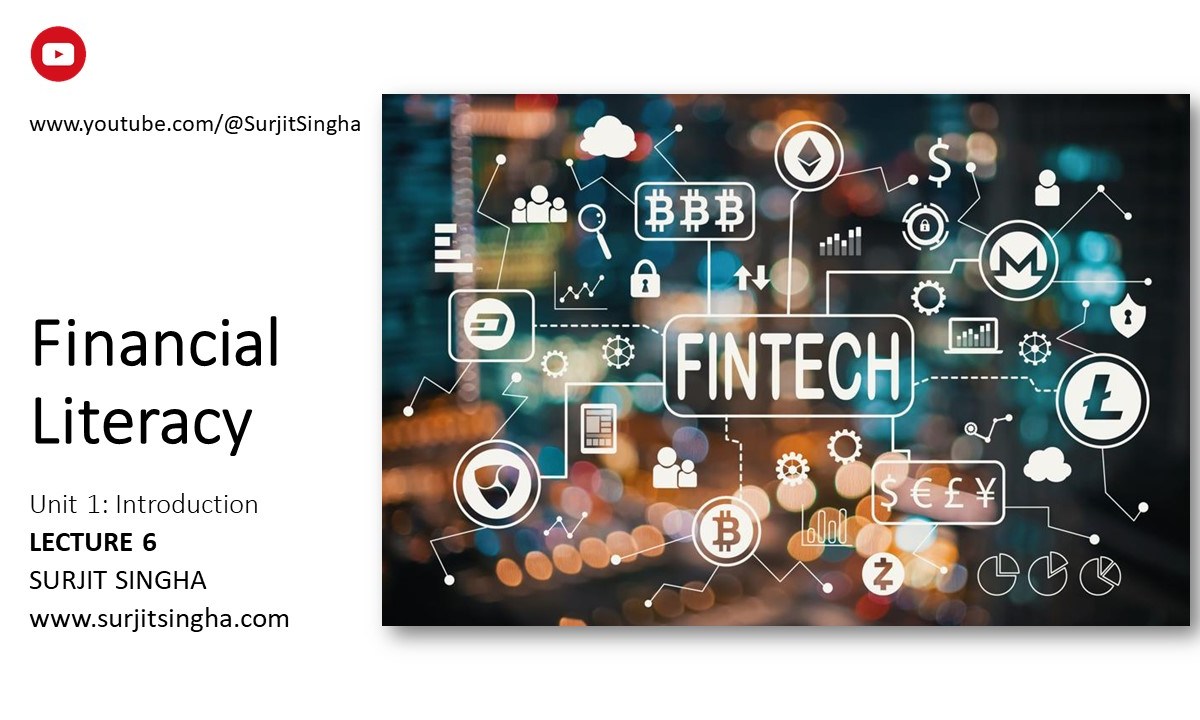
Banks and businesses are currently applying for large sums of money to invest in technology-based solutions. The rise of mobile technology and the Internet has revolutionized the way the financial sector operates. Fintech, which continues to be on the horizon, is setting new trends in delivering innovative products and services in the financial sector. Fintech has created a big market by utilizing creative technology to improve traditional financial services such as capital markets, insurance, money transfer and payments, security, compliance, asset management, and data analytics, among others.

Mobile app-based services:

  • Digital lending and credit.
  • Mobile app banking.
  • Digital wallet.
  • Personal financial services.
  • Online trading.
  • Insurtech.

Tech infrastructure services:

  • Banking as a service.
  • Blockchain.
  • Robo advisors.
  • Payment gateways.
  • Regtech.

NEED OF AVAILING OF FINANCIAL SERVICES.

Financial services are a part of the financial system people and businesses can obtain financial services from the financial service sectors. This sector of the economy includes a wide range of financial institutions, such as banks, investment businesses, lenders, financial companies, real estate agents, and insurance companies. Financial services are necessary for a country’s economy to function. Individuals with money to save may have difficulty locating others who need to borrow without them, and vice versa. People would be so focused on saving to cover risk if financial services were unavailable that they might not buy as many products and services.

NEED FOR BANKING SERVICES.

The bank’s name is usually visible when you look at a cheque or debit card. Customers commonly use many financial services issued and regulated by individual banks. Banks can provide depositors access to their funds while simultaneously retaining many loans.

In the financial system and the economy, banks play a critical role. Banks, as a vital component of the financial system, efficiently allocate cash from savers to borrowers. Therefore, specialist financial services lowered the cost of acquiring information about saving and borrowing options. These financial services contribute to the overall efficiency of the economy.

  1. Encourage savings: banks encourage people’s habits of saving, which makes money available for productive uses.
  2. Connect savers and borrowers: banks act as a bridge between persons with excess funds and those who require funds for various commercial purposes.
  3. Facilitate business transactions: business transactions are facilitated by banks using checks instead of money for receipts and payments. Customers can move funds from one account to another via checks, drafts, and other methods provided by banks.
  4. Source to funds: banks provide short and long-term blondes in advances to business owners and individuals. Bank contributes to improving people’s living standards by offering loans to purchase consumer durable goods, residences, automobiles, and other items.
  5. Consultancy: modern banks fund their operations while providing consulting services to customers. They do this by hiring legal, financial, and market leaders and experts who can advise customers on the industry, income, trade, and investment issues.

 In today’s world, banks provide a wide range of services. This is done to attract a large number of customers. Banks, on the other hand, provide some essential services. As a result, all banks offer these vital services.

U1 L5 Financial Literacy

LECTURE 5

Functions of an Insurance Company[1].

1] Provides Reliability.

Insurance’s primary function is eliminating the uncertainty of an unexpected and sudden financial loss. This is one of the biggest worries of a business. Instead of this uncertainty, it provides the certainty of regular payment, i.e., the premium to be paid.

 2] Protection.

Insurance does not reduce the risk of loss or damage that a company may suffer. But it provides protection against such loss that a company may suffer. So at least the organization does not suffer financial losses that debilitate their daily functioning.

 3] Pooling of Risk.

In insurance, all the policyholders pool their risks together. They all pay their premiums, and if one suffers financial losses, the payout comes from this fund. So, the risk is shared between all of them.

 4] Legal Requirements.

In many cases, getting some form of insurance is required by the law of the land. For example, when goods are in freight or when you open a public space getting fire insurance may be a mandatory requirement. So, an insurance company will help us fulfil these requirements.

 5] Capital Formation.

The pooled premiums of the policyholders help create capital for the insurance company. This capital can then be invested in productive purposes that generate income for the company.

POST OFFICES[2].

A post office is a public facility and a retailer that provides mail services, such as accepting letters and parcels, providing post office boxes, and selling postage stamps, packaging, and stationery. Post offices may offer additional services, which vary by country. These include providing and accepting government forms (such as passport applications), and processing government services and fees (such as road tax, postal savings, or bank fees). The chief administrator of a post office is called a postmaster.

 Before the advent of postal codes and the post office, postal systems would route items to a specific post office for receipt or delivery. During the 19th century in the United States, this often led to smaller communities being renamed after their post offices, particularly after the Post Office Department began to require that post office names not be duplicated within a state.

India Post[3].

India Post is a government-operated postal system in India, part of the Department of Post under the Ministry of Communications. Generally known as the Post Office, it is the world’s most widely distributed postal system. Warren Hastings had taken the initiative under East India Company to start the Postal Service in the country in 1766. It was initially established under the name “Company Mail”. It was later modified into service under the Crown in 1854 by Lord Dalhousie. Dalhousie introduced uniform postage rates (universal service) and helped to pass the India Post Office Act 1854, which significantly improved upon the 1837 Post Office act which introduced regular post offices in India. It created the position of Director General of Post for the whole country.

 It is involved in delivering mail (post), remitting money by money orders, accepting deposits under Small Savings Schemes, providing life insurance coverage under Postal Life Insurance (PLI) and Rural Postal Life Insurance (RPLI) and providing retail services like bill collection, sale of forms, etc. The DoP also acts as an agent for the Indian government in discharging other services for citizens, such as old age pension payments and Mahatma Gandhi National Rural Employment Guarantee Scheme (MGNREGS) wage disbursement. With 154,965 post offices (as of March 2017), India Post is the widest postal network in the world.

 The country has been divided into 23 postal circles, each circle headed by a Chief Postmaster General. Each circle is divided into regions, headed by a Postmaster General and comprising field units known as Divisions. These divisions are further divided into subdivisions. In addition to the 23 circles, there is a base circle to provide postal services to the Armed Forces of India headed by a Director General. One of the highest post offices in the world is in Hikkim, Himachal Pradesh, operated by India Post at an altitude of 14,567 ft (4,440 m).


[1] https://www.toppr.com/guides/business-studies/business-services/insurance/

[2] https://en.wikipedia.org/wiki/Post_office

[3] https://en.wikipedia.org/wiki/India_Post

U1 L4 Financial Literacy

LECTURE 4

FINANCIAL INSTITUTIONS

Banks[1]

A bank is a financial institution licensed to receive deposits and make loans. Banks may also provide financial services such as wealth management, currency exchange, and safe deposit boxes. There are several different kinds of banks, including retail banks, commercial or corporate banks, and investment banks. In most countries, banks are regulated by the national government or central bank.

Banks are essential to the economy because they provide vital services for consumers and businesses. As financial services providers, they give you a safe place to store your cash. Through various account types, such as checking and savings accounts and certificates of deposit (CDs), you can conduct routine banking transactions like deposits, withdrawals, check writing, and bill payments. You can also save your money and earn interest on your investment.

Banks also provide credit opportunities for people and corporations. The bank lends the money you deposit at the bank—short-term cash—to others for long-term debt such as car loans, credit cards, mortgages, and other debt vehicles. This process helps create liquidity in the market—which makes money and keeps the supply going.

 Like any other business, the goal of a bank is to earn a profit for its owners. For most banks, the owners are their shareholders. Banks do this by charging more interest on the loans and other debt they issue to borrowers than what they pay to people who use their savings vehicles. For example, a bank that pays 1% interest on savings accounts and charges 6% interest for loans earns a gross profit of 5% for its owners.

Non-Banking Financial Institutions[2]

A non-banking financial institution (NBFI) is a financial institution that does not have a full banking license and cannot accept deposits from the public. However, NBFIs facilitate alternative financial services, such as investment (collective and individual), risk pooling, financial consulting, brokering, money transmission, and check cashing. NBFIs are a source of consumer credit (along with licensed banks). Examples of non-bank financial institutions include insurance firms, venture capitalists, currency exchanges, some microloan organizations, and pawn shops. These non-bank financial institutions provide services that are not necessarily suited to banks, serve as competition to banks, and specialize in sectors or groups.

INSURANCE COMPANIES[3]

The insurance sector is made up of companies that offer risk management in the form of insurance contracts. The basic concept of insurance is that one party, the insurer, will guarantee payment for an uncertain future event. Meanwhile, another party, the insured or the policyholder, pays a smaller premium to the insurer in exchange for that protection on that uncertain future occurrence.

Types of Insurance Companies

Not all insurance companies offer the same products or cater to the same customer base. Among the largest categories of insurance companies are accident and health insurers, property and casualty insurers, and financial guarantors. The most common personal insurance policies are auto, health, homeowners, and life.

Life insurance companies mainly issue policies that pay a death benefit as a lump sum upon the death of the insured to their beneficiaries. Life insurance policies may be sold as term life, which is less expensive and expires at the end of the term, or permanent (typically whole life or universal life), which is more expensive but lasts a lifetime and carries a cash accumulation component. Life insurers may also sell long-term disability policies that replace the insured’s income if they become sick or disabled.

Businesses require special insurance policies that insure against specific risks faced by a particular business. For example, a fast-food restaurant needs a policy that covers damage or injury resulting from cooking with a deep fryer. An auto dealer is not subject to this type of risk but does require coverage for damage or injury that could occur during test drives.

Some companies engage in reinsurance to reduce risk. Reinsurance is insurance that insurance companies buy to protect themselves from excessive losses due to high exposure. Reinsurance is an integral component of insurance companies’ efforts to keep themselves solvent and avoid default due to payouts, and regulators mandate it for companies of a specific size and type.

For example, an insurance company may write too much hurricane insurance based on models that show low chances of a hurricane inflicting a geographic area. If the inconceivable did happen with a hurricane hitting that region, considerable losses for the insurance company could ensue. Without reinsurance taking some of the risks off the table, insurance companies could go out of business whenever a natural disaster hit.

Types of Insurance Companies in India

  1. Life insurance companies: Life insurance is a contract between an insurer and a policy owner. A life insurance policy guarantees the insurer pays a sum of money to named beneficiaries when the insured dies in exchange for the premiums paid by the policyholder during their lifetime. To enforce the contract, the life insurance application must accurately disclose the insured’s past and current health conditions and high-risk activities.[4]
  2. General insurance companies:

Definition: Insurance contracts that do not come under life insurance are called general insurance. The different forms of general insurance are fire, marine, motor, accident and other miscellaneous non-life insurance.

 Description: The tangible assets are susceptible to damages, and a need to protect the economic value of the assets is needed. For this purpose, general insurance products are bought as they provide protection against unforeseeable contingencies like damage and loss of the asset. Like life insurance, general insurance products come at a price in the form of a premium.


[1] https://www.investopedia.com/terms/b/bank.asp

[2] https://www.worldbank.org/en/publication/gfdr/gfdr-2016/background/nonbank-financial-institution

[3] https://www.investopedia.com/ask/answers/051915/how-does-insurance-sector-work.asp

[4] https://www.investopedia.com/terms/l/lifeinsurance.asp

U1 L3 Financial Literacy

LECTURE 3

PREREQUISITES OF FINANCIAL LITERACY – LEVEL OF EDUCATION, NUMERICAL AND COMMUNICATION ABILITY.

Financial literacy will assist you in accumulating wealth, attaining goals, safeguarding oneself in the event of an emergency, securing the future of one’s family, and making retirement plans, allowing you to live a stress-free life. Financially educated is not just knowing the facts about money but also taking the appropriate procedures to achieve the desired financial goals. If you acquire the following essential knowledge and skills to make intelligent decisions with your money, you will improve your financial awareness over time.

  1. Financial Knowledge.

Compared to a generation before, today’s financial world is highly complex. The simple understanding of how to keep it current in the savings account metal local bank or savings institution may have been enough for financial activities 40 years ago. Consumers should now be able to distinguish between a wide range of financial products and services and the provider of those products and services. Previously, the less indebted generation may not have required a complete awareness of credit features such as compound interest, the consequences of mismanaging credit accounts, etc. There is a need to raise consumer knowledge about the necessity of financial knowledge and how to obtain it. Financial knowledge is essential for everyone, not just investors. It is equally crucial, if not more so, for the average family attempting to balance their budget and save for their children’s education and their parent’s retirement. Through problem-solving, critical thinking, and an awareness of essential financial facts and concepts, financial knowledge and decision-making skills assist people in making educated financial decisions. The following are the crucial components of financial expertise.

  1. Level of education: Although financial knowledge varies with education and income, highly educated individuals with high incomes can be just as ignorant about economic issues as less educated, lower-income consumers. Furthermore, individuals regard financial decision-making and education as complicated and anxious. Take the initiative to self-educate and grow with your financial knowledge by beginning with the basics of money management and maturing into a wise spender.
  2. Understanding financial markets: It’s a direct relationship between financial education and financial market participation. Financial significantly improves stock market participation and increases involvement in saving schemes. Economic market activities directly impact individual wealth, business actions, and the efficiency of our economy. The bond market, the stock market and the foreign exchange market knowledge are essential.
  3. Investment opportunities: Awareness of investment opportunities and financial instruments is integral to financial knowledge. Investing is essential for long-term financial security. Poor decisions can result in the loss of hard-earned funds. As a result, you will require financial expertise and a prudent plan. Working, either as an employee or as a business owner, is one way to make money. Investing in another option to make money. An investment is the purchase of an asset to produce wealth through regular income or profit from the sale of an item. Investment decisions are an essential part of financial planning.
  4. Economic environment: The word economic environment refers to all external economic factors that influence consumer behaviour and business performance and are often beyond an individual or company’s control. The knowledge of the economic environment has a direct impact on your life. Interest rates affect your savings and the payment of loans you might take out for a car or a house, and monetary policy may impact your career prospects and future commodities prices. Understanding the economic environment will expose you to many political disputes surrounding the conduct of economic policy. It will aid you in gaining a better understanding of the economic phenomena you read about in the news.
  5. Interest rates.
  6. Inflation.
  7. Tax rates.
  • Financial Skills.

Financial skills are abilities required to perform critical financial decisions. Financial skills are needed to promote financial self-sufficiency, stability and well-being. Acquiring these skills requires a basic understanding of financial concepts such as savings, investing, and debt, which leads to an overall sense of economic well-being and self-trust. Lacking the knowledge of these skills leads to financial illiteracy. These skills include:

  1. Budgeting: Making a budget is vital in developing financial literacy skills because it allows you to understand your income and expenses accurately. Once you’ve established the budget, you can keep track of your spending and evaluate your spending plan regularly. Thus, budgeting is an essential financial skill that aids in planning and managing money. Budgeting helps in the planning of short-term, medium-term, and long-term expenses. It enables people to save appropriately.
  2. Financial planning: Financial planning is the long-term process of properly managing your finances to assist you in achieving your goals and dreams while working through the financial obstacles that inevitably come at every stage of life. It is important to remember that financial planning is a process, not a product. Financial planning skills refer to the acquisition of competencies that serve as a guide as you journey through life. It essentially aids you in maintaining control over your income, expenses, and investment so that you may manage your partnership and reach your goals.
  3. Using financial tools: Financial tools are applications designed to calculate, estimate and interpret economic variables such as return and risk. Financial tools aid in evaluating investments, budgets, borrowing options and other potential related transactions to determine their performance and suitability; understanding your financial situation, whether personal or business-related, is critical to financial success. The proper financial analysis tool and techniques can assist you in understanding the risk and return of financial investment or selecting the best financial services.
  4. Numerical skills: You don’t need to be a mad genius. The confidence and ability to add, subtract, multiply, divide and use decimals, fractions, and end percentages are essential. As a result, basic numeracy skills have their multiplication and division, as well as decimals complexities, fractions, and negative numbers, which are critical for making basic financial judgments. To accomplish various numerical activities, a financial literate should be able to use both mental calculations and the calculator.
  5. Communication skills: Even though the financial healthcare series revolves around knowledge of managing money, using essential financial tools with the help of mathematics and financial variables. Nonetheless, so-called soft skills are required to be financially successful. Financial literate must be able to communicate and gain knowledge with strong speaking, writing and presentation skills.
  • Financial Etiquette:

Money and manners are a difficult combination to achieve. You don’t want to come out as cheap, ungrateful, or disrespectful, but you also don’t want to get angry or lose a relationship. Thus, financial etiquette is a set of behaviour expected or required to become financial literate.

  1. Sharing confidential financial data: advice such as it is nice to share and sharing is caring is frequently mentioned in conversations, especially when spending time with family and friends. While this may be true in some cases, it is not always the case regarding financial information. While sharing has its advantages, there are five things you should never share with anyone.
  2. Credit card details.
  3. CVV number: card verification value.
  4. Passwords.
  5. PIN: personal identification number.
  6. OTP: one-time password.
  7. Gifting: when we die, we leave behind everything we are on the planet. We do not take anything with us. Even wealthier people cannot take their money with them when they die. Individuals who have acquired considerable wealth will require throughout their lifetimes must leave some of their wealth to family, friends, and charitable causes.
  8. Spending: some people experience financial difficulties due to not earning enough money. On the other hand, many others have a problem because they do not spend their money sensibly or more than they earn. At the same time, many people dedicate most of their time and attention to making more money. They should be aware that without understanding the art of spending, there may not be able to build a prosperous future.
  9. Tax payment: many of us want to avoid circumstances where we have to pay taxes since it is a human tendency to avoid paying taxes. Even when tax rates are lower, our country, in contrast to other modern nations, lacks the desired tax culture. Income tax is one of the most important sources of revenue for the Indian government. If people begin to perceive Income Tax as a burden and avoid paying it, the growth of our nation will suffer, as would social breakdown. Filling your taxes demonstrates that you are a responsible citizen. Filing income tax forms on time allows you to be a good citizen, contribute to India’s prosperity, and provide Peace of Mind for you and your family.

U1 L2 Financial Literacy

LECTURE 2

IMPORTANCE OF FINANCIAL LITERACY[1]

Learning financial literacy has the following benefits:

1 – Personal Financial Planning and Management

Individuals who gain financial knowledge develop various sources of income. They prepare a monthly budget and borrow carefully. Financial knowledge ensures diligent financial management—enough savings for a rainy day.

2 – Identify Fake Schemes

Contemporarily, financial fraud is rising—chit funds, pyramid schemes, Ponzi schemes, carding, etc. A financially literate person will evade shady schemes. It is the perfect antidote to get-rich-quick schemes. 

3 – Spread Investment Awareness

Financial education does not occur in a vacuum. It is not an isolated incident. Educating one individual creates a chain reaction. Such an individual would make efforts to educate family, friends, students, colleagues, etc. A financially literate individual may conduct seminars, teach in colleges, write articles and books, mentor students, etc.

Everyone is interested in finance; everyone is a stakeholder. Therefore, financial literacy is a movement; “FIRE” is a good example.

4 – Succession Planning

It is often said that the poor plan for Saturday night whereas the rich plan for three generations. By being financially prudent, individuals impart valuable knowledge to their children. Moreover, they plan their succession and leave sufficient money for their successors.

5 – Refrains from Herd Mentality

The financially literate don’t follow random public opinion. They get to the bottom of every financial trend. They are more immune to incorrect market speculation. They make cautious investors, but in the long run, the profits add up.

6 – Financial Planning and Decision Making

Setting up an emergency fund and a retirement plan is very important—the earlier, the better.

Financial Literacy Example

Let us assume that both Jacob and Esau earn $6000 every month. Jacob is financially literate and, therefore, allocates his salary as follows:

Spending = $3700.

Investing in Mutual Funds = $1000.

Emergency Fund = $500.

Savings Account = $800.

At the end of the year, Jacob invests $12,000 in mutual funds and $9,600 into his savings account. On average, the total appreciation of the money in mutual funds was 13%, i.e., $1,560, and the savings account yielded an interest of $360.

On the other hand, Esau doesn’t have any financial knowledge and thus spends impulsively without any planning. He leaves the remainder in his salary account—it returns very low interest. Consequentially, Esau spent money on unnecessary items and ran out of cash.

SCOPE OF FINANCIAL LITERACY.

The intellectual understanding of financial concepts and skills such as budgeting, investing, borrowing, taxation, and personal financial planning is referred to as financial literacy. Lacking the knowledge of these skills leads to financial illiteracy. Financial illiteracy results in budget inaccuracy, higher expenses than income, debt accumulation, a poor credit score, financial fraud victim, and other undesirable repercussions. The purpose of financial literacy is to assist people in better understanding financial concepts so that they can better manage their money. It is a life skill that must be mastered in order to be financially successful.

Being financially literate provides a variety of benefits that can improve an individual’s standard of living by increasing financial security. It aids in the betterment of personal financial management. Personal finance is a process which involves the acquisition, practice, and application of a wide range of financial skills. The scope of financial literacy encompasses a wide range of skills.

Scope of Financial Literacy:[2]

Managing IncomeManaging ExpensesManaging DebtCreate SavingInvestingTax PlanningHealthy Credit Score
  1. Managing Income: A human being’s basic necessities are food, shelter, and clothes. How can we meet these essential requirements? We need to buy food, clothing, and a place to live (house). We need money to buy anything. From where are we going to acquire this money?

The term ‘income’ refers to the amount of money that comes into the household in the form of earnings. This money could come from a variety of sources. Salary from a job, part-time jobs, rent from a house or shop, bank interest, or the sale of shares and other investments are all examples of sources of income. It could also be a profit from your household produce or from the use of your abilities. To ensure some savings, the expenditure must be lower than the income. You must plan your spending in order to stay inside your budget. This is called as ‘managing income,’ and it means spending intelligently so that all of your demands are covered. You will need to create a ‘spending plan’ for this.

  • Managing Expenses: Expenditure refers to the money we spend from our earnings to acquire various items to meet our requirements. Income brings money into a household, whereas expenditure takes money away, making it unavailable for other users. Managing expenses is a disciplined approach to spending income. It is based on an individual’s or family’s overall income. It enables an individual or family to live within their income while simultaneously saving for future needs and emergencies. The general rule for managing income and expenses is that income must exceed expenses. We are more likely to spend more than we have if we do not develop a budget plan. As a result, if our expenditure exceeds our income, we may be forced to borrow money to meet our demands. As a result, distinguishing between necessary and unnecessary expenses will keep a person from drowning in debt.
  • Managing Debt: Debt is nothing but borrowed money. In other words, it is money that does not belong to you. For example, if a person borrows money from a bank, uses a credit card, or takes out a short-term loan. All of this is added to the debt. Debt is generally regarded as bad. As a result, knowing debt is critical. However, not everyone can afford to buy a house, a car, or pay a college fee in cash. Borrowing a loan is the only way out in such situations. The most crucial thing is to distinguish between good and bad debt. Furthermore, avoiding bad debt as much as feasible is always preferable. This covers the fundamentals of managing debt. Borrowing money for things essential for a living is considered good debt. For example, purchasing a home or paying for a college fee. On the other hand, bad debt is borrowing money for needless expenses. For example, using a credit card to purchase luxury clothing or electronic devices.
  • Creating Saving: a portion of an individual or a family’s income should also be set aside for future use. This money is set aside is regarded as savings, and it can be utilized for any purpose in the future. Savings and shorts financial security, a secure present and a bright future he stopped long term wealth can be built through prudent financial planning. It is possible to save money by keeping track of one spending patterns a result of Saving; one can easily accomplish the following:
  • Instil financial discipline: One can attain financial discipline in excel in life by saving money regularly.
  • Complete financial goals: Financial goals are targets you hope to achieve over a set period using your financial resources. For example, buying a house, a kid’s education, and retirement savings.
  • Create an emergency fund: An emergency fund serves as a safety net in the event of unforeseen circumstances. At least six months’ worth of income should be saved in the fund.
  • Investing: Rather than keeping money in a bank account, it can be diverted to investment avenues. Investing is about creating and growing wealth so you can live a secure and happy life. Saving money is not difficult if done systematically. After executing effective budgeting, any surplus should be channelized toward investing. Investing will help individuals achieve their financial goals like buying a house, child education, marriage, and planning. It’s all about investing in a strategy that will help you earn substantial profits over time. The investment will assist in the generation of additional monthly income as well as considerable benefits. It is also possible to attain financial goals while allocating funds to retirement savings. Equities, debt instruments, mutual funds, real estate, and gold or some of the most popular investment options.
  • Tax Planning: Taxes can significantly reduce your annual earnings. On the other hand, tax planning is a legitimate way of decreasing your tax payment in any particular financial year. It assists you in making the best use of the text as exemptions, deductions, and perks provided by the government to reduce your burden. Tax planning is the process of saving money by lowering your tax liability. The Income Tax Act of 1961 contains a number of provisions that allow you to claim deductions and save money on taxes. Aside from investing alternatives, there are several additional expenses for which you can claim a deduction. This includes tuition for up to two children, house loan repayment, health insurance premiums, medical payments for specified conditions, contributions, and so on. Tax planning is essential if you want to make the most of what the government has to offer. Tax planning aids in the smooth operation of the financial planning processes. Tax planning aids in the allocation of taxable income to various investment schemes. Tax saving is a long-term effort, and tax planning and investment are many closely linked.
  • Healthy Credit Score: A credit score measures a person’s ability to repay a debt. It’s a numerical representation of their creditworthiness. It is typically expressed as a number based on the individual’s payback history and credit files across various loan and credit agencies. The credit bureaus determine a credit score based on a proprietary formula. When generating a credit score, they analyze various characteristics such as credit history and payback behaviour, among others. A credit score ranges from 300 to 900 points; if your credit score is between 750 to 900, it is regarded as good for availing of credit services such as loans and credit cards.

[1] Vaidya, D. (n.d.). Wall Street Mojo. Financial Literacy. Retrieved July 23, 2022, from https://www.wallstreetmojo.com/financial-literacy/

[2] Umair, M., & V, B. (2021). Financial Literacy (pp. 7-10). Mumbai, India: Himalaya Publishing House.