L7-U1-BE

L7

Micro and Macro Economics.

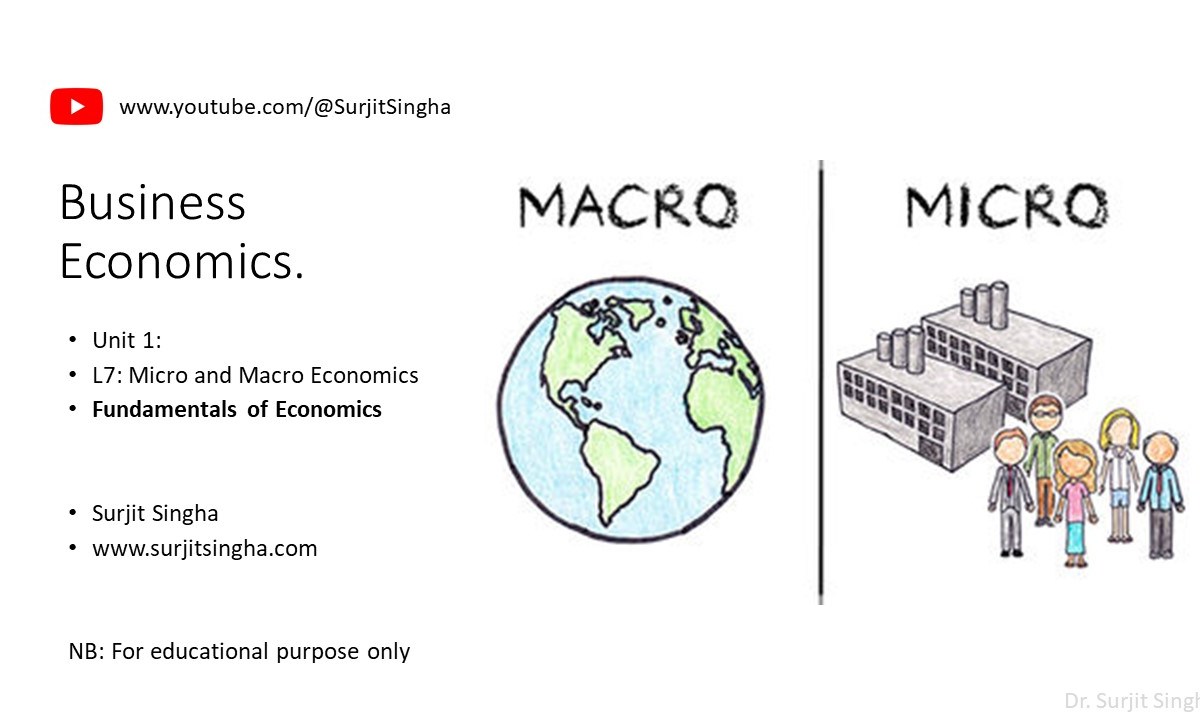
Micro Economics talks about the actions of an individual unit, i.e. an individual, firm, household, market, industry, etc. On the other hand, the Macro Economics studies the economy as a whole, i.e. it assesses not a single unit but the combination of all i.e. firms, households, nation, industries, market, etc.

BASIS FOR COMPARISONMICROECONOMICSMACROECONOMICS
MeaningThe branch of economics that studies the behavior of an individual consumer, firm, family is known as Microeconomics.The branch of economics that studies the behavior of the whole economy, (both national and international) is known as Macroeconomics.
Deals withIndividual economic variablesAggregate economic variables
Business ApplicationApplied to operational or internal issuesEnvironment and external issues
ToolsDemand and SupplyAggregate Demand and Aggregate Supply
AssumptionIt assumes that all macro-economic variables are constant.It assumes that all micro-economic variables are constant.
Concerned withTheory of Product Pricing, Theory of Factor Pricing, Theory of Economic Welfare.Theory of National Income, Aggregate Consumption, Theory of General Price Level, Economic Growth.
ScopeCovers various issues like demand, supply, product pricing, factor pricing, production, consumption, economic welfare, etc.Covers various issues like, national income, general price level, distribution, employment, money etc.
ImportanceHelpful in determining the prices of a product along with the prices of factors of production (land, labor, capital, entrepreneur etc.) within the economy.Maintains stability in the general price level and resolves the major problems of the economy like inflation, deflation, reflation, unemployment and poverty as a whole.
LimitationsIt is based on unrealistic assumptions, i.e. In microeconomics it is assumed that there is a full employment in the society which is not at all possible.It has been analyzed that ‘Fallacy of Composition’ involves, which sometimes doesn’t proves true because it is possible that what is true for aggregate may not be true for individuals too.


L6-U1-BE

L6

Positive Economics & Normative Economics.

Definition of Positive Economics.

Positive Economics is a branch of economics that has an objective approach, based on facts. It analyses and explains the casual relationship between variables. It explains people about how the economy of the country operates. Positive economics is alternatively known as pure economics or descriptive economics.

When the scientific methods are applied to economic phenomena and scarcity related issues, it is positive economics. Statements based on positive economics considers what’s actually occurring in the economy. It helps the policy makers to decide whether the proposed action, will be able to fulfil our objectives or not. In this way, they accept or reject the statements.

Definition of Normative Economics.

The economics that uses value judgments, opinions, beliefs is called normative economics. This branch of economics considers values and results in statements that state, ‘what should be the things’. It incorporates subjective analyses and focuses on theoretical situations.

Normative Economics suggests how the economy ought to operate. It is also known as policy economics, as it considers individual opinions and preferences. Hence, the statements can neither be proven right nor wrong.

Example.[1]

Country A is experiencing labor unrest over the minimum wage. In this situation, Normative economics will give a value judgment on why the proposed minimum wage should be approved or otherwise, using the “what should have been” or “what ought to be” approach.

Positive economics, on the other hand, would describe the economic situation and explain the proposed increment in minimum wage backing it up with facts, verifiable data, actual numbers, and empirical research.


[1] https://thebusinessprofessor.com/en_US/economic-analysis-monetary-policy/positive-economics-definition

L5-U1-BE

L5

Scarcity.

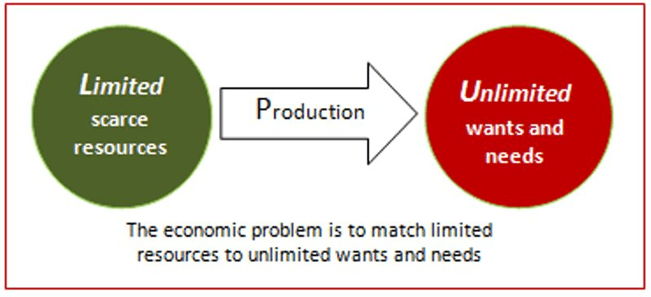
The purpose of production is to satisfy one’s ‘want’, but as the resources are limited, not enough output is available to fulfil every man’s wants. This explains that human wants are unlimited and are not fulfilled by limited resources, as stated by the Law of scarcity.

This chart shows how the Law of scarcity arises.

The demand is high compared to the supply, and satisfaction is not achieved due to insufficient resources. To overcome this, the choice is made available to man to allocate their resources to achieve maximum satisfaction.

For instance, if a man walks into a grocery store with ₹500, he would buy products in a way that when he walks out, the products with him would equal the value of ₹500. He might want food grains, toiletries, milk, cooking essentials, etc. but would allocate the money available to him so that he attains maximum satisfaction from his purchase.

Choices.

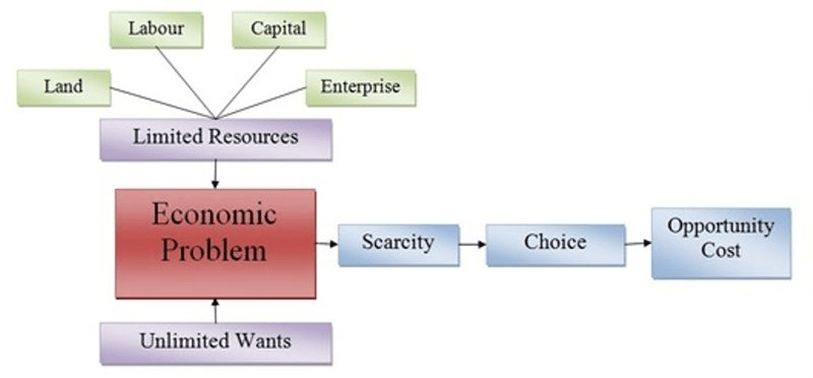
Scarcity gives rise to the economic problem of choice. With limited resources, the choice is given to decide what one wishes to get by sacrificing one of its demands. When the choice is made, there is sacrifice involved in it. The decision to consume a product also means not consuming another. One product can only be consumed by giving up something in exchange. Opportunity Cost refers to the cost of sacrifice that is done to choose the next best alternative.

To Exemplify, a farmer has 10 acres of land; he has a choice to either grow wheat or cotton on it. The limited land is a scarcity of the resource. The alternative crops, wheat and cotton, show how we have choices. To grow one of the two crops, the other crop’s production has to be sacrificed; this is the opportunity cost involved.

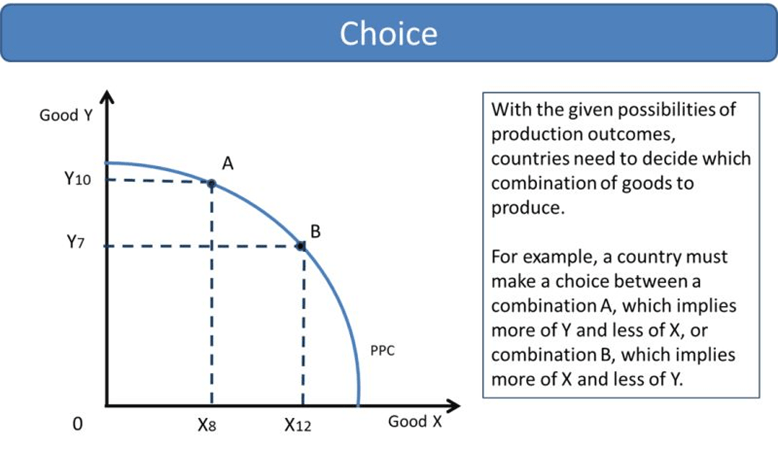
The production Possibility Curve (PPC) gives a graphical representation of how two alternatives can be combined to achieve maximum satisfaction.

The PPC curve shows how more product X means less product Y.

The PPC curve shows different possible points for attaining satisfaction. Points A and B give two different combinations. At point A, X8 and Y10 goods are produced, and at point B X12 and Y7 goods are produced. To produce more of product X, Product Y is to be produced less; this is seen at point B, X12 goods are produced only when good Y is decreased to Y7. This shows that more and more of good X is to be produced only when good Y is sacrificed at its place. A choice needs to be made as to what amount of a particular good can be produced to get the maximum satisfaction from the available resources.

L4-U1-BE

L4

The Economic Problem-Scarcity and Choice.[1]

Economy is derived from two Greek words which mean house and distribute. Economy was studied to understand the management of a household that later started being used to manage resources.

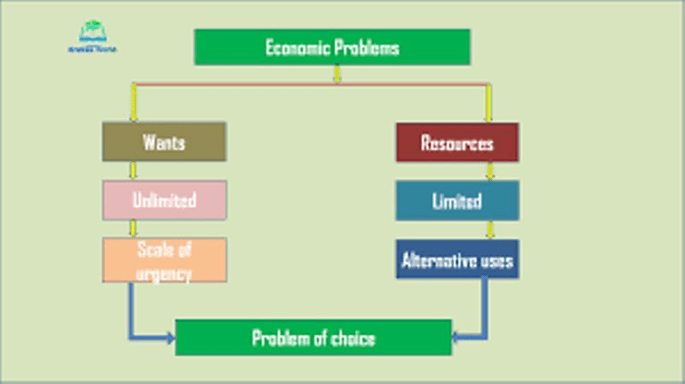
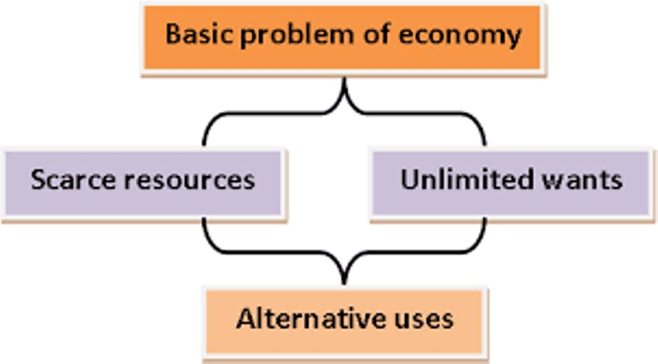
The chart shows the basic problem of the economy.

The basic problem of an economy deals with a man’s unlimited needs and wants and scarce resources. The resources include the production factors: land, labour, capital and entrepreneurship.

The factors of production.

Economics is the social science that studies how people use their scarce resources to satisfy unlimited needs and wants. From a teenager to a homemaker and then to a businessman, all face the same issue of how to spend their income to attain maximum satisfaction.


[1] https://studiousguy.com/the-economic-problem-scarcity-and-choice/

L3-U1-BE

L3

Importance of Business Economics.[1]

Business economics plays an important role in decision making in an organization. Decision making is a process of selecting the best course of action from the available alternatives.

The following points explain the importance of business economics:

Business economics covers various important concepts, such as Demand and Supply analysis; Short run cost and Long run costs; and Law of Diminishing Marginal Utility. These concepts support managers in identifying and analyzing problems and finding solutions.

Business economics helps in establishing relationships between different economic factors, such as income, profits, losses, and market structure. This helps in guiding managers in effective decision making and running the organization.

Difference Between Economics and Business Economics.

  • Economics is a traditional subject that has prevailed from a long time.
  • Business economics is a modern concept and is still developing.
  • Economics mainly covers theoretical aspects.
  • Business economics covers practical aspects.
  • In economics, the problems of individuals and societies are studied.
  • In Business economics, the main area of study is the problems of organizations.
  • In economics, only economic factors are considered.
  • In business economic, both economic and no-economic factors are considered.
  • Both microeconomics and macroeconomics fall under the scope of economics.
  • Only microeconomics falls under the scope of business economics.
  • Economics has a wider scope and covers the economic issues of nations.
  • Business economics is a part of economics and is limited to the economic problems of organizations.

Limitations of Business Economics/Managerial Economics.[2]

The limitations of managerial economics are listed below:

  • Business economics focuses on business analysis based on financial and costing data. The reliability of this data, therefore, depends on the accuracy of the financial accounting information.
  • This analysis is based on historical information. But things change when new systems are introduced, and conclusions cannot be predicted from this previous information. Management controls are subject to the personal preferences of individual managers, which may influence to some extent.
  • It is a costly process as the company usually needs a certain number of managers to keep it functioning properly.
  • The science of business management is relatively new and not fully developed. So, it can be ambiguous in certain scenarios.

[1] https://geektonight.medium.com/what-is-business-economics-definition-scope-importance-geektonight-5b602377ab0e

[2] https://www.vedantu.com/commerce/limitations-of-economics

L2-U1-BE

L2

5. Resource Allocation.

Business Economics uses advanced tools like linear programming to create the best course of action for an optimal utilization of available resources.

6. Theory of Capital and Investment Decisions.

Among other decisions, a firm must carefully evaluate its investment decisions an allocate its capital sensibly. Various theories pertaining to capital and investments offer scientific criteria for choosing investment projects. Further, these theories also help the firm in assessing the efficiency of capital. Business Economics assists the decision-making process when the firm needs to decide between competing uses of funds.

7. Profit Analysis.

Profits depend on many factors like changing prices, market conditions, etc. The profit theories help firms in measuring and managing profits under such uncertain conditions. Further, they also help in planning future profits.

8. Risk and Uncertainty Analysis.

Most businesses operate under a certain amount of risk and uncertainty. Also, analyzing these risks and uncertainties can help firms in making efficient decisions and formulating plans.

What is analyzing demand in Business Economics?

Options are:

A. Understanding buyer behavior

B. Deciding on the optimum size of output

C. Evaluating investment decisions

D. Measuring and managing profits

The correct answer is answer is: A. Understanding buyer behavior

What is the purpose of profit analysis in Business Economics?

Options are:

A. To determine the behavior of costs

B. To understand buyer behavior

C. To evaluate investment decisions

D. To measure and manage profits

The correct answer is answer is: D. To measure and manage profits

How does risk and uncertainty analysis help in Business Economics?

Options are:

A. By providing scientific criteria for choosing investment projects

B. By using linear programming to create the best course of action for optimal utilization of available resources

C. By analyzing risks and uncertainties to make efficient decisions and formulate plans

D. By measuring and managing profits under uncertain conditions

The correct answer is answer is: C. By analyzing risks and uncertainties to make efficient decisions and formulate plans

Demand Analysis is about understanding:

Options are:

  1. buyer income.
  2. buyer behaviour.
  3. the relationship between a buyer and seller.
  4. number of buyers certainly buying from the competitors.

The correct answer is answer is: Demand analysis is all about understanding the nature of the consumer’s preferences and the effects of the changes in the determinants of demand on them. These determinants include the price of the commodity, tastes, and preferences of consumers, consumer’s income, the price of related commodities, etc. In other words, demand analysis is about understanding buyer behavior. Therefore, the correct answer is option b.

L1-U1-BE

Business Economics

Unit 1: Fundamentals of Economics

Principles of Economics: Meaning, scope, importance & limitations-The Economic Problem-Scarcity and Choice; Nature and Scope- Positive and Normative Economics, Micro and Macro Economics; Central Problems of an Economy; Production Possibility Curve; Opportunity Cost.

L1

Introduction to Business Economics.

Business economics, also known as managerial economics, is a branch of economics that focuses on applying economic theory and analysis to solve business problems and make informed decisions. It explores the relationship between business and the economy, examining how businesses operate, compete, and thrive in the marketplace.

Business economics primarily aims to utilize economic principles to understand and predict the behaviour of businesses, markets, and consumers. It provides valuable insights and tools that help organizations effectively allocate resources, maximize profits, and optimize decision-making processes.

Business economics encompasses various topics, including demand and supply analysis, cost and production analysis, market structures, pricing strategies, risk analysis, forecasting, and business strategy formulation. It blends economic theory with practical applications, enabling managers and decision-makers to evaluate different alternatives and make rational choices in the face of uncertainty.

One of the key aspects of business economics is the concept of optimization. Businesses aim to maximize their outcomes, whether profit, market share, or customer satisfaction, by optimizing their use of resources. This involves analyzing various trade-offs and making decisions that yield the best possible results given the constraints faced by the organization.

Furthermore, business economics considers both microeconomic and macroeconomic factors. Microeconomics examines the behaviour of individual firms, consumers, and markets, while macroeconomics considers broader economic factors such as inflation, unemployment, interest rates, and government policies. Understanding the interplay between micro and macro forces is crucial for businesses to navigate the complex and dynamic economic environment.

Business economics provides a framework for understanding the economic forces that shape business decisions and outcomes. It equips managers with analytical tools and insights to make informed choices, optimize resource allocation, and enhance overall business performance. By incorporating economic principles into their decision-making processes, businesses can gain a competitive edge and adapt to the ever-changing business landscape.

Business Economics.[1]

Business economics is a field of applied economics that studies the financial, organizational, market-related, and environmental issues faced by corporations.

Business economics assesses certain factors impacting corporations—business organization, management, expansion, and strategy—using economic theory and quantitative methods. Research topics in the field of business economics might include how and why corporations expand, the impact of entrepreneurs, interactions among corporations, and the role of governments in regulation.

Understanding Business Economics.

In the broadest sense, economics refers to the study of the components and functions of a particular marketplace or economy—such as supply and demand—and the impact of the concept of scarcity. Within economics, production factors, distribution methods, and consumption are important subjects of study. Business economics focuses on the elements and factors within business operations and how they relate to the economy as a whole.

The field of business economics addresses economic principles, strategies, standard business practices, the acquisition of necessary capital, profit generation, the efficiency of production, and overall management strategy. Business economics also includes the study of external economic factors and their influence on business decisions such as a change in industry regulation or a sudden price shift in raw materials.

The Scope of Business Economics.[2]

1. Analyzing Demand and Forecasting.

Analyzing demand is all about understanding buyer behavior. It studies the preferences of consumers along with the effects of changes in the determinants of demand. Also, these determinants include the price of the good, consumer’s income, tastes/ preferences, etc.

Forecasting demand is a technique used to predict the future demand for a good and service. Further, this prediction is based on the past behavior of factors which affect the demand. This is important for firms as accurate predictions help them produce the required quantities of goods at the right time.

Further, it gives them enough time to arrange various factors of production in advance like raw materials, labor, equipment, etc. Business Economics offers scientific tools which assist in forecasting demand.

2. Production and Cost Analysis.

A business economist has the following responsibilities with regards to the production:

  • Decide on the optimum size of output based on the objectives of the firm.
  • Also, ensure that the firm does not incur any undue costs.

By production analysis, the firm can choose the appropriate technology offering a technically efficient way of producing the output. Cost analysis, on the other hand, enables the firm to identify the behavior of costs when factors like output, time period, and the size of plant change. Further, by using both these analyses, a firm can maximize profits by producing optimum output at the least possible cost.

3. Inventory Management.

Firms can use certain rules to reduce costs associated with maintaining inventory in the form of raw materials, work in progress, and finished goods. Further, it is important to understand that the inventory policies affect the profitability of a firm. Hence, economists use methods like the ABC analysis and mathematical models to help the firm in maintaining an optimum stock of inventories.

4. Market Structure and Pricing Policies.

Any firm needs to know about the nature and extent of competition in the market. A thorough analysis of the market structure provides this information. Further, with the help of this, firms command a certain ability to determine prices in the market. Also, this information helps firms create strategies for market management under the given competitive conditions.

Price theory, on the other hand, helps the firm in understanding how prices are determined under different kinds of market conditions. Also, it assists the firm in creating pricing policies.


[1] https://www.investopedia.com/terms/b/business-economics.asp

[2] https://www.toppr.com/guides/business-economics/introduction-to-business-economics/scope-of-business-economics/
U1 L6 FMI

L6

Phase of financial sector reforms.[1]

The first phase, also known as first generation reform. Financial sector reforms start its works in the early 1990s, by which the Indian economy has achieved high growth in an environment of macro-economic and financial stability. The period has been marked by broad based economic reform that has touched every segment of the economy. These reforms were designated essentially to promote greater efficiency the economy through promotion of greater. In this phase the health of financial sector has recorded very significant improvement.

The main objective of the financial sector reforms in India was to create an efficient, productive and profitable financial services industry. Narasimham committee view that in this phase that the objective of financial sector reforms in India should not focus on correcting the present financial weakness but should strive to eliminate the roots of the cause of the present challenges faced by the Indian market economy.

Second Generation reforms.

Second generation reforms or the second phase of the reforms commenced in the mid-1990s and laid greater emphasis on the strengthening the financial system on the introduction of the structural improvements .Narasimham committee II was to look into the extent of the effectiveness of the implementation of reforms suggested by Narasimham committee I and was entrusted with the responsibility to lay down a course of future reforms for the growth and integration of the banking sector with international standard.

Principles of financial sector reforms.

1. Development of financial institution.

2. Development of efficient, competitive and stable financial sector

3. Mutually reinforcing measures that would serve as enabling reforms which would not in any way disrupt the confidence in the system.

4. Development of the financial infrastructure in terms of technology, changing real framework, setting up of a supervision body laying down of audit standards.

5. Initiatives to nurture integrate and develop money, forex, debt market.

6. Introduction of complementary reforms across monetary, fiscal and external sector.

7. Introduction of various measures by cautious and gradual phasing this giving time to various agents to carry out necessary norms.

Approaches of financial sector reforms.

Financial sector reforms can be divided into four approaches.

1. Banking sector reforms.

2. Debt Market reforms.

3. Forex market reforms.

4. Reforms in other segment.

Banking sector reforms

Despite the general approach of the financial sector reforms process, many of regulatory and supervisory norms were started out first for commercial banks and thereafter were expanded to other financial intermediaries. It consists of a two -fold process. Firstly, the process involved recapitalization of banks from government resources to bring them at par appropriate capitalization standards. On a second level, an approach was adopted replacing privatization. The main idea was to increase the competition in the banking system. The main aim of banking sector reforms was to promote a diversified, efficient and competitive financial system with ultimate goal of improving the allocate efficiency of resources through operational flexibility, improved financial viability and institutional strengthening. There are many reforms taken for enhancing the effectiveness of banking system like prudential norms, supervisory measures, technology related measures.

1. Introduction and phased implementation of international best practices.

2. Norms for risk -weighted capital adequacy requirements, accounting, income recognition.

3. Measures to strengthen risk management through recognition of different components of risk, norms on connected lending, risk concentration.

4. Granting of operational autonomy to public sector banks, transparency norms for entry of Indian private sector, foreign and joint -venture investment in the financial sector in the form of FDI (foreign direct investment).

5. Establishment of board for financial supervision as the apex supervisory authority for banks, financial institution and NBFC (non-banking financial companies).

Debt Market reforms.

Major reforms have been carried out in the government securities debt market. Functioning of Government securities debt market was really initiated in the 1990s.The system had to essentially move from a strategy of pre-emption of resources from banks at administrated interest rates and through monetization of a SLR (statutory liquidity ratio). The high SLR reserve requirement lead to the creation of a captive market for government securities which were issued at low administrated interest rate.

Major reforms in the debt market are:

1. Administrated interest rates on government were replaced by an auction system for price discovery.

2. Primary dealers were introduced as market makers in the government securities market

3. Repo was introduced as a tool of short -term liquidity adjustments.

4. Foreign institutional investors were allowed to invest in government securities in certain limit.

5. 91-day treasury bills were introduced for managing liquidity.

Forex Market Reforms

The forex market exchange market in India had been characterized by heavy control since the 1950s along with increasing trade control designed to foster import substitution. Both current and capital accounts were shut and forex was made available through a complex licensing system undertaken by the RBI.

The reforms were taken in forex market are:

1. Evolution of exchange rate regime from a single -currency to fixed exchange rate system to fixing the value of rupee against a basket of currencies.

2. Replacement of the earlier FERA act 1973, by the market Friendly FEMA act 1999.

3. Development of rupee -foreign currency swap market.

4. Permission to various participants in the foreign exchange market including exporters, FIIS (foreign institutional investors).

5. Foreign exchange earners permitted to maintain foreign currency account.

Reforms in other segments of the financial sector.

Measures aimed at establishing prudential regulation, supervision, competition and efficiency enhancing measures have also been introduced for non-bank financial intermediaries (NBFs). Development finance institution, NBFs ,urban cooperative banks, specialized term lending institution and primary dealers all of these have been brought under the regulation of the board for financial supervision.

For increasing transparency, market efficiency, integration of national markets and prevention of unfair trade practices regarding trading regulate and develop capital market was introduced. Another important reform is establishment of SEBI act 1992 as a regulator for equity markets. Mutual funds have been permitted to open offshore funds for the purpose of investing in equities. The Indian corporate sector has been allowed to tap international capital markets through ADRs (American depository receipt), GDRs (Global depository receipt), FCCBs (foreign currency convertible bonds), and NRIs (non-resident Indians) have been allowed to invest in Indian companies.

India has taken dramatic strides in recent tears to advance financial sector reforms. But in a fast -evolving market place, reforms are by necessity a continues process. It is important to note that financial sector reforms by themselves cannot guarantee good economic performance. That depends upon a number of other factors, including especially the maintains of as a favourable macro -economic environment and the pursuit of much needed economic reforms in other parts of the real economy. It concludes that finance and growth are interlinked; with increasing developments all around the world, the Indian banking and financial system has to develop in a manner that stimulates growth and competition. Most of the changes or amendments are recommends in the legislative framework by both of the Narasimham committees (I & II) have been carried out although much still needs to be done. India has undergone more than decade of financial sector reforms which has led to substantial transformation and liberalization of the entire financial sector.

Further reading:


[1] http://www.ijbm.co.in/downloads/vol3-issue1/6.pdf

U1 L5 FMI

L5

Financial system and economic development.[1]

Financial institutions and markets are together called the financial system. This financial system is the backbone of the national economy. This is because the efficiency with which the financial system works plays a very important role in the economic development of a nation. The role of the financial system may not be apparent since we assume its existence to be a given. However, when we do start paying attention to the financial system, it is easy to see why it plays a foundational role in the economic development of a country.

1. Interest Rates Stabilization:

The financial system ensures that all the organizations and institutions which it is composed of, behave as one unified system. Generally, healthy competition is promoted between the members of the system. This means that members have to compete with each other by lowering their costs. As a result, the benefits of lower interest rates are passed on to the consumers. It is the existence of the financial system, which ensures that interest rates remain stable across the country. The banking system led by a central bank makes this possible. In the absence of a financial system, each region would have its own interest rate based on the availability of capital. However, with the financial system in place, interest rates remain the same across the entire country. As a result, businessmen and entrepreneurs throughout the country are on an equal footing.

2. Aids Trade and Commerce:

Credit risk has always been the main factor that inhibits trade and commerce. If a seller is not sure about whether they will get paid for the goods which they sold, then they will not sell more goods till the earlier payment has been received. This reduces inventory turnaround and leads to a decline in trade and commerce. Financial systems ensure quick and timely payment. With the advent of advanced technology, it is now possible to remit money to any part of the world within a few seconds. Hence, financial markets and institutions aid in trade and commerce and even improve the gross domestic product of a country.

3. Aids International Trade:

The risks inherent in trade and commerce get multiplied several times when it comes to international trade. This is because firstly, the seller and buyer, are in different legal jurisdictions. Hence, the enforceability of contracts is reduced. Secondly, the quantity of goods involved in import and export transactions is extremely large. Hence, the outstanding amounts also become large, and this ends up increasing the overall risk in the transaction.

Financial systems play a very important role in the international trade process. This is because importers and exporters generally use banks as an intermediary in the process. The importer deposits money with the bank in the form of a letter of credit. This letter of credit is then paid to the exporter by the bank when goods are received. As a result, neither party has to rely on each other. Instead, both of them can rely on the bank, which has a higher credit rating and therefore aids in the reduction of risk. Similarly, countries have created special boards for export credit and promotion. These boards provide important services like insurance and payment guarantees in international trade. It would be fair to say that in the absence of financial markets and systems; international trade would be negatively impacted.

4. Aids in Attracting Capital:

Stable financial markets raise investor confidence. As a result, investors from domestic as well as international markets start investing in the capital markets. As a result, more capital becomes available to domestic companies. They can then use this capital to increase economies of scale, which makes them more competitive in the international market. If these financial institutions and markets were not present, foreign investors would find it very difficult to locate investment opportunities and follow through with them.

5. Aids Infrastructure Development:

Financial markets play a vital role in infrastructure development, as well. This is because the private sector may face great difficulties in raising large amounts of funds for projects with a high gestation period. It is the financial markets that provide the liquidity required by investors. Investors can sell their securities and cash out whenever they want. It is not important for the same investor to hold on to the security for the entire tenure of the loan. Key sectors like power generation, oil, and gas, transport, telecommunication, and railways receive a lot of funding at concessional rates thanks to the financial markets.

Financial markets also allow governments to raise large sums of money. This enables them to continue deficit spending. In the absence of financial markets, governments would not be able to continue deficit spending, which is important to fund infrastructure projects in the short run.

6. Help in Employment Creation:

The financial system provides capital to entrepreneurs who want to start a business. When these businesses come into existence, they, directly and indirectly, require the services of a wide variety of personnel. As a result, a lot of employment is generated in the economy. The financial services sector provides a lot of employment. Many of these jobs are high paying white-collar positions that are capable of bringing the employed person into the middle class.

To sum it up, financial systems are like the foundation of a building. This is because the financial system is fundamental, and the economy cannot stand without it. However, until everything is working fine, no-one notices the financial system just like the foundation.

Financial Sector Reforms.[2]

India’s financial system comprising its banks, equity market, and bond marketing, financial institutions is crucial determinant of the country’s economic growth. Financial sector reforms in India introduced as a part of the structural adjustment and economic reforms programmed in the early 1990s have had a profound impact on the functioning of the financial institution especially banks. A special committee appointed on the financial system to look into all aspects of the financial system and make comprehensive recommendations for reforms in banking, forex market, debt market and other sector reforms.

Meaning of financial sector.

Financial sector is a category of stocks containing firms that provide financial services to commercial and retail customers. This sector includes banks, investment funds, insurance companies and real estate. A large proportion of this sector generate revenue from mortgages and loans. Financial sector is that segment of a national economy which encompasses the flow of capital.

Introduction to Financial Sector Reforms.

Financial sector is the backbone of every economy and it play a crucial role in the mobilization and allocation of resources. The constituents of the financial sector are banks financial institutions, financial instruments and markets which mobilize the resources from surplus sector and channelize the same to the different needy sectors in the economy. Financial sector reforms have long been regarded as an important part of agenda for policy reforms in developing countries. This was because they were expected to increase the efficiency of resource mobilization and allocation in real economy which in turn was expected to generate higher rate of growth.

Financial sector reforms mean to improve the allocative efficiency of resources and ensure financial stability and maintain confidence in the financial system by enhancing its soundness and efficiency. Reforms of the financial sector was recognized from the very beginning, as an integral part of the economic reforms initiated in 1991.The economic reform process covered two serious crises involving the BOP (balance of payment) crisis and facing the problem of banking system. With increasing globalization in Indian economy, the reform process witnessed a significant move toward adoption of international best practices in several areas like banking supervision and corporate governance.

Objective of Financial sector reforms.

1. The main objective of the financial sector reforms is to allocate the resources efficiently, increasing the return on investment and accelerated the growth of real sector in the economy.

2. Create an efficient, competitive and stable that could contribute measure to stimulate growth.

3. Relaxation the external constraints in the operation of banking sector, restructuring,

recapitalization in the competitive element in the market through the entry of new banks.

4. Increased transparency in the banking system through the introduction of prudential norms and increase the role of the market forces due to the deregulated interest rates.

5. Remove financial repression and provide operational and functional autonomy to institutions.

6. Promote the maintenance of financial stability even in the face of domestic and external shocks.


[1] https://www.managementstudyguide.com/financial-systems-and-economic-development.htm

[2] http://www.ijbm.co.in/downloads/vol3-issue1/6.pdf

U1 L4 FMI

L4

Elements of the financial system and economic development.

Elements of a Financial System.[1]

The six elements of a financial system are lenders and borrowers, financial intermediaries, financial instruments, financial markets, money creation and price discovery. These financial-system components keep money flowing between people and businesses in an organized manner. Here’s what each is and how it functions.

  1. Lenders and Borrowers.

Lenders loan money to borrowers. Although people can be lenders on a private basis, lenders in a financial system are typically financial institutions. Mortgage lenders, banks and credit unions are some of the most common types of lenders. Credit cards are also forms of loans, making credit card companies a type of lender.

A borrower is any person or entity that takes out a loan. A homebuyer often finances the purchase of their home through a mortgage loan, making them a borrower. Businesses also take out loans from financial institutions. The processes of lending and borrowing help keep money flowing through a financial system because they allow people and entities to make purchases that they could not afford otherwise.

One characteristic of a good financial system is regulation surrounding lending. Loans have interest rates and other additional fees that require a borrower to pay back more than the original amount, called the principal, that they borrowed. If borrowers get loans without understanding the full cost, they may not be able to pay the money back. Financial institutions could run out of money if a large number of borrowers were unable to pay back their loans. That’s why there are regulations surrounding criteria for getting loans and the amount of interest and other fees a lender can charge a borrower. These regulations protect both the borrower and lender, and they keep money moving throughout the financial system.

  • Financial Intermediaries.

Financial intermediaries act in between two financial institutions to make the entire financial system more stable. Think of a financial intermediary as a “middle man.” Financial intermediaries rarely own the money they hold. Rather, these businesses and organizations move funds from one part of the financial system to the next.

Financial intermediaries balance out financial systems because they move money from areas that have too much to areas that don’t have enough. Banks are one example of a financial intermediary. Suppose a business needs a $1 million loan. The bank can offer that loan by combining the funds of 10,000 people who have $100 deposited in their bank accounts. Those 10,000 people won’t be missing their $100 because the bank has more money, from other depositors, available.

  • Financial Instruments.

A financial instrument is a contract for trading a financial asset. Financial instruments are an important part of a financial system because they allow wealth to keep moving throughout the system. Checks, bonds, certificates of deposit, stock trades and stock options contracts are all examples of financial instruments.

  • Financial Markets.

A financial market is any marketplace, physical or virtual, where financial instruments can be traded between people and financial institutions. The stock market is a financial market. Other examples of financial markets include the real estate market, the bonds market, the commodities market and the foreign exchanges market.

  • Money Creation.

Financial systems rely on money circulating throughout them. A government may introduce new money to the market by printing it. In the United States, the Federal Reserve makes decisions regarding the creation of money. Sometimes, money is given to banks virtually rather than being physically printed.

Different financial systems may have different forms of money creation, but there must be an adequate amount of money circulating to keep the system going. In regards to cryptocurrency, money creation happens when a new type of currency is created. In terms of the stock market, money creation happens when a company makes more shares available for the public to purchase.

  • Price Discovery.

Price discovery is the process of setting a price for goods, services or even financial instruments. Price discovery is based on a variety of factors, such as supply and demand. If more people want something, its price rises. If there’s a limited supply of a certain good, its price rises. Items that are unwanted or plentiful often have cheaper prices.

Although it may not always seem this way to consumers, price discovery is a collaborative effort between buyers and sellers. Sellers must price their goods in order to make a profit, and buyers must be willing to pay that price.


[1] https://www.reference.com/business-finance/elements-financial-system-35ea4c59d37616b6