U1 L7 Financial Literacy

LECTURE 7


NEED FOR INSURANCE SERVICES.

There is no doubting that knowing you and your loved ones are financially secure from several unanticipated circumstances can give you more Peace of Mind. Life’s uncertainties, such as an untimely death or a medical emergency, might arise at any time. Accidents or damage to your vehicle, property or other items are examples of these scenarios. Having to deal with the financial consequences of these events might burn a hole in your wallet. You could have to use your savings or your family’s hard-earned cash. As a result, you and your family require immediate insurance covers and financial support against all dangers affecting your life, health, and property.

1.      Financial security: No matter how much money you make or how much you have saved, an unforeseen incident can devastate your financial situation in an instant. As a result, insuring yourself, your family, and your valuables is the best approach to becoming financially secure. Your family depends on your financial support to maintain a respectable living level, which is why insurance becomes even more critical once we have a family. It implies that if something unexpected happens, the people who matter most in your life may be safeguarded from financial difficulty.2.      Transfer of risk: The insurance contract is based on financial risk transfer from the insured to the insurer. As an insured, you pay premiums in exchange for compensation from the insurer in case of a covered occurrence. As a result, obtaining insurance lessens your financial burden.3.      Social Security: retirement policy is a kind of insurance that allows you to save a portion of your income at a time and initiates your financial security after you retire. The covered person will receive a pension from accumulated income. Insurance provides financial stability as well as Peace of Mind. No amount of money can compensate for your Peace of Mind. As a result, insurance ensures you are protected against unanticipated life disasters, giving you complete Peace of Mind.4.      Some types of insurance are compulsory: insurance is essential because it is sometimes required by law. Motor insurance is an example of this. Every motor vehicle being driven on Indian roads must have at least third-party motor insurance, according to the motor vehicle act of 1988. Motor insurance is quite helpful in the event of a claim.5.      Insurance encourages savings: several live insurance policies, such as a money-back policy, assist in the formation of regular savings by allocating cash in the form of a premium each year. Your money back is policy-based and amounts to the policyholder after a few years of investing in the policy, unlike a standard life insurance plan that pays the money back at maturity.While no one can foresee the future or prevent unexpected events from occurring, we may take steps to safeguard ourselves. Insurance plays an integral part in your life by providing financial security for you and your family in an emergency. Insurance is not only a tax-saving alternative; small deposits made over time will give you protection in advance.

NEED FOR THE POSTAL SERVICES.In India’s socio-economic development, postal services are essential. It is the government’s intermediary for delivering government programs to the needy on the last mile. These include providing financial assistance to people’s homes and transferring benefits directly through the India post payment banks or IPPB.Many savings and investment plans are safe and secure because they are tailored to the most vulnerable members of society. The government backs these up.Most services provided by Indian post offices, such as letter or parcel delivery, money transfers, insurance, and pension programs, add excellent value for money because the rates are inexpensive to the average person.

1.      Postal services: Letters, parcels, packets, in other mail are collected, sorted, and distributed by Indian postal services. In addition, a variety of different services are available to the general public as well as businesses.2.      Remittance services: Let’s say you work far away from home and need to transfer money to your family. You can send it through the postal services remittance facility. Get offers money order and postal order services, leading users to send money from one location to another within and beyond a country.3.      Banking services: Banks only deal with cash. A bank is a financial institution that accepts deposits from the general public and provides loans and advances to people who need finances. A bank, in addition to receiving deposits and lending money, also assists customers in a safe keeping their belongings, moving money from one location to another, and giving business information. Post offices provide some services, such as accepting and withdrawing public deposits. As a result, we can say that these are the banking services the post office offers. It provides several schemes under this service to encourage people to save.4.      Insurance services: Post offices offer life insurance under two schemes:a.       Postal life insurance was first offered to postal workers. Employees of the federal and state governments, public sector businesses, universities, government 80 organizations, nationalized banks, and financial institutions have all been covered over the years. The post office allows employees of these companies under 50 to ensure their lives for the set duration by paying a predetermined premium. It promises to pay a specific amount of money up on the insured’s death or the end of a particular period.b.      Rural postal life insurance: rural postal life insurance is provided by the post offices to a person living in rural areas and the poorer sections of society, similar to past life insurance. The insured person pays a very modest premium for insurance coverage under it.
U1 L6 Financial Literacy

LECTURE 6

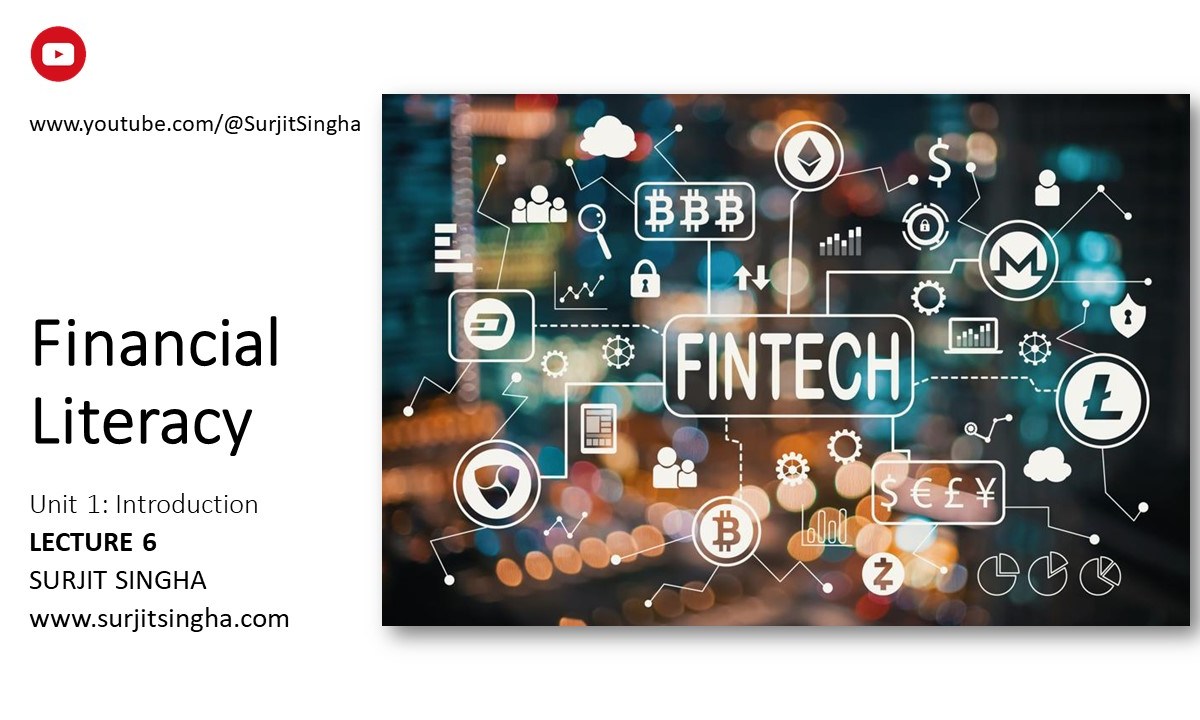
SCOPE OF FINTECH SERVICES.

Banks and businesses are currently applying for large sums of money to invest in technology-based solutions. The rise of mobile technology and the Internet has revolutionized the way the financial sector operates. Fintech, which continues to be on the horizon, is setting new trends in delivering innovative products and services in the financial sector. Fintech has created a big market by utilizing creative technology to improve traditional financial services such as capital markets, insurance, money transfer and payments, security, compliance, asset management, and data analytics, among others.

Mobile app-based services:

  • Digital lending and credit.
  • Mobile app banking.
  • Digital wallet.
  • Personal financial services.
  • Online trading.
  • Insurtech.

Tech infrastructure services:

  • Banking as a service.
  • Blockchain.
  • Robo advisors.
  • Payment gateways.
  • Regtech.

NEED OF AVAILING OF FINANCIAL SERVICES.

Financial services are a part of the financial system people and businesses can obtain financial services from the financial service sectors. This sector of the economy includes a wide range of financial institutions, such as banks, investment businesses, lenders, financial companies, real estate agents, and insurance companies. Financial services are necessary for a country’s economy to function. Individuals with money to save may have difficulty locating others who need to borrow without them, and vice versa. People would be so focused on saving to cover risk if financial services were unavailable that they might not buy as many products and services.

NEED FOR BANKING SERVICES.

The bank’s name is usually visible when you look at a cheque or debit card. Customers commonly use many financial services issued and regulated by individual banks. Banks can provide depositors access to their funds while simultaneously retaining many loans.

In the financial system and the economy, banks play a critical role. Banks, as a vital component of the financial system, efficiently allocate cash from savers to borrowers. Therefore, specialist financial services lowered the cost of acquiring information about saving and borrowing options. These financial services contribute to the overall efficiency of the economy.

  1. Encourage savings: banks encourage people’s habits of saving, which makes money available for productive uses.
  2. Connect savers and borrowers: banks act as a bridge between persons with excess funds and those who require funds for various commercial purposes.
  3. Facilitate business transactions: business transactions are facilitated by banks using checks instead of money for receipts and payments. Customers can move funds from one account to another via checks, drafts, and other methods provided by banks.
  4. Source to funds: banks provide short and long-term blondes in advances to business owners and individuals. Bank contributes to improving people’s living standards by offering loans to purchase consumer durable goods, residences, automobiles, and other items.
  5. Consultancy: modern banks fund their operations while providing consulting services to customers. They do this by hiring legal, financial, and market leaders and experts who can advise customers on the industry, income, trade, and investment issues.

 In today’s world, banks provide a wide range of services. This is done to attract a large number of customers. Banks, on the other hand, provide some essential services. As a result, all banks offer these vital services.

U1 L5 Financial Literacy

LECTURE 5

Functions of an Insurance Company[1].

1] Provides Reliability.

Insurance’s primary function is eliminating the uncertainty of an unexpected and sudden financial loss. This is one of the biggest worries of a business. Instead of this uncertainty, it provides the certainty of regular payment, i.e., the premium to be paid.

 2] Protection.

Insurance does not reduce the risk of loss or damage that a company may suffer. But it provides protection against such loss that a company may suffer. So at least the organization does not suffer financial losses that debilitate their daily functioning.

 3] Pooling of Risk.

In insurance, all the policyholders pool their risks together. They all pay their premiums, and if one suffers financial losses, the payout comes from this fund. So, the risk is shared between all of them.

 4] Legal Requirements.

In many cases, getting some form of insurance is required by the law of the land. For example, when goods are in freight or when you open a public space getting fire insurance may be a mandatory requirement. So, an insurance company will help us fulfil these requirements.

 5] Capital Formation.

The pooled premiums of the policyholders help create capital for the insurance company. This capital can then be invested in productive purposes that generate income for the company.

POST OFFICES[2].

A post office is a public facility and a retailer that provides mail services, such as accepting letters and parcels, providing post office boxes, and selling postage stamps, packaging, and stationery. Post offices may offer additional services, which vary by country. These include providing and accepting government forms (such as passport applications), and processing government services and fees (such as road tax, postal savings, or bank fees). The chief administrator of a post office is called a postmaster.

 Before the advent of postal codes and the post office, postal systems would route items to a specific post office for receipt or delivery. During the 19th century in the United States, this often led to smaller communities being renamed after their post offices, particularly after the Post Office Department began to require that post office names not be duplicated within a state.

India Post[3].

India Post is a government-operated postal system in India, part of the Department of Post under the Ministry of Communications. Generally known as the Post Office, it is the world’s most widely distributed postal system. Warren Hastings had taken the initiative under East India Company to start the Postal Service in the country in 1766. It was initially established under the name “Company Mail”. It was later modified into service under the Crown in 1854 by Lord Dalhousie. Dalhousie introduced uniform postage rates (universal service) and helped to pass the India Post Office Act 1854, which significantly improved upon the 1837 Post Office act which introduced regular post offices in India. It created the position of Director General of Post for the whole country.

 It is involved in delivering mail (post), remitting money by money orders, accepting deposits under Small Savings Schemes, providing life insurance coverage under Postal Life Insurance (PLI) and Rural Postal Life Insurance (RPLI) and providing retail services like bill collection, sale of forms, etc. The DoP also acts as an agent for the Indian government in discharging other services for citizens, such as old age pension payments and Mahatma Gandhi National Rural Employment Guarantee Scheme (MGNREGS) wage disbursement. With 154,965 post offices (as of March 2017), India Post is the widest postal network in the world.

 The country has been divided into 23 postal circles, each circle headed by a Chief Postmaster General. Each circle is divided into regions, headed by a Postmaster General and comprising field units known as Divisions. These divisions are further divided into subdivisions. In addition to the 23 circles, there is a base circle to provide postal services to the Armed Forces of India headed by a Director General. One of the highest post offices in the world is in Hikkim, Himachal Pradesh, operated by India Post at an altitude of 14,567 ft (4,440 m).


[1] https://www.toppr.com/guides/business-studies/business-services/insurance/

[2] https://en.wikipedia.org/wiki/Post_office

[3] https://en.wikipedia.org/wiki/India_Post

U1 L4 Financial Literacy

LECTURE 4

FINANCIAL INSTITUTIONS

Banks[1]

A bank is a financial institution licensed to receive deposits and make loans. Banks may also provide financial services such as wealth management, currency exchange, and safe deposit boxes. There are several different kinds of banks, including retail banks, commercial or corporate banks, and investment banks. In most countries, banks are regulated by the national government or central bank.

Banks are essential to the economy because they provide vital services for consumers and businesses. As financial services providers, they give you a safe place to store your cash. Through various account types, such as checking and savings accounts and certificates of deposit (CDs), you can conduct routine banking transactions like deposits, withdrawals, check writing, and bill payments. You can also save your money and earn interest on your investment.

Banks also provide credit opportunities for people and corporations. The bank lends the money you deposit at the bank—short-term cash—to others for long-term debt such as car loans, credit cards, mortgages, and other debt vehicles. This process helps create liquidity in the market—which makes money and keeps the supply going.

 Like any other business, the goal of a bank is to earn a profit for its owners. For most banks, the owners are their shareholders. Banks do this by charging more interest on the loans and other debt they issue to borrowers than what they pay to people who use their savings vehicles. For example, a bank that pays 1% interest on savings accounts and charges 6% interest for loans earns a gross profit of 5% for its owners.

Non-Banking Financial Institutions[2]

A non-banking financial institution (NBFI) is a financial institution that does not have a full banking license and cannot accept deposits from the public. However, NBFIs facilitate alternative financial services, such as investment (collective and individual), risk pooling, financial consulting, brokering, money transmission, and check cashing. NBFIs are a source of consumer credit (along with licensed banks). Examples of non-bank financial institutions include insurance firms, venture capitalists, currency exchanges, some microloan organizations, and pawn shops. These non-bank financial institutions provide services that are not necessarily suited to banks, serve as competition to banks, and specialize in sectors or groups.

INSURANCE COMPANIES[3]

The insurance sector is made up of companies that offer risk management in the form of insurance contracts. The basic concept of insurance is that one party, the insurer, will guarantee payment for an uncertain future event. Meanwhile, another party, the insured or the policyholder, pays a smaller premium to the insurer in exchange for that protection on that uncertain future occurrence.

Types of Insurance Companies

Not all insurance companies offer the same products or cater to the same customer base. Among the largest categories of insurance companies are accident and health insurers, property and casualty insurers, and financial guarantors. The most common personal insurance policies are auto, health, homeowners, and life.

Life insurance companies mainly issue policies that pay a death benefit as a lump sum upon the death of the insured to their beneficiaries. Life insurance policies may be sold as term life, which is less expensive and expires at the end of the term, or permanent (typically whole life or universal life), which is more expensive but lasts a lifetime and carries a cash accumulation component. Life insurers may also sell long-term disability policies that replace the insured’s income if they become sick or disabled.

Businesses require special insurance policies that insure against specific risks faced by a particular business. For example, a fast-food restaurant needs a policy that covers damage or injury resulting from cooking with a deep fryer. An auto dealer is not subject to this type of risk but does require coverage for damage or injury that could occur during test drives.

Some companies engage in reinsurance to reduce risk. Reinsurance is insurance that insurance companies buy to protect themselves from excessive losses due to high exposure. Reinsurance is an integral component of insurance companies’ efforts to keep themselves solvent and avoid default due to payouts, and regulators mandate it for companies of a specific size and type.

For example, an insurance company may write too much hurricane insurance based on models that show low chances of a hurricane inflicting a geographic area. If the inconceivable did happen with a hurricane hitting that region, considerable losses for the insurance company could ensue. Without reinsurance taking some of the risks off the table, insurance companies could go out of business whenever a natural disaster hit.

Types of Insurance Companies in India

  1. Life insurance companies: Life insurance is a contract between an insurer and a policy owner. A life insurance policy guarantees the insurer pays a sum of money to named beneficiaries when the insured dies in exchange for the premiums paid by the policyholder during their lifetime. To enforce the contract, the life insurance application must accurately disclose the insured’s past and current health conditions and high-risk activities.[4]
  2. General insurance companies:

Definition: Insurance contracts that do not come under life insurance are called general insurance. The different forms of general insurance are fire, marine, motor, accident and other miscellaneous non-life insurance.

 Description: The tangible assets are susceptible to damages, and a need to protect the economic value of the assets is needed. For this purpose, general insurance products are bought as they provide protection against unforeseeable contingencies like damage and loss of the asset. Like life insurance, general insurance products come at a price in the form of a premium.


[1] https://www.investopedia.com/terms/b/bank.asp

[2] https://www.worldbank.org/en/publication/gfdr/gfdr-2016/background/nonbank-financial-institution

[3] https://www.investopedia.com/ask/answers/051915/how-does-insurance-sector-work.asp

[4] https://www.investopedia.com/terms/l/lifeinsurance.asp

U1 L3 Financial Literacy

LECTURE 3

PREREQUISITES OF FINANCIAL LITERACY – LEVEL OF EDUCATION, NUMERICAL AND COMMUNICATION ABILITY.

Financial literacy will assist you in accumulating wealth, attaining goals, safeguarding oneself in the event of an emergency, securing the future of one’s family, and making retirement plans, allowing you to live a stress-free life. Financially educated is not just knowing the facts about money but also taking the appropriate procedures to achieve the desired financial goals. If you acquire the following essential knowledge and skills to make intelligent decisions with your money, you will improve your financial awareness over time.

  1. Financial Knowledge.

Compared to a generation before, today’s financial world is highly complex. The simple understanding of how to keep it current in the savings account metal local bank or savings institution may have been enough for financial activities 40 years ago. Consumers should now be able to distinguish between a wide range of financial products and services and the provider of those products and services. Previously, the less indebted generation may not have required a complete awareness of credit features such as compound interest, the consequences of mismanaging credit accounts, etc. There is a need to raise consumer knowledge about the necessity of financial knowledge and how to obtain it. Financial knowledge is essential for everyone, not just investors. It is equally crucial, if not more so, for the average family attempting to balance their budget and save for their children’s education and their parent’s retirement. Through problem-solving, critical thinking, and an awareness of essential financial facts and concepts, financial knowledge and decision-making skills assist people in making educated financial decisions. The following are the crucial components of financial expertise.

  1. Level of education: Although financial knowledge varies with education and income, highly educated individuals with high incomes can be just as ignorant about economic issues as less educated, lower-income consumers. Furthermore, individuals regard financial decision-making and education as complicated and anxious. Take the initiative to self-educate and grow with your financial knowledge by beginning with the basics of money management and maturing into a wise spender.
  2. Understanding financial markets: It’s a direct relationship between financial education and financial market participation. Financial significantly improves stock market participation and increases involvement in saving schemes. Economic market activities directly impact individual wealth, business actions, and the efficiency of our economy. The bond market, the stock market and the foreign exchange market knowledge are essential.
  3. Investment opportunities: Awareness of investment opportunities and financial instruments is integral to financial knowledge. Investing is essential for long-term financial security. Poor decisions can result in the loss of hard-earned funds. As a result, you will require financial expertise and a prudent plan. Working, either as an employee or as a business owner, is one way to make money. Investing in another option to make money. An investment is the purchase of an asset to produce wealth through regular income or profit from the sale of an item. Investment decisions are an essential part of financial planning.
  4. Economic environment: The word economic environment refers to all external economic factors that influence consumer behaviour and business performance and are often beyond an individual or company’s control. The knowledge of the economic environment has a direct impact on your life. Interest rates affect your savings and the payment of loans you might take out for a car or a house, and monetary policy may impact your career prospects and future commodities prices. Understanding the economic environment will expose you to many political disputes surrounding the conduct of economic policy. It will aid you in gaining a better understanding of the economic phenomena you read about in the news.
  5. Interest rates.
  6. Inflation.
  7. Tax rates.
  • Financial Skills.

Financial skills are abilities required to perform critical financial decisions. Financial skills are needed to promote financial self-sufficiency, stability and well-being. Acquiring these skills requires a basic understanding of financial concepts such as savings, investing, and debt, which leads to an overall sense of economic well-being and self-trust. Lacking the knowledge of these skills leads to financial illiteracy. These skills include:

  1. Budgeting: Making a budget is vital in developing financial literacy skills because it allows you to understand your income and expenses accurately. Once you’ve established the budget, you can keep track of your spending and evaluate your spending plan regularly. Thus, budgeting is an essential financial skill that aids in planning and managing money. Budgeting helps in the planning of short-term, medium-term, and long-term expenses. It enables people to save appropriately.
  2. Financial planning: Financial planning is the long-term process of properly managing your finances to assist you in achieving your goals and dreams while working through the financial obstacles that inevitably come at every stage of life. It is important to remember that financial planning is a process, not a product. Financial planning skills refer to the acquisition of competencies that serve as a guide as you journey through life. It essentially aids you in maintaining control over your income, expenses, and investment so that you may manage your partnership and reach your goals.
  3. Using financial tools: Financial tools are applications designed to calculate, estimate and interpret economic variables such as return and risk. Financial tools aid in evaluating investments, budgets, borrowing options and other potential related transactions to determine their performance and suitability; understanding your financial situation, whether personal or business-related, is critical to financial success. The proper financial analysis tool and techniques can assist you in understanding the risk and return of financial investment or selecting the best financial services.
  4. Numerical skills: You don’t need to be a mad genius. The confidence and ability to add, subtract, multiply, divide and use decimals, fractions, and end percentages are essential. As a result, basic numeracy skills have their multiplication and division, as well as decimals complexities, fractions, and negative numbers, which are critical for making basic financial judgments. To accomplish various numerical activities, a financial literate should be able to use both mental calculations and the calculator.
  5. Communication skills: Even though the financial healthcare series revolves around knowledge of managing money, using essential financial tools with the help of mathematics and financial variables. Nonetheless, so-called soft skills are required to be financially successful. Financial literate must be able to communicate and gain knowledge with strong speaking, writing and presentation skills.
  • Financial Etiquette:

Money and manners are a difficult combination to achieve. You don’t want to come out as cheap, ungrateful, or disrespectful, but you also don’t want to get angry or lose a relationship. Thus, financial etiquette is a set of behaviour expected or required to become financial literate.

  1. Sharing confidential financial data: advice such as it is nice to share and sharing is caring is frequently mentioned in conversations, especially when spending time with family and friends. While this may be true in some cases, it is not always the case regarding financial information. While sharing has its advantages, there are five things you should never share with anyone.
  2. Credit card details.
  3. CVV number: card verification value.
  4. Passwords.
  5. PIN: personal identification number.
  6. OTP: one-time password.
  7. Gifting: when we die, we leave behind everything we are on the planet. We do not take anything with us. Even wealthier people cannot take their money with them when they die. Individuals who have acquired considerable wealth will require throughout their lifetimes must leave some of their wealth to family, friends, and charitable causes.
  8. Spending: some people experience financial difficulties due to not earning enough money. On the other hand, many others have a problem because they do not spend their money sensibly or more than they earn. At the same time, many people dedicate most of their time and attention to making more money. They should be aware that without understanding the art of spending, there may not be able to build a prosperous future.
  9. Tax payment: many of us want to avoid circumstances where we have to pay taxes since it is a human tendency to avoid paying taxes. Even when tax rates are lower, our country, in contrast to other modern nations, lacks the desired tax culture. Income tax is one of the most important sources of revenue for the Indian government. If people begin to perceive Income Tax as a burden and avoid paying it, the growth of our nation will suffer, as would social breakdown. Filling your taxes demonstrates that you are a responsible citizen. Filing income tax forms on time allows you to be a good citizen, contribute to India’s prosperity, and provide Peace of Mind for you and your family.

U1 L2 Financial Literacy

LECTURE 2

IMPORTANCE OF FINANCIAL LITERACY[1]

Learning financial literacy has the following benefits:

1 – Personal Financial Planning and Management

Individuals who gain financial knowledge develop various sources of income. They prepare a monthly budget and borrow carefully. Financial knowledge ensures diligent financial management—enough savings for a rainy day.

2 – Identify Fake Schemes

Contemporarily, financial fraud is rising—chit funds, pyramid schemes, Ponzi schemes, carding, etc. A financially literate person will evade shady schemes. It is the perfect antidote to get-rich-quick schemes. 

3 – Spread Investment Awareness

Financial education does not occur in a vacuum. It is not an isolated incident. Educating one individual creates a chain reaction. Such an individual would make efforts to educate family, friends, students, colleagues, etc. A financially literate individual may conduct seminars, teach in colleges, write articles and books, mentor students, etc.

Everyone is interested in finance; everyone is a stakeholder. Therefore, financial literacy is a movement; “FIRE” is a good example.

4 – Succession Planning

It is often said that the poor plan for Saturday night whereas the rich plan for three generations. By being financially prudent, individuals impart valuable knowledge to their children. Moreover, they plan their succession and leave sufficient money for their successors.

5 – Refrains from Herd Mentality

The financially literate don’t follow random public opinion. They get to the bottom of every financial trend. They are more immune to incorrect market speculation. They make cautious investors, but in the long run, the profits add up.

6 – Financial Planning and Decision Making

Setting up an emergency fund and a retirement plan is very important—the earlier, the better.

Financial Literacy Example

Let us assume that both Jacob and Esau earn $6000 every month. Jacob is financially literate and, therefore, allocates his salary as follows:

Spending = $3700.

Investing in Mutual Funds = $1000.

Emergency Fund = $500.

Savings Account = $800.

At the end of the year, Jacob invests $12,000 in mutual funds and $9,600 into his savings account. On average, the total appreciation of the money in mutual funds was 13%, i.e., $1,560, and the savings account yielded an interest of $360.

On the other hand, Esau doesn’t have any financial knowledge and thus spends impulsively without any planning. He leaves the remainder in his salary account—it returns very low interest. Consequentially, Esau spent money on unnecessary items and ran out of cash.

SCOPE OF FINANCIAL LITERACY.

The intellectual understanding of financial concepts and skills such as budgeting, investing, borrowing, taxation, and personal financial planning is referred to as financial literacy. Lacking the knowledge of these skills leads to financial illiteracy. Financial illiteracy results in budget inaccuracy, higher expenses than income, debt accumulation, a poor credit score, financial fraud victim, and other undesirable repercussions. The purpose of financial literacy is to assist people in better understanding financial concepts so that they can better manage their money. It is a life skill that must be mastered in order to be financially successful.

Being financially literate provides a variety of benefits that can improve an individual’s standard of living by increasing financial security. It aids in the betterment of personal financial management. Personal finance is a process which involves the acquisition, practice, and application of a wide range of financial skills. The scope of financial literacy encompasses a wide range of skills.

Scope of Financial Literacy:[2]

Managing IncomeManaging ExpensesManaging DebtCreate SavingInvestingTax PlanningHealthy Credit Score
  1. Managing Income: A human being’s basic necessities are food, shelter, and clothes. How can we meet these essential requirements? We need to buy food, clothing, and a place to live (house). We need money to buy anything. From where are we going to acquire this money?

The term ‘income’ refers to the amount of money that comes into the household in the form of earnings. This money could come from a variety of sources. Salary from a job, part-time jobs, rent from a house or shop, bank interest, or the sale of shares and other investments are all examples of sources of income. It could also be a profit from your household produce or from the use of your abilities. To ensure some savings, the expenditure must be lower than the income. You must plan your spending in order to stay inside your budget. This is called as ‘managing income,’ and it means spending intelligently so that all of your demands are covered. You will need to create a ‘spending plan’ for this.

  • Managing Expenses: Expenditure refers to the money we spend from our earnings to acquire various items to meet our requirements. Income brings money into a household, whereas expenditure takes money away, making it unavailable for other users. Managing expenses is a disciplined approach to spending income. It is based on an individual’s or family’s overall income. It enables an individual or family to live within their income while simultaneously saving for future needs and emergencies. The general rule for managing income and expenses is that income must exceed expenses. We are more likely to spend more than we have if we do not develop a budget plan. As a result, if our expenditure exceeds our income, we may be forced to borrow money to meet our demands. As a result, distinguishing between necessary and unnecessary expenses will keep a person from drowning in debt.
  • Managing Debt: Debt is nothing but borrowed money. In other words, it is money that does not belong to you. For example, if a person borrows money from a bank, uses a credit card, or takes out a short-term loan. All of this is added to the debt. Debt is generally regarded as bad. As a result, knowing debt is critical. However, not everyone can afford to buy a house, a car, or pay a college fee in cash. Borrowing a loan is the only way out in such situations. The most crucial thing is to distinguish between good and bad debt. Furthermore, avoiding bad debt as much as feasible is always preferable. This covers the fundamentals of managing debt. Borrowing money for things essential for a living is considered good debt. For example, purchasing a home or paying for a college fee. On the other hand, bad debt is borrowing money for needless expenses. For example, using a credit card to purchase luxury clothing or electronic devices.
  • Creating Saving: a portion of an individual or a family’s income should also be set aside for future use. This money is set aside is regarded as savings, and it can be utilized for any purpose in the future. Savings and shorts financial security, a secure present and a bright future he stopped long term wealth can be built through prudent financial planning. It is possible to save money by keeping track of one spending patterns a result of Saving; one can easily accomplish the following:
  • Instil financial discipline: One can attain financial discipline in excel in life by saving money regularly.
  • Complete financial goals: Financial goals are targets you hope to achieve over a set period using your financial resources. For example, buying a house, a kid’s education, and retirement savings.
  • Create an emergency fund: An emergency fund serves as a safety net in the event of unforeseen circumstances. At least six months’ worth of income should be saved in the fund.
  • Investing: Rather than keeping money in a bank account, it can be diverted to investment avenues. Investing is about creating and growing wealth so you can live a secure and happy life. Saving money is not difficult if done systematically. After executing effective budgeting, any surplus should be channelized toward investing. Investing will help individuals achieve their financial goals like buying a house, child education, marriage, and planning. It’s all about investing in a strategy that will help you earn substantial profits over time. The investment will assist in the generation of additional monthly income as well as considerable benefits. It is also possible to attain financial goals while allocating funds to retirement savings. Equities, debt instruments, mutual funds, real estate, and gold or some of the most popular investment options.
  • Tax Planning: Taxes can significantly reduce your annual earnings. On the other hand, tax planning is a legitimate way of decreasing your tax payment in any particular financial year. It assists you in making the best use of the text as exemptions, deductions, and perks provided by the government to reduce your burden. Tax planning is the process of saving money by lowering your tax liability. The Income Tax Act of 1961 contains a number of provisions that allow you to claim deductions and save money on taxes. Aside from investing alternatives, there are several additional expenses for which you can claim a deduction. This includes tuition for up to two children, house loan repayment, health insurance premiums, medical payments for specified conditions, contributions, and so on. Tax planning is essential if you want to make the most of what the government has to offer. Tax planning aids in the smooth operation of the financial planning processes. Tax planning aids in the allocation of taxable income to various investment schemes. Tax saving is a long-term effort, and tax planning and investment are many closely linked.
  • Healthy Credit Score: A credit score measures a person’s ability to repay a debt. It’s a numerical representation of their creditworthiness. It is typically expressed as a number based on the individual’s payback history and credit files across various loan and credit agencies. The credit bureaus determine a credit score based on a proprietary formula. When generating a credit score, they analyze various characteristics such as credit history and payback behaviour, among others. A credit score ranges from 300 to 900 points; if your credit score is between 750 to 900, it is regarded as good for availing of credit services such as loans and credit cards.

[1] Vaidya, D. (n.d.). Wall Street Mojo. Financial Literacy. Retrieved July 23, 2022, from https://www.wallstreetmojo.com/financial-literacy/

[2] Umair, M., & V, B. (2021). Financial Literacy (pp. 7-10). Mumbai, India: Himalaya Publishing House.

U1 L1 Financial Literacy

Financial Literacy

Unit 1: Introduction (7 Hours)

Meaning, importance and scope of financial literacy; Prerequisites of Financial Literacy – level of education, numerical and communication ability; Financial Institutions – Banks, Insurance companies, Post Offices; Mobile App-based services. Need of availing of financial services from banks, insurance companies and postal services.

LECTURE 1

FINANCIAL LITERACY: Meaning[1]

Financial literacy is understanding and effectively using various financial skills, including personal financial management, budgeting, and investing. Financial literacy is the foundation of your relationship with money and is a lifelong learning journey. The earlier you start, the better off you will be because education is the key to success when it comes to money.

UNDERSTANDING FINANCIAL LITERACY

In recent decades financial products and services have become increasingly widespread throughout society. Whereas earlier generations of Americans may have purchased goods primarily in cash, various credit products, such as credit and debit cards and electronic transfers, are popular today.

Other products, such as mortgages, student loans, health insurance, and self-directed investment accounts, have also grown in importance. This has made it even more imperative for individuals to understand how to use them responsibly.

Although many skills might fall under financial literacy, famous examples include household budgeting, learning how to manage and pay off debts, and evaluating the tradeoffs between different credit and investment products. These skills often require at least a working knowledge of critical financial concepts, such as compound interest and the time value of money.

Given the importance of finance in modern society, lacking financial literacy can damage an individual’s long-term financial success.

Being financially illiterate can lead to several pitfalls, such as being more likely to accumulate unsustainable debt burdens, either through poor spending decisions or a lack of long-term preparation. This, in turn, can lead to poor credit, bankruptcy, housing foreclosure, and other negative consequences.

STRATEGIES TO IMPROVE YOUR FINANCIAL LITERACY SKILLS

Developing financial literacy to improve your personal finances involves learning and practising a variety of skills related to budgeting, managing and paying off debts, and understanding credit and investment products.

Here are several practical strategies to consider.

Create a Budget—Track how much money you receive each month against how much you spend in an Excel sheet, on paper, or with a budgeting app. Your budget should include income (paychecks, investments, etc.), fixed expenses (rent/mortgage payments, utilities, loan payments), discretionary spending (nonessentials such as eating out, shopping, and travel), and savings.

Pay Yourself First—To build savings, this reverse budgeting strategy involves choosing a savings goal (say, a down payment for a home), deciding how much you want to contribute toward it each month, and setting that amount aside before you distribute up the rest of your expenses.

Pay Bills Promptly—Stay on top of monthly bills, ensuring that payments arrive on time consistently. Consider taking advantage of automatic debits from a checking account or bill-pay apps and sign up for payment reminders (by email, phone, or text).

Get Your Credit Report—Consumers can request a free credit report from various credit bureaus once a year.

Check Your Credit Score—A good credit score helps you obtain the best interest rates on loans and credit cards, among other benefits. Monitor your score.

Manage Debt—Use your budget to stay on top of debt by reducing spending and increasing repayment. Develop a debt-reduction plan, such as first paying down the loan with the highest interest rate. Contact lenders to renegotiate repayment, consolidate loans, or find a debt-counselling program if your debt is excessive.

Invest in Your Future—If your employer offers a retirement savings account, sign up and contribute the maximum to receive the employer match. Consider opening an individual retirement account (IRA) and creating a diversified investment portfolio of stocks, fixed income, and commodities. If necessary, seek financial advice from professional advisors to help determine how much money you will need to retire comfortably and develop strategies to reach your goal.


[1] Fernando, J. (2021, October 29). Financial Literacy Definition. Investopedia; http://www.investopedia.com. https://www.investopedia.com/terms/f/financial-literacy.asp