L10-U1-BE

L10

Opportunity Cost:

When we decide to do one thing, we are deciding not to do something else. To ensure that we make the right decisions, it is important that we consider the alternatives, particularly the best alternative. Opportunity Cost is the cost of a decision in terms of the best alternative given up to achieve it.

Opportunity Cost and Consumers:

Consumers are buyers and users of goods and services. We all are consumers. The vast majority of us cannot buy everything we like. I may, for example, have to choose which economics dictionary to buy. I will probably consider a number of different ones, considering their prices.

The choice will then tend to settle on two of them. I will select the one with the widest and the most accurate informative coverage. The closer the two dictionaries are in quality and price, the harder the choice will be.

Opportunity Cost and Workers:

Undertaking one job involves an opportunity cost. People employed as teachers might also be able to work as civil servants. They need to carefully consider their preference for the jobs available. This would be influenced by a number of factors, including the remuneration offered, chances of promotion and the job satisfaction to be gained from each job. If the pay of civil servants or their working conditions improve, the opportunity cost of being a teacher will increase. It may even increase to the point where some teachers resign and become civil servants instead.

Opportunity Cost and Producers:

Producers have to decide what to make. If a farmer uses a field to grow sugar beet, he cannot keep cattle on that field. If a car producer uses some of his factory space and workers to produce one model of a car, he cannot use the same space and workers to make another model of the car at the same time.

In deciding what to produce, private sector firms will tend to choose the option which will give them the maximum profit. They will also consider, the demand for different products and the cost of producing those products.

Opportunity Cost and the Government:

Government has to carefully consider, its expenditure of tax revenue on various things. If it decides to spend more on education, the opportunity cost involved may be a reduced expenditure on health care. It could, of course, raise tax revenue in order to spend more on education. In this case, the opportunity cost would be put on the taxpayers. To pay higher taxes, people may have to give up the opportunity to buy certain products or to save.

L9-U1-BE

L9

The Production Possibilities Curve

Since human wants are unlimited and the means to satisfy them are limited, every society is faced with the fundamental problem of choosing and allocating its scarce resources to alternative uses. The production possibility curve or frontier is an analytical tool which is used to illustrate and explain this problem of choice.

Assumptions:

(1) Only two goods X (consumer goods) and Y (capital goods) are produced in different proportions in the economy.

(2) The same resources can be used to produce either or both of the two goods and can be shifted freely between them.

(3) The supplies of factors are fixed. But they can be reallocated for the production of the two goods within limits.

(4) The production techniques are given and constant.

(5) The economy’s resources are fully employed and technically efficient.

(6) The time period is short.

Explanation:

Given these assumptions, we construct a hypothetical production possibility schedule of such an economy in Table 5.1.

Table 5.1: Production Possibility Schedule:

PossibilitiesQuantity of XQuantity of Y
P0250
В100230
С150200
D200150
P12500

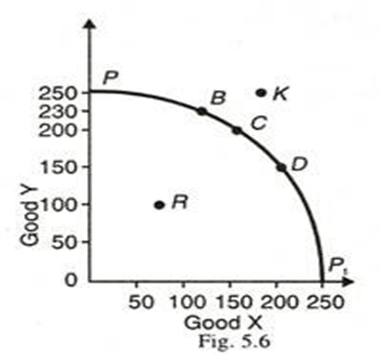
In this schedule, P and P1 are such possibilities in which the economy can produce either 250 units of Y or 250 units of X with given quantities of factors. But the assumption is that the economy should produce both the goods. There are many possibilities to produce the two goods. Such possibilities are В, С and D.

The economy can produce 100 units of X and 230 units of Y in possibility B; 150 units of X and 200 units of Y in possibility C; and 200 units of X and 150 units of Y in possibility D. The production possibility schedule shows that when the economy produces more units of X, it produces less units of Y successively.

In other words, the economy withdraws the given quantities of factors from the production of Y and uses them in producing more of X. For example, to reach the possibility С from B, the economy produces 50 units more of X and sacrifices 30 units of Y; whereas in possibility D for the same units of X, it sacrifices 50 units of Y.

Table 5.1 is represented diagrammatically in Figure 5.6. Units of good X are measured horizontally and that of Y on the vertical axis. The concave curve PP1 depicts the various possible combinations of the two goods, P, В, C, D and P1. This is the production possibility curve which is also known as the transformation curve or production possibility frontier. Each production possibility curve is the locus of output combinations which can be obtained from given quantities of factors or inputs.

This curve not only shows production possibilities but also the rate of transformation of one product into the other when the economy moves from one possibility point to the other. The rate of transformation on a production possibility curve increases as we move from point В to С and to D.

The production possibility curve further shows that when the society moves from the possibility point В to С or to D, it transfers resources from the production of good Y to the production of good X. As put by Samuelson: “A full-employment economy must always in producing one good be giving up something of another. Substitution is the Law of life in a full-employment economy. The production possibility frontier depicts society’s menu of choices.” This is what McConnel calls the ‘optimum product-mix’ of a society.

Again, all possibility combinations lying on the production possibility curve (such as В, С and D) show the combinations of the two goods that can be produced by the existing resources and technology of the society. Such combinations are said to be “technologically efficient”.

Any combination lying inside the production possibility curve, such as R in Figure 5.6, implies that the society is not using its existing resources fully. Such a combination is said to be “technologically inefficient”. Any combination lying outside the production-possibility frontier, such as K, implies that the economy does not possess sufficient resources to produce this combination. It is said to be “technologically infeasible or unobtainable”.

L8-U1-BE

L8

Central Problems of an Economy:

The primary economic activities of life are the production, distribution, and disposition of goods and services. A society will be facing a scarcity of resources during the time of fulfilment of these activities. Scarcity is evident due to the availability of limited resources and human needs having no limit. This variation between supply and demand leads to central problems in an economy.

The central problems of an economy revolve around the following factors:

  1. What to produce?
  2. How to produce?
  3. For whom to produce?

What to produce?

It is one of the central problems in an economy. It is related to the type and quantity of goods and services that need to be produced.

Since resources are in limited quantities, producing more of one good will result in less production of the other.

How to produce?

This aspect deals with the process or technique by which the goods and services can be produced. Generally, there are two techniques of production:

  1. Labour intensive techniques
  2. Capital intensive techniques

The choice of technique for production depends on the availability of the resource in that nation, hence resource allocation becomes a challenge.

For whom to produce?

This problem deals with determining the final consumers of the goods produced. As resources are scarce in an economy, it becomes difficult to cater to all sections of the society.

It leads to a problem of choice in an economy as a good that may be in demand among one section, may not be in demand for another section of the society.

Such a situation arises due to the difference in income distribution among the population, which causes a change in buying behaviour.

L7-U1-BE

L7

Micro and Macro Economics.

Micro Economics talks about the actions of an individual unit, i.e. an individual, firm, household, market, industry, etc. On the other hand, the Macro Economics studies the economy as a whole, i.e. it assesses not a single unit but the combination of all i.e. firms, households, nation, industries, market, etc.

BASIS FOR COMPARISONMICROECONOMICSMACROECONOMICS
MeaningThe branch of economics that studies the behavior of an individual consumer, firm, family is known as Microeconomics.The branch of economics that studies the behavior of the whole economy, (both national and international) is known as Macroeconomics.
Deals withIndividual economic variablesAggregate economic variables
Business ApplicationApplied to operational or internal issuesEnvironment and external issues
ToolsDemand and SupplyAggregate Demand and Aggregate Supply
AssumptionIt assumes that all macro-economic variables are constant.It assumes that all micro-economic variables are constant.
Concerned withTheory of Product Pricing, Theory of Factor Pricing, Theory of Economic Welfare.Theory of National Income, Aggregate Consumption, Theory of General Price Level, Economic Growth.
ScopeCovers various issues like demand, supply, product pricing, factor pricing, production, consumption, economic welfare, etc.Covers various issues like, national income, general price level, distribution, employment, money etc.
ImportanceHelpful in determining the prices of a product along with the prices of factors of production (land, labor, capital, entrepreneur etc.) within the economy.Maintains stability in the general price level and resolves the major problems of the economy like inflation, deflation, reflation, unemployment and poverty as a whole.
LimitationsIt is based on unrealistic assumptions, i.e. In microeconomics it is assumed that there is a full employment in the society which is not at all possible.It has been analyzed that ‘Fallacy of Composition’ involves, which sometimes doesn’t proves true because it is possible that what is true for aggregate may not be true for individuals too.


L6-U1-BE

L6

Positive Economics & Normative Economics.

Definition of Positive Economics.

Positive Economics is a branch of economics that has an objective approach, based on facts. It analyses and explains the casual relationship between variables. It explains people about how the economy of the country operates. Positive economics is alternatively known as pure economics or descriptive economics.

When the scientific methods are applied to economic phenomena and scarcity related issues, it is positive economics. Statements based on positive economics considers what’s actually occurring in the economy. It helps the policy makers to decide whether the proposed action, will be able to fulfil our objectives or not. In this way, they accept or reject the statements.

Definition of Normative Economics.

The economics that uses value judgments, opinions, beliefs is called normative economics. This branch of economics considers values and results in statements that state, ‘what should be the things’. It incorporates subjective analyses and focuses on theoretical situations.

Normative Economics suggests how the economy ought to operate. It is also known as policy economics, as it considers individual opinions and preferences. Hence, the statements can neither be proven right nor wrong.

Example.[1]

Country A is experiencing labor unrest over the minimum wage. In this situation, Normative economics will give a value judgment on why the proposed minimum wage should be approved or otherwise, using the “what should have been” or “what ought to be” approach.

Positive economics, on the other hand, would describe the economic situation and explain the proposed increment in minimum wage backing it up with facts, verifiable data, actual numbers, and empirical research.


[1] https://thebusinessprofessor.com/en_US/economic-analysis-monetary-policy/positive-economics-definition

L5-U1-BE

L5

Scarcity.

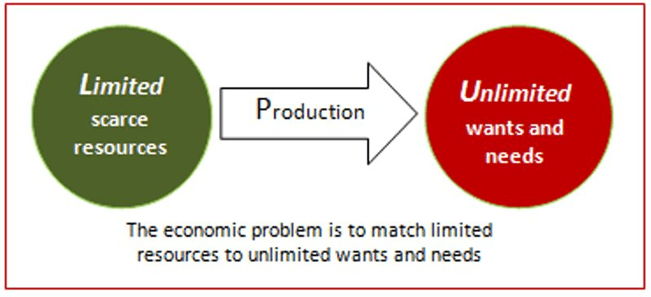
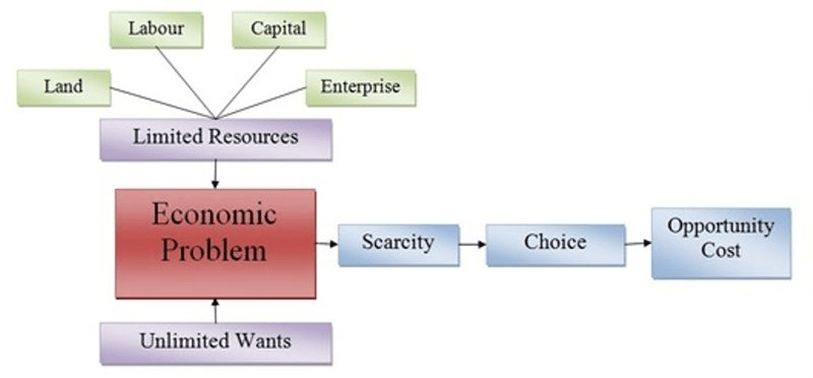
The purpose of production is to satisfy one’s ‘want’, but as the resources are limited, not enough output is available to fulfil every man’s wants. This explains that human wants are unlimited and are not fulfilled by limited resources, as stated by the Law of scarcity.

This chart shows how the Law of scarcity arises.

The demand is high compared to the supply, and satisfaction is not achieved due to insufficient resources. To overcome this, the choice is made available to man to allocate their resources to achieve maximum satisfaction.

For instance, if a man walks into a grocery store with ₹500, he would buy products in a way that when he walks out, the products with him would equal the value of ₹500. He might want food grains, toiletries, milk, cooking essentials, etc. but would allocate the money available to him so that he attains maximum satisfaction from his purchase.

Choices.

Scarcity gives rise to the economic problem of choice. With limited resources, the choice is given to decide what one wishes to get by sacrificing one of its demands. When the choice is made, there is sacrifice involved in it. The decision to consume a product also means not consuming another. One product can only be consumed by giving up something in exchange. Opportunity Cost refers to the cost of sacrifice that is done to choose the next best alternative.

To Exemplify, a farmer has 10 acres of land; he has a choice to either grow wheat or cotton on it. The limited land is a scarcity of the resource. The alternative crops, wheat and cotton, show how we have choices. To grow one of the two crops, the other crop’s production has to be sacrificed; this is the opportunity cost involved.

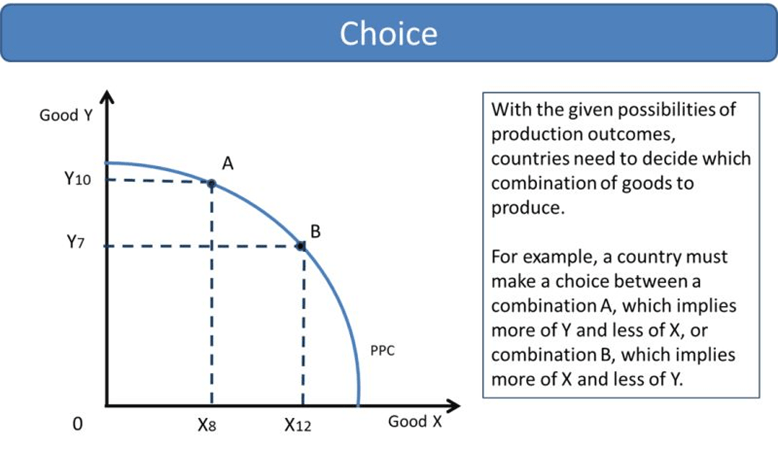
The production Possibility Curve (PPC) gives a graphical representation of how two alternatives can be combined to achieve maximum satisfaction.

The PPC curve shows how more product X means less product Y.

The PPC curve shows different possible points for attaining satisfaction. Points A and B give two different combinations. At point A, X8 and Y10 goods are produced, and at point B X12 and Y7 goods are produced. To produce more of product X, Product Y is to be produced less; this is seen at point B, X12 goods are produced only when good Y is decreased to Y7. This shows that more and more of good X is to be produced only when good Y is sacrificed at its place. A choice needs to be made as to what amount of a particular good can be produced to get the maximum satisfaction from the available resources.

L4-U1-BE

L4

The Economic Problem-Scarcity and Choice.[1]

Economy is derived from two Greek words which mean house and distribute. Economy was studied to understand the management of a household that later started being used to manage resources.

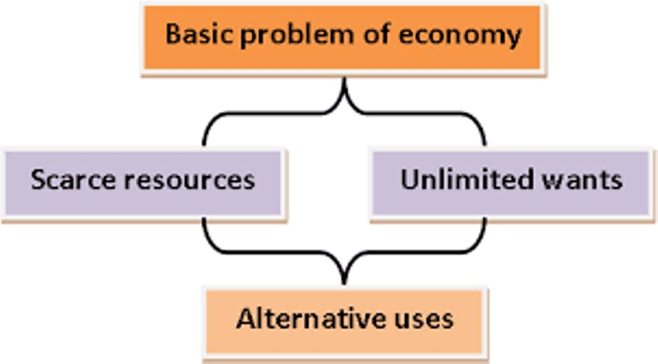
The chart shows the basic problem of the economy.

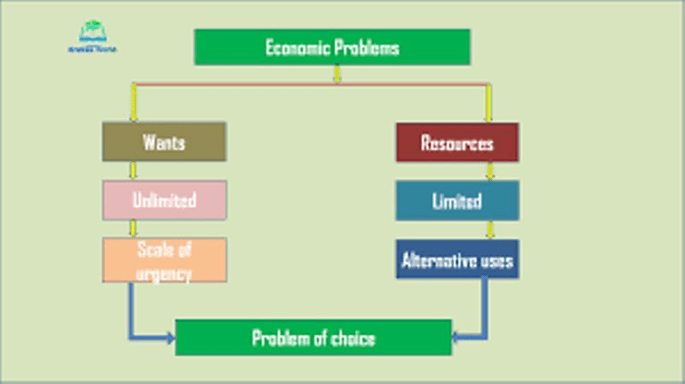
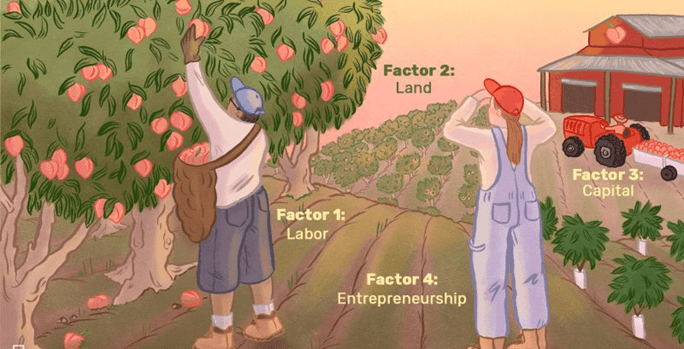
The basic problem of an economy deals with a man’s unlimited needs and wants and scarce resources. The resources include the production factors: land, labour, capital and entrepreneurship.

The factors of production.

Economics is the social science that studies how people use their scarce resources to satisfy unlimited needs and wants. From a teenager to a homemaker and then to a businessman, all face the same issue of how to spend their income to attain maximum satisfaction.


[1] https://studiousguy.com/the-economic-problem-scarcity-and-choice/

L3-U1-BE

L3

Importance of Business Economics.[1]

Business economics plays an important role in decision making in an organization. Decision making is a process of selecting the best course of action from the available alternatives.

The following points explain the importance of business economics:

Business economics covers various important concepts, such as Demand and Supply analysis; Short run cost and Long run costs; and Law of Diminishing Marginal Utility. These concepts support managers in identifying and analyzing problems and finding solutions.

Business economics helps in establishing relationships between different economic factors, such as income, profits, losses, and market structure. This helps in guiding managers in effective decision making and running the organization.

Difference Between Economics and Business Economics.

  • Economics is a traditional subject that has prevailed from a long time.
  • Business economics is a modern concept and is still developing.
  • Economics mainly covers theoretical aspects.
  • Business economics covers practical aspects.
  • In economics, the problems of individuals and societies are studied.
  • In Business economics, the main area of study is the problems of organizations.
  • In economics, only economic factors are considered.
  • In business economic, both economic and no-economic factors are considered.
  • Both microeconomics and macroeconomics fall under the scope of economics.
  • Only microeconomics falls under the scope of business economics.
  • Economics has a wider scope and covers the economic issues of nations.
  • Business economics is a part of economics and is limited to the economic problems of organizations.

Limitations of Business Economics/Managerial Economics.[2]

The limitations of managerial economics are listed below:

  • Business economics focuses on business analysis based on financial and costing data. The reliability of this data, therefore, depends on the accuracy of the financial accounting information.
  • This analysis is based on historical information. But things change when new systems are introduced, and conclusions cannot be predicted from this previous information. Management controls are subject to the personal preferences of individual managers, which may influence to some extent.
  • It is a costly process as the company usually needs a certain number of managers to keep it functioning properly.
  • The science of business management is relatively new and not fully developed. So, it can be ambiguous in certain scenarios.

[1] https://geektonight.medium.com/what-is-business-economics-definition-scope-importance-geektonight-5b602377ab0e

[2] https://www.vedantu.com/commerce/limitations-of-economics

L2-U1-BE

L2

5. Resource Allocation.

Business Economics uses advanced tools like linear programming to create the best course of action for an optimal utilization of available resources.

6. Theory of Capital and Investment Decisions.

Among other decisions, a firm must carefully evaluate its investment decisions an allocate its capital sensibly. Various theories pertaining to capital and investments offer scientific criteria for choosing investment projects. Further, these theories also help the firm in assessing the efficiency of capital. Business Economics assists the decision-making process when the firm needs to decide between competing uses of funds.

7. Profit Analysis.

Profits depend on many factors like changing prices, market conditions, etc. The profit theories help firms in measuring and managing profits under such uncertain conditions. Further, they also help in planning future profits.

8. Risk and Uncertainty Analysis.

Most businesses operate under a certain amount of risk and uncertainty. Also, analyzing these risks and uncertainties can help firms in making efficient decisions and formulating plans.

What is analyzing demand in Business Economics?

Options are:

A. Understanding buyer behavior

B. Deciding on the optimum size of output

C. Evaluating investment decisions

D. Measuring and managing profits

The correct answer is answer is: A. Understanding buyer behavior

What is the purpose of profit analysis in Business Economics?

Options are:

A. To determine the behavior of costs

B. To understand buyer behavior

C. To evaluate investment decisions

D. To measure and manage profits

The correct answer is answer is: D. To measure and manage profits

How does risk and uncertainty analysis help in Business Economics?

Options are:

A. By providing scientific criteria for choosing investment projects

B. By using linear programming to create the best course of action for optimal utilization of available resources

C. By analyzing risks and uncertainties to make efficient decisions and formulate plans

D. By measuring and managing profits under uncertain conditions

The correct answer is answer is: C. By analyzing risks and uncertainties to make efficient decisions and formulate plans

Demand Analysis is about understanding:

Options are:

  1. buyer income.
  2. buyer behaviour.
  3. the relationship between a buyer and seller.
  4. number of buyers certainly buying from the competitors.

The correct answer is answer is: Demand analysis is all about understanding the nature of the consumer’s preferences and the effects of the changes in the determinants of demand on them. These determinants include the price of the commodity, tastes, and preferences of consumers, consumer’s income, the price of related commodities, etc. In other words, demand analysis is about understanding buyer behavior. Therefore, the correct answer is option b.

L1-U1-BE

Business Economics

Unit 1: Fundamentals of Economics

Principles of Economics: Meaning, scope, importance & limitations-The Economic Problem-Scarcity and Choice; Nature and Scope- Positive and Normative Economics, Micro and Macro Economics; Central Problems of an Economy; Production Possibility Curve; Opportunity Cost.

L1

Introduction to Business Economics.

Business economics, also known as managerial economics, is a branch of economics that focuses on applying economic theory and analysis to solve business problems and make informed decisions. It explores the relationship between business and the economy, examining how businesses operate, compete, and thrive in the marketplace.

Business economics primarily aims to utilize economic principles to understand and predict the behaviour of businesses, markets, and consumers. It provides valuable insights and tools that help organizations effectively allocate resources, maximize profits, and optimize decision-making processes.

Business economics encompasses various topics, including demand and supply analysis, cost and production analysis, market structures, pricing strategies, risk analysis, forecasting, and business strategy formulation. It blends economic theory with practical applications, enabling managers and decision-makers to evaluate different alternatives and make rational choices in the face of uncertainty.

One of the key aspects of business economics is the concept of optimization. Businesses aim to maximize their outcomes, whether profit, market share, or customer satisfaction, by optimizing their use of resources. This involves analyzing various trade-offs and making decisions that yield the best possible results given the constraints faced by the organization.

Furthermore, business economics considers both microeconomic and macroeconomic factors. Microeconomics examines the behaviour of individual firms, consumers, and markets, while macroeconomics considers broader economic factors such as inflation, unemployment, interest rates, and government policies. Understanding the interplay between micro and macro forces is crucial for businesses to navigate the complex and dynamic economic environment.

Business economics provides a framework for understanding the economic forces that shape business decisions and outcomes. It equips managers with analytical tools and insights to make informed choices, optimize resource allocation, and enhance overall business performance. By incorporating economic principles into their decision-making processes, businesses can gain a competitive edge and adapt to the ever-changing business landscape.

Business Economics.[1]

Business economics is a field of applied economics that studies the financial, organizational, market-related, and environmental issues faced by corporations.

Business economics assesses certain factors impacting corporations—business organization, management, expansion, and strategy—using economic theory and quantitative methods. Research topics in the field of business economics might include how and why corporations expand, the impact of entrepreneurs, interactions among corporations, and the role of governments in regulation.

Understanding Business Economics.

In the broadest sense, economics refers to the study of the components and functions of a particular marketplace or economy—such as supply and demand—and the impact of the concept of scarcity. Within economics, production factors, distribution methods, and consumption are important subjects of study. Business economics focuses on the elements and factors within business operations and how they relate to the economy as a whole.

The field of business economics addresses economic principles, strategies, standard business practices, the acquisition of necessary capital, profit generation, the efficiency of production, and overall management strategy. Business economics also includes the study of external economic factors and their influence on business decisions such as a change in industry regulation or a sudden price shift in raw materials.

The Scope of Business Economics.[2]

1. Analyzing Demand and Forecasting.

Analyzing demand is all about understanding buyer behavior. It studies the preferences of consumers along with the effects of changes in the determinants of demand. Also, these determinants include the price of the good, consumer’s income, tastes/ preferences, etc.

Forecasting demand is a technique used to predict the future demand for a good and service. Further, this prediction is based on the past behavior of factors which affect the demand. This is important for firms as accurate predictions help them produce the required quantities of goods at the right time.

Further, it gives them enough time to arrange various factors of production in advance like raw materials, labor, equipment, etc. Business Economics offers scientific tools which assist in forecasting demand.

2. Production and Cost Analysis.

A business economist has the following responsibilities with regards to the production:

  • Decide on the optimum size of output based on the objectives of the firm.
  • Also, ensure that the firm does not incur any undue costs.

By production analysis, the firm can choose the appropriate technology offering a technically efficient way of producing the output. Cost analysis, on the other hand, enables the firm to identify the behavior of costs when factors like output, time period, and the size of plant change. Further, by using both these analyses, a firm can maximize profits by producing optimum output at the least possible cost.

3. Inventory Management.

Firms can use certain rules to reduce costs associated with maintaining inventory in the form of raw materials, work in progress, and finished goods. Further, it is important to understand that the inventory policies affect the profitability of a firm. Hence, economists use methods like the ABC analysis and mathematical models to help the firm in maintaining an optimum stock of inventories.

4. Market Structure and Pricing Policies.

Any firm needs to know about the nature and extent of competition in the market. A thorough analysis of the market structure provides this information. Further, with the help of this, firms command a certain ability to determine prices in the market. Also, this information helps firms create strategies for market management under the given competitive conditions.

Price theory, on the other hand, helps the firm in understanding how prices are determined under different kinds of market conditions. Also, it assists the firm in creating pricing policies.


[1] https://www.investopedia.com/terms/b/business-economics.asp

[2] https://www.toppr.com/guides/business-economics/introduction-to-business-economics/scope-of-business-economics/