L5
Scarcity.
The purpose of production is to satisfy one’s ‘want’, but as the resources are limited, not enough output is available to fulfil every man’s wants. This explains that human wants are unlimited and are not fulfilled by limited resources, as stated by the Law of scarcity.
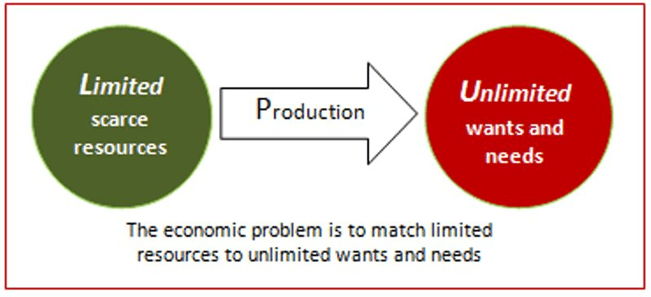
This chart shows how the Law of scarcity arises.
The demand is high compared to the supply, and satisfaction is not achieved due to insufficient resources. To overcome this, the choice is made available to man to allocate their resources to achieve maximum satisfaction.
For instance, if a man walks into a grocery store with ₹500, he would buy products in a way that when he walks out, the products with him would equal the value of ₹500. He might want food grains, toiletries, milk, cooking essentials, etc. but would allocate the money available to him so that he attains maximum satisfaction from his purchase.
Choices.
Scarcity gives rise to the economic problem of choice. With limited resources, the choice is given to decide what one wishes to get by sacrificing one of its demands. When the choice is made, there is sacrifice involved in it. The decision to consume a product also means not consuming another. One product can only be consumed by giving up something in exchange. Opportunity Cost refers to the cost of sacrifice that is done to choose the next best alternative.
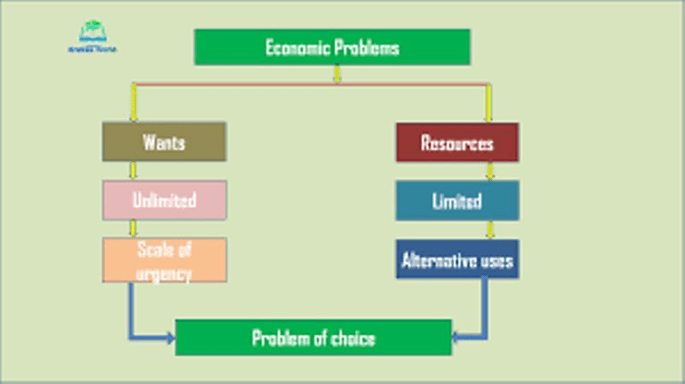
To Exemplify, a farmer has 10 acres of land; he has a choice to either grow wheat or cotton on it. The limited land is a scarcity of the resource. The alternative crops, wheat and cotton, show how we have choices. To grow one of the two crops, the other crop’s production has to be sacrificed; this is the opportunity cost involved.
The production Possibility Curve (PPC) gives a graphical representation of how two alternatives can be combined to achieve maximum satisfaction.
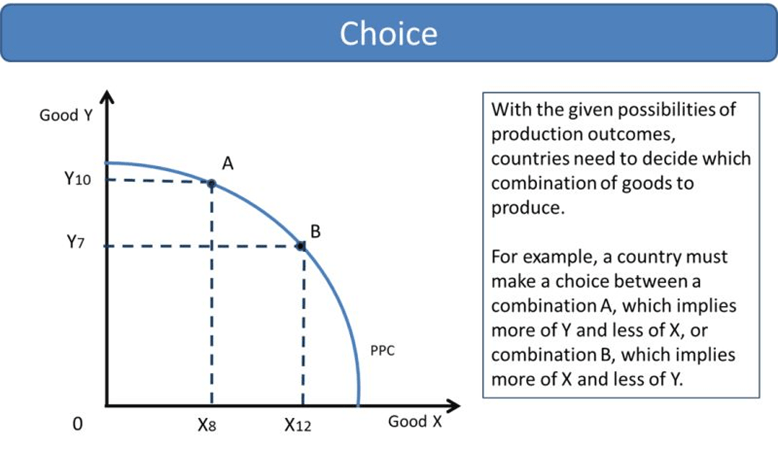
The PPC curve shows how more product X means less product Y.
The PPC curve shows different possible points for attaining satisfaction. Points A and B give two different combinations. At point A, X8 and Y10 goods are produced, and at point B X12 and Y7 goods are produced. To produce more of product X, Product Y is to be produced less; this is seen at point B, X12 goods are produced only when good Y is decreased to Y7. This shows that more and more of good X is to be produced only when good Y is sacrificed at its place. A choice needs to be made as to what amount of a particular good can be produced to get the maximum satisfaction from the available resources.
 Academician