L10
Opportunity Cost:
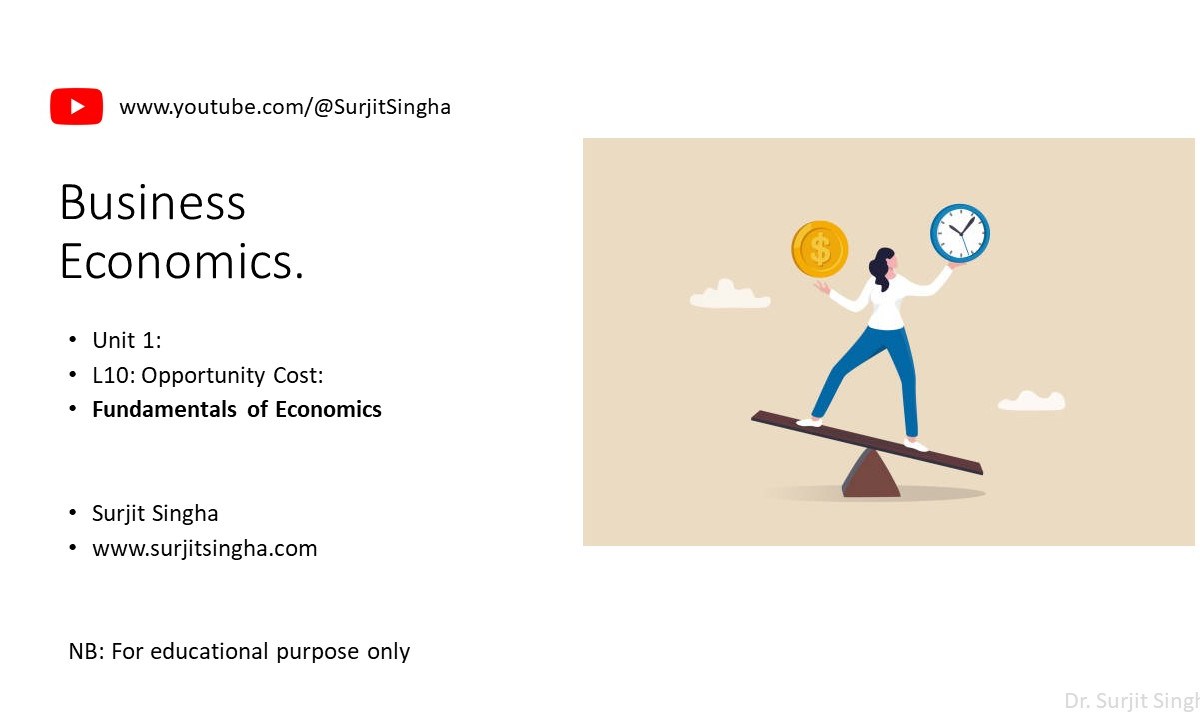
When we decide to do one thing, we are deciding not to do something else. To ensure that we make the right decisions, it is important that we consider the alternatives, particularly the best alternative. Opportunity Cost is the cost of a decision in terms of the best alternative given up to achieve it.
Opportunity Cost and Consumers:
Consumers are buyers and users of goods and services. We all are consumers. The vast majority of us cannot buy everything we like. I may, for example, have to choose which economics dictionary to buy. I will probably consider a number of different ones, considering their prices.
The choice will then tend to settle on two of them. I will select the one with the widest and the most accurate informative coverage. The closer the two dictionaries are in quality and price, the harder the choice will be.
Opportunity Cost and Workers:
Undertaking one job involves an opportunity cost. People employed as teachers might also be able to work as civil servants. They need to carefully consider their preference for the jobs available. This would be influenced by a number of factors, including the remuneration offered, chances of promotion and the job satisfaction to be gained from each job. If the pay of civil servants or their working conditions improve, the opportunity cost of being a teacher will increase. It may even increase to the point where some teachers resign and become civil servants instead.
Opportunity Cost and Producers:
Producers have to decide what to make. If a farmer uses a field to grow sugar beet, he cannot keep cattle on that field. If a car producer uses some of his factory space and workers to produce one model of a car, he cannot use the same space and workers to make another model of the car at the same time.
In deciding what to produce, private sector firms will tend to choose the option which will give them the maximum profit. They will also consider, the demand for different products and the cost of producing those products.
Opportunity Cost and the Government:
Government has to carefully consider, its expenditure of tax revenue on various things. If it decides to spend more on education, the opportunity cost involved may be a reduced expenditure on health care. It could, of course, raise tax revenue in order to spend more on education. In this case, the opportunity cost would be put on the taxpayers. To pay higher taxes, people may have to give up the opportunity to buy certain products or to save.
 Academician